

By Barbara R. Blackburn
Understanding is similar to climbing a mountain. You may have to start at the bottom, but to get the full view (the rigorous view), you have to make it to the top.
You climb to the top one step at a time; the steps become increasingly more difficult as you go, but the view is worth it.
There are many models for organizing higher levels of questions, but we will look at five. Each takes a slightly different approach and can be adapted for your precise purposes.
Question Shells
Dylan Wiliam in Embedded Formative Assessment points out that there are only two good reasons to ask questions: to cause students to think and to provide information so you know what to do next. I particularly like his notion of Question Shells to both prompt thinking and to garner information.
Rather than asking students basic questions such as “What is the main character doing in the climax?”, change the “what” to a “why.” “Why is the main character acting that way in the climax?” Notice how it changes the tenor of the question, pushing for a deeper understanding of the situation.
Four Types of Student Inquiry
Another helpful framework when planning comes from Inquiry Mindset: Elementary Edition by Trevor Mackenzie and Rebecca Bathurst-Hunt. Directly related to questioning, inquiry is a critical part of our classrooms, especially when we want students to learn to inquire and question on their own.
In their discussion of student inquiry, they point out that when we inquire of students, we do so in one of four ways.
- We use a structured approach, in which the teacher is in total control.
- We use a controlled approach, where the teacher chooses topics and resources, while also providing several essential questions. Students have a bit more freedom, but the major aspects of the inquiry are determined by the teacher.
- Then there is guided inquiry, in which the teacher chooses the topic and questions, but students are given significantly more agency during the process.
- Finally, in free inquiry, students choose their topics without any prescribed outcome.
Essential Questions
Todd Stanley in Promoting Rigor Through Higher Level Questioning suggests that teachers use five guidelines when formulating questions. I’ve found these to be quite useful when considering rigorous questions.

Ten Hacks
Next, in a somewhat different direction, Connie Hamilton in Hacking Questions provides ten “hacks” that she explains in her book (see the study guide here). These are suggestions to encourage engaging high-level questioning for your students. I highly recommend Connie’s book; I found it to be filled with practical suggestions. For example, when students say “I don’t know,” she points out we need to determine what they mean. Perhaps they didn’t hear the question; they may be uncertain, shy, or not confident; they may be thinking; or they may not know how to respond. Our next step, which Connie provides in a great table, is determined by the reason. (See her free resources).
Student Questions
Now, I’d like to turn our attention to questions students ask. In Building Thinking Classrooms in Mathematics, Grades K-12, Peter Liljedahl notes that students ask specific types of questions. I think this is helpful as we consider how we respond to the questions, and how we follow-up with additional questions.
When students ask you a proximity question, it’s pretty basic. You are nearby, and they ask you a question. The likelihood is that the students never use the information they gain. Stop-thinking questions are ones they use to end their thinking. They might ask “Do we have to learn this?” “Will this be on the test?” or “Am I right?”.
Both of these types of questions undermine learning, so your goal is to help students shift to the third type of question: keep-thinking questions. When students ask keep-thinking questions, they are clarifying information or extending the question. In other words, students continue to engage with the task.

Peter points out that students will eventually stop asking proximity and stop-thinking questions and they gain confidence in their thinking. Student agency also increases.
A Final Note
Increasing questioning allows students to work at higher levels of rigor. Explore these five models and you’ll develop options you can use to move to higher level questioning.
 Dr. Barbara R. Blackburn, a “Top 10 Global Guru in Education,” is a bestselling author of over 30 books and a sought-after consultant. She was an award-winning professor at Winthrop University and has taught students of all ages. In addition to speaking at conferences worldwide, she regularly presents virtual and on-site workshops for teachers and administrators.
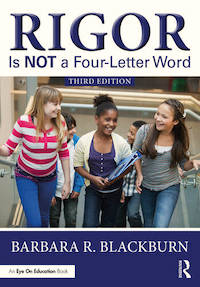
Barbara is the author of Rigor is NOT a Four Letter Word, 3rd Edition (Routledge/Eye On Education, 2025) and many other books and articles about teaching and leadership. Visit her website and see some of her most popular MiddleWeb articles about effective teaching and support for new teachers here.

