

Listen to the interview with Melanie Meehan and Maggie Roberts (transcript):
Sponsored by Renaissance and Erikson Institute
This page contains Bookshop.org links. When you make a purchase through these links, Cult of Pedagogy gets a small percentage of the sale at no extra cost to you. What’s the difference between Amazon and Bookshop.org?
Literacy has always been a hot topic in education, and the intensity surrounding it has really ramped up in the last few years. But in most of those conversations, we rarely bring up writing. There’s no shortage of debate about phonics, fluency, and reading comprehension, but writing instruction is almost never mentioned, even though reading and writing are so deeply intertwined.
This glaring omission was something Melanie Meehan and Maggie Roberts wanted to address. Meehan is a former curriculum coordinator who recently opened her own in-person writing center. Roberts is a literacy consultant and former middle school teacher who spent nearly two decades supporting teachers in classrooms. Earlier this month, they published a new book together called Foundational Skills for Writing: A Brain-Based Guide to Strengthen Executive Functions, Language, and Other Cornerstones for Writers. In the book, they explore what the brain actually has to do when we ask kids to write, and what gets in the way.


The book breaks the larger task of writing into smaller skill categories, including transcription skills like handwriting, keyboarding, spelling, and large and small motor development, oral language — the speaking and listening skills that are a precursor to writing and include sentence construction, and executive functioning, which includes working memory, cognitive flexibility, and inhibitory control. To be a proficient writer, a person needs to develop and practice all of these skills, and in the book, Meehan and Roberts show teachers how to develop them in students.

On the podcast, they shared eight of the strategies from the book. Each strategy is from a collection they call “Minute Moves,” short, flexible activities that take just a couple of minutes and can be dropped into transitions, used as warm-ups, or slipped in on the walk to lunch. They’re designed to help students automatize the foundational skills that, when underdeveloped, eat up the cognitive energy they need for the real work of writing. You can listen to the interview in the player above, read the transcript, or browse the summary below.
Spelling Minute Moves
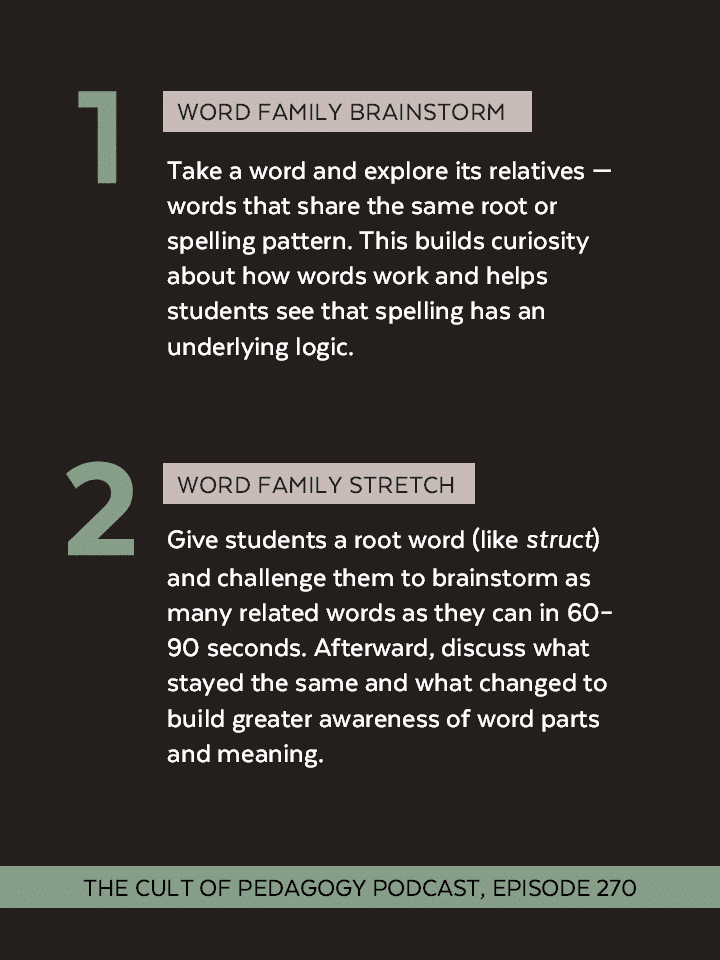
1. Word Family Brainstorm
This one comes from spelling researcher Rebecca Treiman, whom Meehan describes as someone who genuinely believes that words are cool. The idea is simple: take a word and start uncovering its relatives.
Take the often confused homophones two, to, and too. Instead of teaching all three together as a cluster, have students consider the connection between two (the number) and words like twin, twine, and twenty. Suddenly there’s a pattern: the TW combination has a relationship with the concept of twoness.
Meehan gave another example from her own tutoring work. A student was struggling with the word decision, and she pointed out its connection to decide. That led to incision, concise, and a surprising one: scissors. All of them trace back to a Latin root meaning “to cut.” Once you see that all those words belong to the same family, the spelling for decision makes more sense.
“The more that you can get kids curious and thinking words are cool,” Meehan says, “the better.”
2. Word Family Stretch
This one is closely related but has its own distinctive shape. Give students a root like struct, meaning “to build.” Set a timer for 60 to 90 seconds, and challenge them to brainstorm as many related words as they can: structure, destruction, construct, structural, instruct, instruction…
The key move that comes after the brainstorm is the debrief: What stayed the same? What changed? How did the meaning shift when you added a prefix or suffix? Through these discussions, students start to internalize that word parts carry meaning, and that patterns show up across academic vocabulary.
Roberts noted that some roots are “bound” (like struct, which can’t stand alone) while others are “free” (like form, which works on its own and also becomes reform, transform, inform, deform). Helping students understand that distinction deepens their feel for how words work.
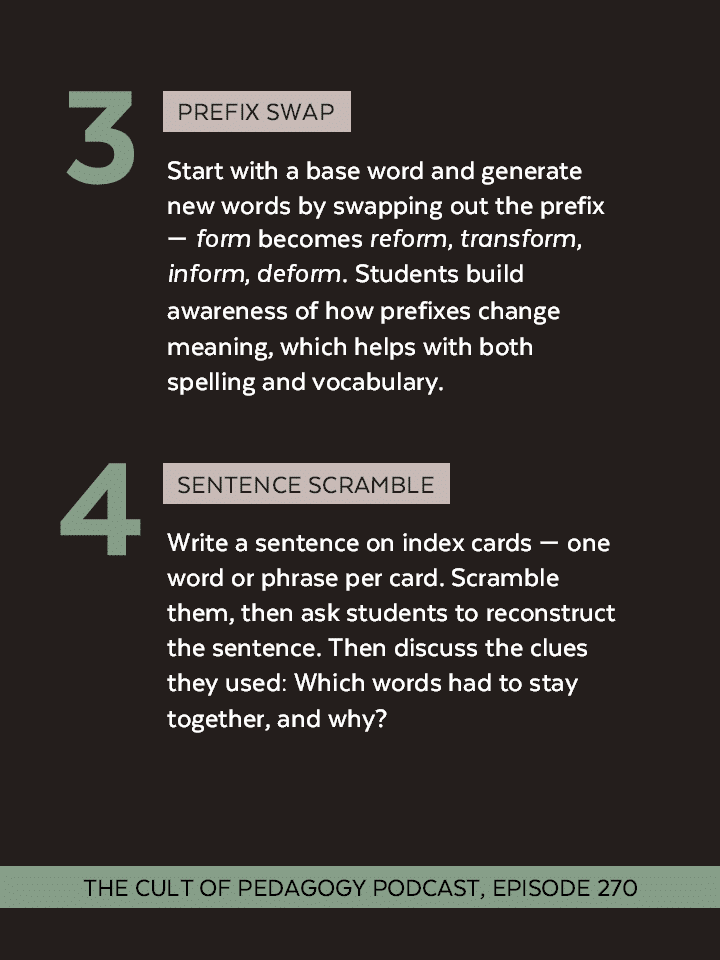
3. Prefix Swap
This one builds directly on the previous two, and Meehan is quick to point out that all three spelling minute moves are essentially doing the same underlying work: building neurological pathways, one quick activity at a time.
The focus here is specifically on prefixes and what happens when you swap them out. Give students a base word and have them generate as many variations as they can by changing the prefix: form becomes reform, transform, inform, deform. The meaning shifts each time, and that’s the discovery students are after.
This turns out to be especially powerful for multilingual learners. Meehan mentioned working with students who immediately understood benevolent and malevolent because they recognized bene and mal from their other languages.
Taken together, Meehan observes, these three activities “are really building the neurological pathways” that helps students lock words in rather than constantly struggling to retrieve them.
Sentence Construction Minute Moves
4. Sentence Scramble
Take a sentence and break it into its component words or phrases, written on index cards (one word per card). Scramble them, then ask students to put the sentence back together.
Using physical cards allows students to move them around and experiment. Once students have settled on a sentence, ask them questions about their process, like How did you figure out the order? What clues did you use? Which words had to stay together, and why?
You can raise the stakes by removing punctuation, adding a distractor word that doesn’t belong, or asking students to extend the sentence with words and phrases of their own. The goal, Roberts says, is for students to build “an internalized understanding of sentence patterns and sentence construction” that they can carry into their own writing.
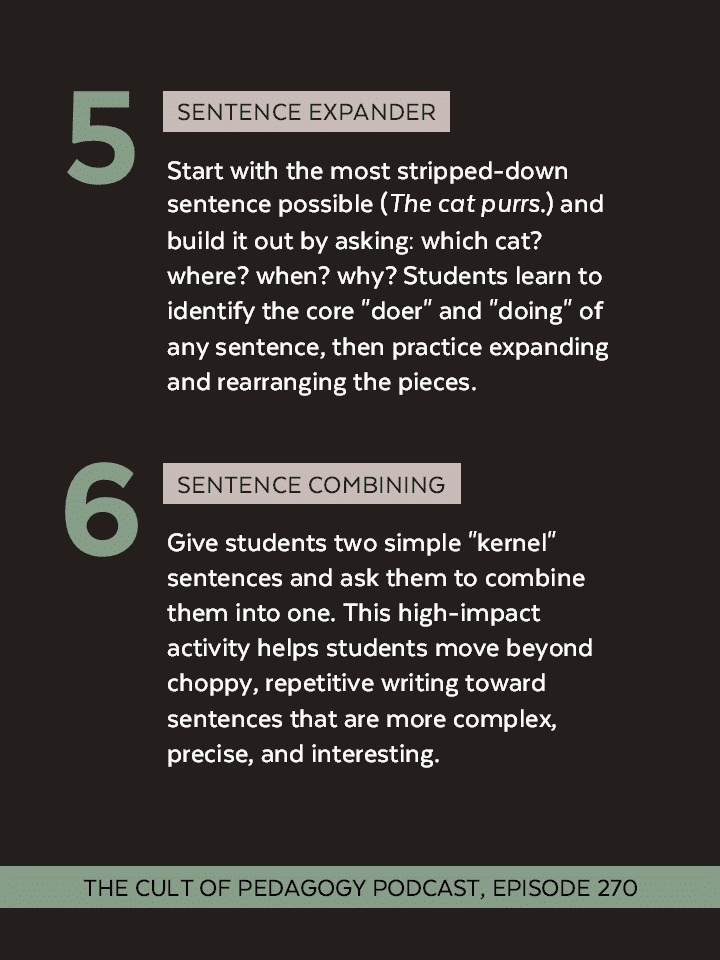
5. Sentence Expander
Start with a kernel sentence; something like The cat purrs. Then build on it together by asking students a series of questions: Which cat? What color? Where? When? Why?
Meehan’s favorite way to frame this is to use the terms “doer” and “doing” rather than subject and predicate, which she finds too abstract for most kids. Once they can reliably identify who’s doing what in a sentence, they can begin to understand why it’s so hard to follow a sentence when those two elements get separated by more detail.
Once the sentence is fully expanded (The orange cat is sleeping on the couch in the afternoon because he is tired), experiment with rearranging the words to make new variations. Giving students a chance to play with that helps them learn to develop richer, more complex sentences.
6. Sentence Combining
“Sentence combining is a really high-impact, quick way for kids to graduate from writing a series of simple sentences to ones that are more syntactically complex, interesting, and precise,” Roberts says.
With this activity, you give students two short, bare-bones sentences and ask them to combine them into one. For example, My cat is orange. and My cat is big. becomes My big orange cat… You can scaffold this for beginners by underlining the word to be “harvested” from one sentence and inserted into the other. As students grow more confident, they can move to combining three sentences and adding different conjunctions (because, and, but…) to change the meaning.
When students get practice like this, they then naturally transfer it to their own writing, merging short, choppy sentences into more sophisticated ones.
Executive Functioning Minute Moves
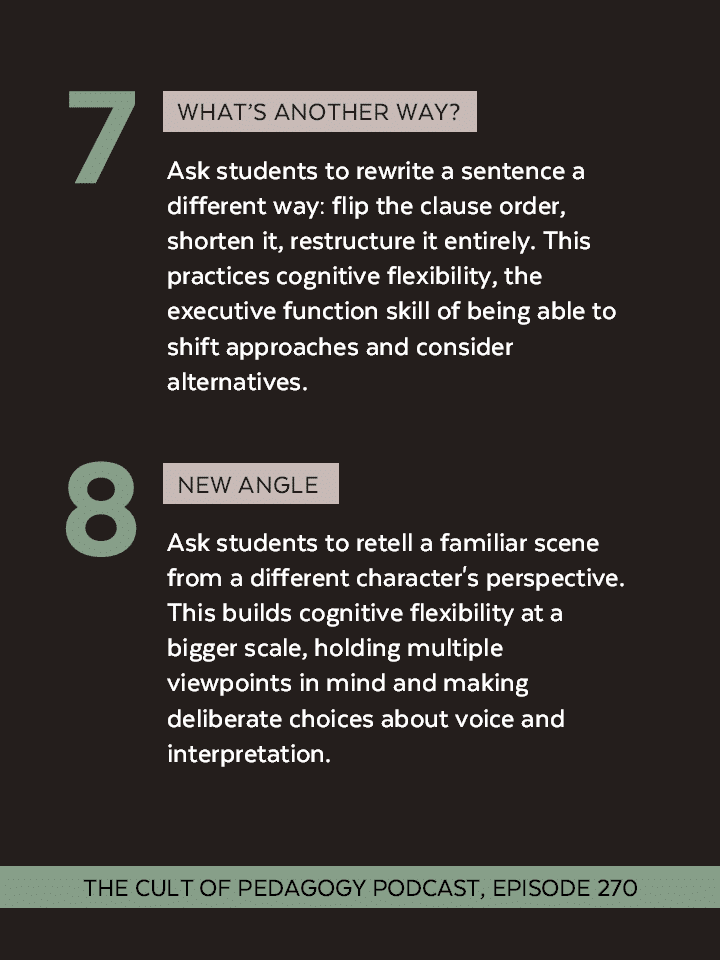
7. What’s Another Way?
One of the executive functions the book places at the center of the writing process is cognitive flexibility, the ability to shift approaches, consider alternatives, and revise your thinking. This minute move practices it directly at the sentence level.
Give students a sentence and ask them to rewrite it a different way. What if you started with the dependent clause instead of the independent one? What if you replaced the noun with a pronoun? What if you made it shorter?
Meehan points out that writing is not only about learning to write longer, more complex sentences. Sometimes the most powerful move is to write a very short one. “The whole art and the craft of writing is varying them and having that skill set to be able to intentionally go from long and complex sentences when they’re impactful to short sentences when they’re impactful and have the wherewithal to vary that.”
She adds that giving students the vocabulary to describe this skill has a big impact. “When you start naming that as cognitive flexibility for kids,” she says, “that’s exciting to them.” There’s something genuinely empowering about being told you’re practicing a sophisticated cognitive skill — especially for students who have struggled to see themselves as capable writers.
8. New Angle
This one also targets cognitive flexibility, but zooms out from the sentence to the story level. Ask students to retell a familiar scene from a book they’re reading, a shared class text, or a short film, from a different character’s perspective.
Roberts illustrated it with a real memory: the cafeteria food fight she witnessed as a ninth grader looks very different when you retell it through the eyes of the teacher who had applesauce poured in her hair. Taking on a different perspective requires holding multiple viewpoints in mind simultaneously, and making real choices about voice, detail, and interpretation.
Meehan uses short videos for this with the students she tutors. One of her favorites is Snack Attack, a three-minute Pixar short that tells the same event from two very different points of view. In one session, she and a student each wrote one character’s perspective in scenes, then they swapped documents and continued writing from the other character’s point of view. The student got competitive about keeping up with Meehan’s pace, which was an unintended bonus. But more than that, he was genuinely practicing something that matters far beyond the writing classroom: the ability to understand how other people think.
“It’s not just about writing and it’s not just about watching this show,” Meehan said, “but it’s also about democracy and thinking about how other people think and what their perspectives are.”
Join our mailing list and get weekly tips, tools, and inspiration that will make your teaching more effective and fun. You’ll get access to our members-only library of free downloads, including 20 Ways to Cut Your Grading Time in Half, the e-booklet that has helped thousands of teachers save time on grading. Over 50,000 teachers have already joined—come on in.

