

A tuft of cream-colored down stirred in the branches — a baby eagle scanning the horizon.
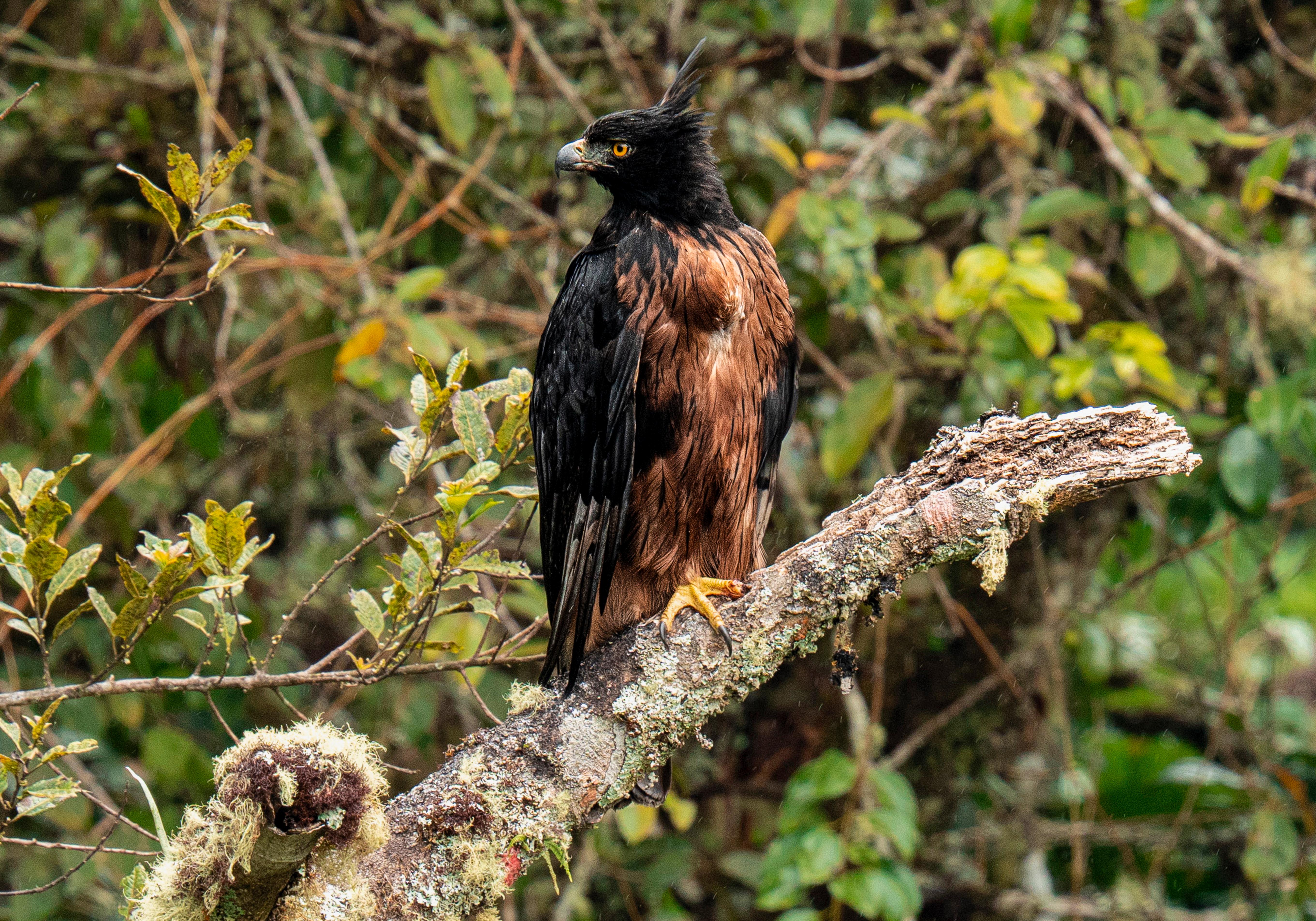
Moments later, its mother swooped into view, with a small mammal gripped in her talons. This is the black-and-chestnut eagle, one of South America’s largest and most endangered birds of prey, with fewer than 1,000 left in the wild.
In the last 80 years, only 18 nests have been recorded in Colombia. But one of them was recently discovered in Huila — the heart of the country’s most important coffee-growing region.
“The black-and-chestnut eagle is one of the most important species in our territory,” said Camilo Agudelo, director of CAM Huila, the regional agency responsible for conserving Huila’s natural areas. “Today we see how communities, biologists and institutions are coming together to protect it.”
That collaboration includes the Conservation International-backed HYLEA Pact — a landscape-scale effort to restore forest connectivity between the Andes and the Amazon through more sustainable coffee production.
In Huila, coffee is a way of life — and a cornerstone of Colombia’s economy. The region’s smallholder farmers help make the country one of the world’s top producers, accounting for 10 percent of the global supply and supporting more than 2 million jobs nationwide.
Yet even as coffee sustains millions of livelihoods, the region’s forests and wildlife face mounting pressures.
Since 2011, 25,000 hectares (61,000 acres) of forest have been lost, shrinking habitat for species like the black-and-chestnut eagle and threatening the forests that are vital to both wildlife and local communities. Climate change compounds the challenge, pushing coffee cultivation upslope and putting the area’s more than 1,200 species — including over 60 that are threatened — at even greater risk.
The HYLEA Pact, led by Conservation International, the international development organization IDH, the CAM and the Government of Huila, aims to help farmers grow coffee in ways that help nature thrive.
“The approach we’re taking in Huila is comprehensive — and that’s a major contributor to the forest’s recovery,” said Raina Lang, who leads the global coffee program at Conservation International. “We’re restoring degraded lands, improving regenerative agriculture in coffee lands and increasing environmental awareness about forest and species protection,” she explains.
At the heart of the initiative is an effort to help farmers adapt to a changing climate by farming in ways that work with nature.
By interspersing fruit trees, timber species and nitrogen-fixing plants alongside coffee, communities enhance soil fertility, reduce erosion and diversify their sources of income. This blend of agriculture and forestry — called agroforestry — helps restore degraded land, support biodiversity, and increase resilience to climate change. The trees’ roots also hold the soil in place, reducing sediment carried downstream and keeping waterways clearer.
The sight of the nesting pair of eagles is proof that the forest is thriving — and an indicator that coffee, when grown the right way, can help sustain that balance, said Lang.
Other species are returning, too.
Last summer, a community-led group that monitors biodiversity in the forest checked a set of camera traps hidden throughout the forest. To their surprise, they captured pictures of the same jaguar they had spotted two years earlier — this time on the opposite side of the mountain. “Seeing the same animal moving freely across the corridor, you can’t help but feel the forest is connected again — and that coffee contributes,” Lang said.
That connection is exactly what the HYLEA Pact was designed to achieve. Through camera traps and field surveys, the initiative monitors wildlife to track forest recovery — including the black-and-chestnut eagle family nesting high above the coffee trees.
“We have been able to document every step of the eaglet’s daily life, from nest building, incubation, and rearing to its first flaps of wings outside the nest” said Willington Yáñez, leader of YAREIT, a black-and-chestnut eagle conservation group.
Each pair of black-and-chestnut eagles needs 10,000 hectares of continuous forest to survive. Through the steady work of local communities, patches of forest are being reconnected, and more species are finding safe passageways to new habitat.
“The presence of this pair and their offspring in Huila is not just a scientific record, it is a sign of hope,” said Carlos Costa, executive director of Conservation International-Colombia. “It reminds us that if we work together with communities and institutions, we can reverse the decline of the most endangered species and ensure that they continue to play their vital role in Andean ecosystems.”
**
With support from the Walmart Foundation and Starbucks, the HYLEA Pact is helping build regenerative and resilient coffee and cocoa landscapes in Huila, Colombia. Learn more ›

