

By Juliana Tapper
 Two weeks into my eighth school year as a math intervention teacher, my administrators dropped a bombshell on my math intervention plan: Stop teaching remedial content and teach grade level content instead.
I panicked, wondering how students struggling with basic multiplication and fractions could possibly master multi-step equations. However, wanting to keep my job in a brand new school, in a brand new state, I sat my kids down the next day for a motivational speech that changed me forever: “I believe you can do grade level math, so we’re going to do grade level math.”
To my surprise, the atmosphere immediately shifted from apathy to hope. We went to work, and my students rose to the challenge, performing equally to their non-intervention peers on district benchmarks. This proved that what they needed wasn’t more remediation, but a teacher with high expectations of what they could do.
This experience taught me the transformative difference between a “Just in Case” remediation model and the “Just in Time” intervention model that truly serves our students.
Part 1: The Most Effective Intervention Model
Most of our intervention programs operate under a remedial Just in Case model. We try to reteach all prior grade level content just in case they missed it. Think of this approach like a road full of potholes; we pick up our shovel and try to fill every single pothole a student experienced in the past before allowing them to move forward.
While this approach comes from a place of care, it has unintended consequences. It forces students to spend weeks re-doing math they have already failed – often leading to boredom and a deep sense of defeat. Worse, it effectively tells them, “I know you can’t do grade level math so let’s just keep practicing the basics.”
To intervene effectively, we must shift to a Just in Time model. Instead of filling potholes, think of a staircase. We start with essential grade level content (e.g., solving multi-step equations, proportional relationships, etc). We acknowledge the gap between our students’ current level of understanding and that grade level content, so we build a staircase by teaching only the specific prerequisite skills needed to master that concept right now, just in time for lessons on that essential grade level content.
This approach communicates the single most important message that a student who struggles needs to hear: high expectations. Research consistently points to the importance of teacher expectations. The Opportunity Myth (TNTP, 2018) found that teacher expectations for student success against grade-level standards had the strongest relationship to student growth of any factor studied.
Similarly, the Pygmalion effect (Rosenthal & Jacobson, 1968) showed us that labels we place on students often become self-fulfilling prophecies of achievement – label a student as gifted and they outperform their peers in end of year assessments. So the converse might also be true, label a student as “low” and those low expectations become a self-fulfilling prophecy of their academic achievement.
When we bombard ourselves with diagnostic data showing students are “years behind,” it creates a subconscious ceiling and ignites our implicit bias. By committing to Just in Time intervention, we stop being gatekeepers who hold students back until they are “ready,” and start being Gatebreakers who provide the access they need to succeed today.
Looking for specifics? I’ve created done-for-you lists of essential content and possible gaps for 6th grade through Algebra 1 in my free Just In Time Math Intervention guide.

Part 2: The Elephant in the Room – Fluency
We can’t talk about grade-level math without addressing the elephant in the room: “But they don’t know their basic math facts!”
It is incredibly frustrating when you’re trying to teach grade level content, but students are counting on their fingers and can’t ever seem to remember their multiplication tables. However, stopping the grade level train to spend months on multiplication drills is a trap. Not only does it kill the pacing required for Just in Time intervention, but traditional drill and kill methods often trigger math anxiety which shuts down working memory.
So, how do we build fluency without pausing instruction? Our fluency practice must meet four criteria:
► Time Aware: You do not need weeks to ensure mastery of basic facts before moving on. These skills are spiraled into upper grade math. Instead, integrate number sense routines into warm ups or dedicate 20 minutes a week (like “Fluency Friday”) to build number sense. This keeps the grade level momentum moving while chipping away at the gaps.
► Age Appropriate: Nothing shuts down a 7th grader faster than a worksheet with bubble letters and butterfly clip art. They know it was made for 4th graders and feel disrespected. To maintain high expectations, use tools that feel mature.
► Visually Approachable: For a student with math anxiety, a page of 50 multiplication problems looks like a threat. It triggers the brain’s fear center, making recall nearly impossible. Instead, use visually approachable options like Number Talks, Open Middle problems, or “Which One Doesn’t Belong.”
► The Calculator Permission Slip: We also have to make peace with the calculator. If a student needs a calculator to access grade level mathematics – like solving systems of equations – let them use it. If we withhold it, we are effectively saying, “You aren’t allowed to learn Algebra until you master arithmetic.”
 That is gatekeeping. You can teach students to create their own multiplication table on the back of a test as a scaffold, but in the meantime, use the calculator to bridge the gap so they can experience success today.
Part 3: Effective Intervention Structures
Once we commit to the Just In Time mindset, the question is: When and how? Middle school schedules are tight, but here is guidance on how to maximize the four most common intervention set ups.
► Additional daily intervention period (Same Grade): Your role is to teach the prerequisite skills identified in your gap analysis for the essential grade level content your students are learning that week in their core math class. Add in at least 20 minutes a week of fluency practice based on the recommendations above.
► Additional daily intervention period (Multi-Grade): We know Algebra 1 is the gatekeeper for many students. Instead of driving yourself crazy prepping 10 lessons for different levels, focus everyone on essential algebra skills like solving equations and linear functions. Also, add in at least 20 minutes a week (or even one full day a week) of fluency practice based on the recommendations above.
► 1-4 times a week intervention (30-40 minutes): This set up is challenging because it’s often not enough time to see massive achievement gains. Because of the time constraints, I suggest focusing on helping students have a positive math experience. Math trauma and math anxiety are real; your intervention students likely experience it. Spend your time focusing on valuing the different ways students think and reason – which is proven to cure math anxiety. I don’t have space here, but in Chapter 4 of my book, I go into detail about six core engagement structures you can use to do this valuing.
► No intervention (but students need support): Teachers here must be dedicated to the first step of the Just in Time Intervention cycle: fine tune your focus to only essential grade level content and cut the rest. This gives you time to teach the staircase of gaps needed. Student Achievement Partners has wonderful resources on identifying essential content as does my free Just In Time Intervention guide (linked above).
No matter the scenario, resist the urge to review basic operations for months and months. I often see teachers reviewing basics in December because “students still don’t know their facts.” You cannot communicate high expectations if you spend half the year on elementary math. Teach the specific skill needed for the specific unit and mix in fluency practice in your warm ups or “fluency Fridays” that focus on developing number sense instead of rote memorization or drill and kill.
Trust your students, trust yourself
Shifting from Just in Case to Just in Time intervention is not easy. It requires trusting that our students are capable of more than their test scores suggest. It asks us to stop filling every pothole and start building staircases. But the reward is worth it. When we provide grade level access, structural support, and age appropriate fluency practice, we stop being gatekeepers and become Gatebreakers who break the doors of opportunity wide open.
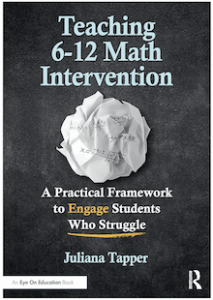 Juliana Tapper is a seasoned educator with experience as a math intervention and Algebra 1 teacher in South Central Los Angeles, East San Jose, and Denver. Having worked closely with students who have been historically unsuccessful in math, she understands the intricacies of supporting learners who struggle. She is the author of Teaching 6-12 Math Intervention: A Practical Framework to Engage Students Who Struggle (Routledge/Eye On Education, 2025) which presents her full B.R.E.A.K. it™ Math Intervention Framework.
After her time in the classroom, Juliana became a district math coach and TOSA (Teacher on Special Assignment) before founding CollaboratEd Consulting where she provides professional development to schools, districts, state departments of education, and juvenile justice systems. Juliana is a sought-after presenter at national conferences like NCTM, NCSM, ASCD, and Learning Forward. Visit her website and follow her at LinkedIn.

