

A MiddleWeb Blog
I still remember the first time my mother made tater-tot casserole. She loved new recipes and poured her heart into it as she browned the beef with onions and garlic and then folded in the sour cream, soup, and colorful vegetables.
She then hand-arranged the tater tots in perfect, military rows and blanketed them with grated cheddar cheese before placing the dish in the oven. It was a labor of love.
However, her enthusiasm didn’t transfer to my plate. I just sat there, poking at the odd combination of textures and smells. To me, it was just a strange, unappealing mixture. I pushed it around with my fork, unwilling to engage with the meal she had worked so hard to create.
 This scene plays out daily in classrooms across the country. We pour our energy into refining learning experiences, yet we’re met with blank stares or “disengaged” sighs. The hard truth is that instructional design is only half the battle (Huang, Muhamad, & Nawi, 2025); if we don’t understand the internal mechanics of student motivation and engagement, even our best-laid plans will stay untouched on the plate.
The “Fuel and Vehicle” of Learning
While often used interchangeably, motivation and engagement describe two different parts of a student’s learning experience. Understanding the distinction helps us identify whether a student lacks the “spark” to start or the “tools” to keep going.
Motivation represents the “why” behind a student’s behavior, serving as the internal “fuel” or drive that initiates the desire to learn. This internal spark typically stems from two distinct sources: intrinsic motivation, which is a genuine, personal interest in a particular learning task, or extrinsic motivation, which is the desire to obtain a specific reward, such as a grade, or to avoid a negative consequence (Lai, 2011; Ryan & Deci, 2020).
Engagement, on the other hand, is the “vehicle,” or observable process and behavior that results from motivation. It encompasses the intensity and quality of the student’s involvement in a learning activity, which can manifest as behavioral (e.g., participation, effort), emotional (e.g., interest, belonging), and cognitive (e.g., deep thinking, problem-solving) investment (Reschly & Christenson, 2022).
 Understanding the distinction between motivation and engagement is essential. Put simply, motivation is the fuel – the underlying desire to act – while engagement is the vehicle moving, or the act of involvement itself. When approaching learning tasks, students can have a tank full of fuel without the car moving.
Because of this, effective learning requires a dual approach: teachers must not only provide the “why” to spark student motivation but also carefully design the “how” to keep them actively engaged. For a quick reference, the table below outlines key aspects of motivation versus engagement.
Moving from “I Can’t” to “I Will”: Building Student Confidence and Purpose
Students often experience low motivation when they feel a task is too difficult or when they don’t understand why the work matters. To support them, we can use scaffolding to break down complex assignments into manageable steps and provide direct, clear instructions on the strategies they need to succeed (Graham et al., 2012).
Beyond clear instruction, we can boost engagement by (1) showing students the “why” behind their work by connecting classroom lessons to real-world goals and interests; (2) giving specific feedback that shows students exactly how to improve, and (3) whenever possible, providing autonomy and choice in topics, materials, and how they demonstrate learning.
At its core, motivation is about a student’s belief that they can succeed. This is why we must help them attribute their “wins” to things they can actually influence, like the work they put in and the tools they use (Weiner, 2000). When we link success to specific actions – like saying, “Your focus on the rubric really shows in this draft” – we give them a roadmap for next time.
You might also point out their problem-solving process by saying, “I noticed you tried a different approach when the first one didn’t work. That seemed to have really paid off.” We can also help our students view mistakes as temporary detours and empower them to move past the “I can’t” mindset and develop the persistence needed to grow.
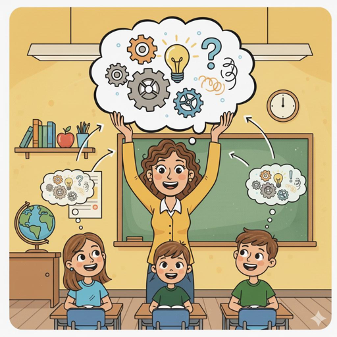 Student motivation is largely driven by an interaction between a student’s behavior, their environment, and personal factors, such as self-efficacy, or their belief in their own ability to succeed at specific tasks. Educators can build their students’ confidence by providing “mastery experiences,” or frequent success.
This can be accomplished by breaking complex assignments into small, achievable sub-tasks, ensuring students feel frequent success early on. Educators can also use modeling to narrate their own thought processes through “think-alouds,” making the invisible mental work of a task clear and attainable (Graham & Perin, 2007). (Also see Laura Robb’s “Using Teacher Think-Alouds.”)
Designing for Connection and Control
Students enter our classrooms with different mindsets that dictate how they handle challenges. While some are driven by a desire to master new skills, many are focused on simply finishing a task, earning a specific grade, or avoiding the social “risk” of looking incapable (Dweck & Leggett, 1988).
To shift this focus toward true learning, we should design assignments that value progress over perfection. By allowing for multiple attempts and revisions, we teach students that learning is an ongoing journey rather than a one-time event.
Creating this safe, low-stakes environment is essential because when students feel socially and emotionally supported, they are more likely to engage in “academic risk-taking,” such as asking for help or trying a difficult strategy (Rimm-Kaufman et al., 2014). This shift helps students move past the fear of failure and toward a sustainable habit of persistence.
Research also suggests that students are most naturally motivated when three basic needs are met: autonomy (feeling in control), competence (feeling capable), and relatedness (feeling connected to others) (Deci & Ryan, 2000).
We support these needs in our classrooms by offering meaningful choices such as letting students pick their own research topics or choose their preferred presentation format – and by providing a clear, structured path to success.
Additionally, we can foster a sense of connection through collaboration and authentic assignments (like projects that impact the local community) to help students feel their work has real-world value. When these needs are met, motivation shifts from simply “doing it for a grade” to a genuine, internal desire to learn.
Serving a Lesson They’ll Want to Finish
Just as a perfectly prepared casserole requires more than just high-quality ingredients to be enjoyed, effective learning experiences require more than just strong instructional design. By distinguishing between the “fuel” of motivation and the “vehicle” of engagement, we can better diagnose why a student might be hesitant to take that first bite of learning.
When educators prioritize a student’s need for autonomy, competence, and connection, we move our learners beyond “pushing food around the plate” and create an environment where they are eager to participate and persist.
As we step into our classrooms tomorrow, remember that our role is part chef and part coach. By scaffolding difficult tasks and celebrating the “wins” found in the process rather than just the final product, we build the confidence students need to move from “I can’t” to “I will.”
When we provide learners with both the spark to start and the tools to keep going, we help each of our students move one step closer to becoming self-directed learners who view every challenge as an opportunity to grow.
Illustrations
Google Gemini. (2026). [Cartoon clipart of a boy poking at a tater tot casserole while a smiling woman in an apron looks on]. Generated using Gemini 3 Flash from https://gemini.google.com
Google Gemini. (2026). [Cartoon clipart of a car being fueled up with motivation]. Generated using Gemini 3 Flash from https://gemini.google.com
Gemini. (2026). [Cartoon illustration of a female teacher using a thought-bubble “think-aloud” to model mental processes for teenage students] [AI-generated image]. Google AI.

