

Rigor and Assessment in the Classroom: Strategies and Tools (2nd Edition)
By Barbara R. Blackburn
(Routledge/Eye On Education, 2025 – Learn more)
Reviewed by Melinda Stewart
 In Rigor and Assessment in the Classroom: Strategies and Tools (2nd Edition), Barbara R. Blackburn continues her mission to redefine rigor in education. Blackburn explains that rigor is not an unreachable standard or an overwhelming workload. Rigor is meaningful, engaging, and appropriately challenging learning for all students.
In this edition she builds on her previous work while incorporating fresh tools, strategies, and insights that reflect the evolving demands of today’s classrooms.
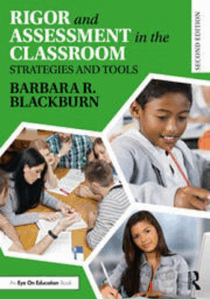 Blackburn’s unwavering clarity is effective. She addresses the confusion and misconceptions that often surround the word rigor and presents it as attainable, intentional, and deeply student-centered.
From the start, Blackburn reminds educators that rigor is not about giving students more work, but it is about pushing them to think more deeply, reflect more critically, and apply their learning in authentic, thoughtful ways. She incorporates strategies that help students monitor their own progress, reflect on their learning, and set goals for improvement.
Similar in style to how Blackburn approached scaffolding in her 2024 book Scaffolding for Success, she is concise and the material is accessible. The heart of Rigor and Assessment in the Classroom: Strategies and Tools (2nd Edition) lies in its practical, classroom tested strategies. Blackburn doesn’t just talk about rigor in theory; she shows educators how to build it through purposeful planning, aligned assessments, and consistent instructional practices.
Concrete, flexible tools and strategies
Blackburn offers concrete tools for designing lessons and assessments that not only measure what students know, but their thinking. The focus on aligning rigorous instruction with rigorous assessments is particularly impactful, and throughout the book she reminds us that if we want students to engage in deep thinking throughout the entire learning process, our assessments must be thoughtful and reflect the level of depth and complexity we are seeking.
Having taught language (English Language Learners and Spanish Language Learners) and reading intervention at the high school level for more than three decades, I appreciate that Blackburn doesn’t push for a one-size-fits-all solution to assessment and rigor. I can often be heard in meetings arguing that we need a shared understanding of the word rigor because what is rigorous to one student is not necessarily rigorous to the next.
The toolkit of strategies that Blackburn provides in this book allows teachers to tailor their assessments to the unique needs of their students. There’s an underlying understanding that not all students come to the table with the same set of skills, and thus assessments should be differentiated and intentional.
I cannot tell a lie, I set down the book for a moment and gave snaps. From exit tickets to peer assessments, her exploration of various formative assessment methods and suggestions can help educators refine their approaches to understanding where their students are in the learning process before the final summative assessments arrive.
Whether you’re trying to refine your current assessment practices or are just beginning to explore ways to integrate rigor more intentionally, this book is a great starting point and a solid reference as you continue to grow in your teaching practice on your own or with a group of colleagues.
Melinda Stewart has been an educator for 30 years. She has an MA in Teaching, Education and Learning and has done graduate work in the areas of English as a Second Language, Reading, Spanish, and most recently English Language Arts. She is currently working as a Spanish teacher and ELM coach at Fairmont Junior Senior High School. Melinda is an MEA and AFT professional development facilitator and trainer who has a deep passion for learning and equity.

