

William (Bill) Foege’s achievements for the health of humanity tower above almost everyone. He passed away this past week. Born in 1936, his many diverse achievements include:
- * Eradicated smallpox. Working with DA Henderson and J Michael Lane, he was a key innovator in the global campaign against this highly fatal communicable disease, the only human disease ever eradicated entirely. He promoted the successful ring vaccination strategy, using surveillance and containment. Further reading: Foege’s book House on Fire, the Fight to Eradicate Smallpox (2011)
- * Directed the U.S. Centers for Disease Control and Prevention (CDC) from 1977-1983 where he led the expansion of CDC’s work in maternal/child health, HIV/AIDS, environmental health and strengthened CDC’s leadership as a voice for science. He was a proponent of population-level prevention of disease. He began at CDC in the Epidemic Intelligence Service in 1962. During his tenure, CDC promoted nutrition programs around the world. In 1979, he convinced the First Lady, Rosalynn Carter to visit Thailand at the time of the Cambodian refugee crisis.
- * Served in the 1990s on the board of CARE USA, which has fed upwards of 400 million people during its history. CARE was the premier NGO providing immediate and long-term solutions to malnutrition in famines, crises and failed states.
- * He was a key early Senior Advisor to the Gates Foundation (as of 1999), influencing their programs for child survival, micronutrients and vaccines.
- * Served eight years on the board of directors of the Conrad N Hilton Foundation, including serving on the committee that selected with international nonprofits would win the foundation’s annual Humanitarian Prize often given to NGOs reaching homeless people in far corners of the globe. Foege said “We must keep promoting the idea of global citizenship, to erase the divisions between nations, cultures, religions, and races.””
- * Helped to set up the Carter Center and served as Executive Director from 1986 to 1992. He collaborated with President Carter to shape the Center’s early vision and give it a reputation for rigorous, principled engagement in global health, such as its campaign to eradicate Guinea worm disease.
- * He created the Task Force for Child Survival, based at CDC, with President Jimmy Carter’s support. It was later renamed the Task Force for Global Health.
- * He was known for making other people feel listened to and important. As one colleague said, “you always had the impression that all of his attention was on you and what you were saying.”
- * He was an amazing public speaker, who really knew how to tell a story. Patrick O’Carroll said of him: “Whenever he spoke, his vision and compassion would reawaken the optimism that prompted us to choose this field and re-energize our efforts to make this world a better place.”
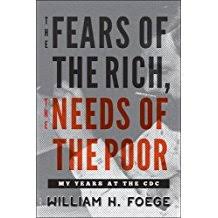
- * He was an accomplished author and professor at Emory University School of Public Health. He is remembered for many aphorisms, such as “vaccines are the tugboats of preventive health.”
In 2016, his commencement speech at Emory University was titled “Every Day we Edit our Obituaries.” He advised the students, “it’s not until you get to be my age that you know how good a life has been. But consciously, daily edit your obituary so you realize that sooner. Edit with care and gusto.” He added “We like to feel we are civilized. How do we measure that?… Every measure fails, except one. But there is one measure of civilization and it comes down to how people treat each other. Kindness is the basic ingredient.” Quoting Albert Einstein, he also encouraged the graduates to “be good ancestors.”
Emory professor and colleague Kenneth Castro remembers “He reminded us to be generous with sharing credit during collaborative efforts and to practice “ego subordination””
Bill Gates recalls, in his online GatesNotes how “late in life, Bill spoke openly about his own mortality. “I feel so enthusiastic every day about seeing the newest thing in science and health,” he told an interviewer. “The part that’s going to be hard about dying is not dying but not being able to see what’s happening next.””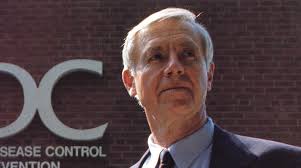
Foege was the third of six children growing up in Decorah Iowa He is survived by his wife, Paula, two sons, Robert and Michael, three sisters, four grandchildren; and two great-grandchildren.
One story Foege liked to tell often was from his days organizing vaccinations in West Africa, where the village leaders brought everyone from the fields to get vaccinated. The village leaders beat their drums and everyone came. Foege, who stood 6 feet 7 inches tall, asked, “what message did you send?” The reply: ‘come quick if you want to see the tallest man in the world.”
Other testimonials:
https://www.who.int/news/item/25-01-2026-in-memoriam-dr-william-h.-foege-(1936-2026)
https://www.cdcfoundation.org/stories/honoring-legacy-health-hero-dr-bill-foege
https://www.taskforce.org/bill-foege-tribute/
https://www.gatesnotes.com/home/home-page-topic/reader/remembering-bill-foege
https://www.statnews.com/2026/01/25/william-foege-obituary-smallpox-cdc-vaccination/
https://www.legacy.com/us/obituaries/legacyremembers/william-foege-obituary?id=60632713
Further reading:
A vignette: https://www.gatesnotes.com/Story-of-A-Hero-Bill-Foege
Collected speeches: https://muse.jhu.edu/resource_group/167
Life: https://en.wikipedia.org/wiki/William_Foege
Confronting emerging infections: https://stacks.cdc.gov/view/cdc/15522

