

In December of 2025, a hodge-podge, high-power mix of water users, water managers and policy makers, non-profits, scientists, and journalists convened in Las Vegas for the 80th annual Colorado River Water Users Association Conference (CRWUA) in Las Vegas. The conference, and the open and closed-door meetings it hosts, was themed “forging a path forward”. Insofar as forging is an act of hammering and compression, the theme was almost too on the nose with states having missed a November 11 deadline for agreement on future management of the Colorado River, and is now facing a new deadline looming on the horizon of 2026. It was a fitting culmination of a complicated year on one of the world’s hardest-working rivers, where drought and demand have stretched already thin supplies to the brink. The economies and cultures of nearly 40 million people hang in the balance of the ongoing negotiations, as does the health and future of the river itself.
2025 on the Colorado River…
This past year was chock-full of high-profile meetings between the principals of the seven Colorado River basin states working to negotiate a path forward for management of the Colorado River. American Rivers participated in collective action and influence on the next generation of rules, called “Interim Guidelines.” Critically, we worked with partners to provide a science-informed Cooperative Conservation Alternative that prioritized the health and long-term viability of the river alongside community, economic, and cultural needs. While it’s been rebranded in the federal government’s latest document as the “Maximum Operational Flexibility Alternative” (we’ll get into this more below), the Alternative remains one of five under consideration.
Originally faced with a November 11, 2025, deadline for agreement, the upper and lower basin states failed to come together with a shared vision for the future of the Colorado River. We worked with partners to both pressure and support the principles working to find an agreement.
Let’s stay in touch!
We’re hard at work in the Southwest for rivers and clean water. Sign up to get the most important news affecting your water and rivers delivered right to your inbox.
We leveraged the power of storytelling to encourage those determining the future of the Colorado River to prioritize the river itself. Our newest film collaboration with Fin & Fur Films, The American Southwest, aired in more than 70 theatres during a 40-day theatre run in the West, and inspired thousands to take action on behalf of the river. We hosted and spoke on panels to help audiences understand the significance of a very wonky process and know how to direct their energy to action.
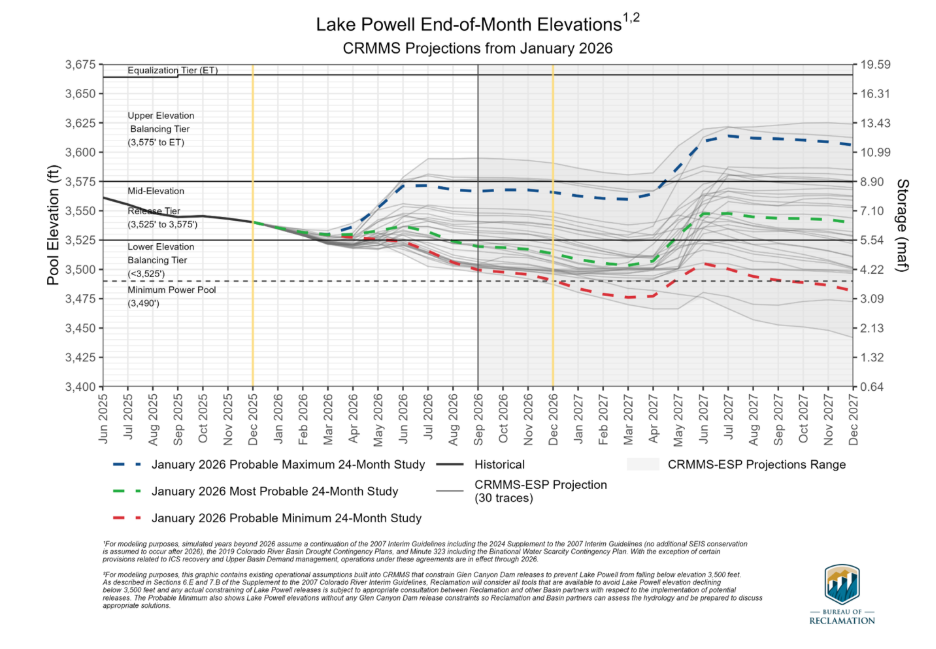
Meanwhile, the BOR 24-month projections released in October of 2025 suggested, and for many who have been tracking climate models for years, confirmed a worrying trajectory for water availability in the basin, with some models predicting Lake Powell dropping below the minimum level for hydropower as early as fall 2026.
The 24-month study, paired with the sobering, recently released NRCS report for Colorado Statewide Water Supply Conditions, underscore the imminence of future water management strategies that plan for profound shortages, and look to integrate flexible tools, policies, and programs that can respond to a severely diminished water supply and work proactively to minimize harm to communities, economies, and the critically, to the river itself.
What’s next?
Well, it’s a little hard to say. The states face a new deadline of February 14th to come to an agreement about the future management of the Colorado River. Unfortunately, following a recent meeting of governors and their representatives in Washington DC, agreement does not look likely. In mid-January, the Trump Administration issued a framework for five alternatives, which overwhelmingly propose cuts to the Lower Basin States, nearly all of which are likely to lead to litigation.
The long-anticipated draft environmental impact statement (DEIS) was issued on January 9, providing a preview of the menu of options for future management of the overstressed river. The DEIS outlines five potential frameworks for managing the river, and tests them against various climate forecasts. Some experts claim the models don’t go far enough to represent the likely extent and impact of prolonged drought in the Basin.
- No Action Alternative: assumes that after this year, reservoir operations would revert to pre-2007 conditions. Current drought-response adaptations would cease, and annual decisions would rely on outdated and broad authorities rather than strategies aimed at mitigating the risks the Basin faces now and going forward.
- Basic Coordination Alternative (Federal Authorities Alternative): The Draft EIS expressly recognizes that this alternative would not successfully sustain the basin for the term anticipated (20 years) but may work if needed for a short-term. Under most hydrologies, it may not sufficiently reduce the risk of reservoir drawdown in prolonged drought, potentially perpetuating low reservoir storage impacts on ecosystems and water supplies.
- Enhanced Coordination Alternative (Federal Authorities Hybrid Alternative): Intended to strike a balance between federal coordination and stakeholder-driven strategies that factor in Tribal water, it yields improved reservoir health (stability and predictability) under a broader range of hydrological conditions than the No Action and Basic Coordination Alternatives. The success of this alternative depends heavily on the size and extent of stakeholder participation and involvement.
- Maximum Operational Flexibility Alternative (Cooperative Conservation Alternative): Prioritizes system resilience and conservation, potentially achieving greater storage stability and flexibility if implemented effectively. It may require new agreements among stakeholders, voluntary contributions to conservation reserves, and broader water management tools. This alternative is likely the most protective of critical infrastructure and long-term ecosystem health because it integrates conservation reserves, proactive storage buffers, and measures that could support more stable instream flows and habitat conditions, benefiting native species and riparian environments. It’s important to note that in order to achieve the stability and reliability the Basin demands, this alternative assumes the largest cuts (of the proposed alternatives) to water user supplies and deliveries.
- Supply Driven Alternative: This alternative is designed to respond dynamically to actual water supply conditions, potentially triggering deeper conservation actions in dry conditions and moderating releases when supply is higher. This alternative has the potential to better align water use with hydrologic realities, reducing stress on storage and ecosystems during drought. However, the plan relies on operations that directly implicate competing interpretations of the Colorado River Compact and other elements of the Law of the River, which the Basin States have not yet been able to overcome. Like the others, this alternative depends heavily on broad agreements among states and stakeholders before implementation.
It’s important to recognize that all alternatives face a number of uncertainties, and no alternative fully eliminates the risk of low storage under extreme drought scenarios. This means monitoring, adaptive triggers, and stakeholder cooperation remain critical across all scenarios.
If the states don’t come together by the new Valentine’s Day (ironic, we know) deadline, it’s hard to know what will happen; however, a Federal alternative will likely result in litigation from the states. And, while there may be a time and place for litigation, the consequences of Colorado River management being tied up in court for the foreseeable future is bad news for a river facing dwindling supplies, a very grim snowpack, and increasing demand. It limits the flexibility and collaboration required for thoughtful, proactive response, and the kinds of solutions that the circumstances and the river demand.
Our own Sinjin Eberle said it best in his recent quote in this LA Times article:
Ultimately, we would hope that all of the states and the federal government combined recognize that without the river being healthy and sustainable, industry is going to suffer, agriculture is going to suffer, communities are going to suffer. Hopefully the states can respond to that in a way that is comprehensive and allows for sustainability.”
Sinjin Eberle

