They were firing darts at a blue whale from a drone — and they were running out of chances.
In mid-October, a small research team searched the waters off eastern Indonesia for blue whales. For days, the team watched plumes of breath rise and vanish on the horizon — whales surfacing, diving and then slipping away again.
Eight times, they tried to tag one. Eight times, they missed.
This was their ninth attempt.
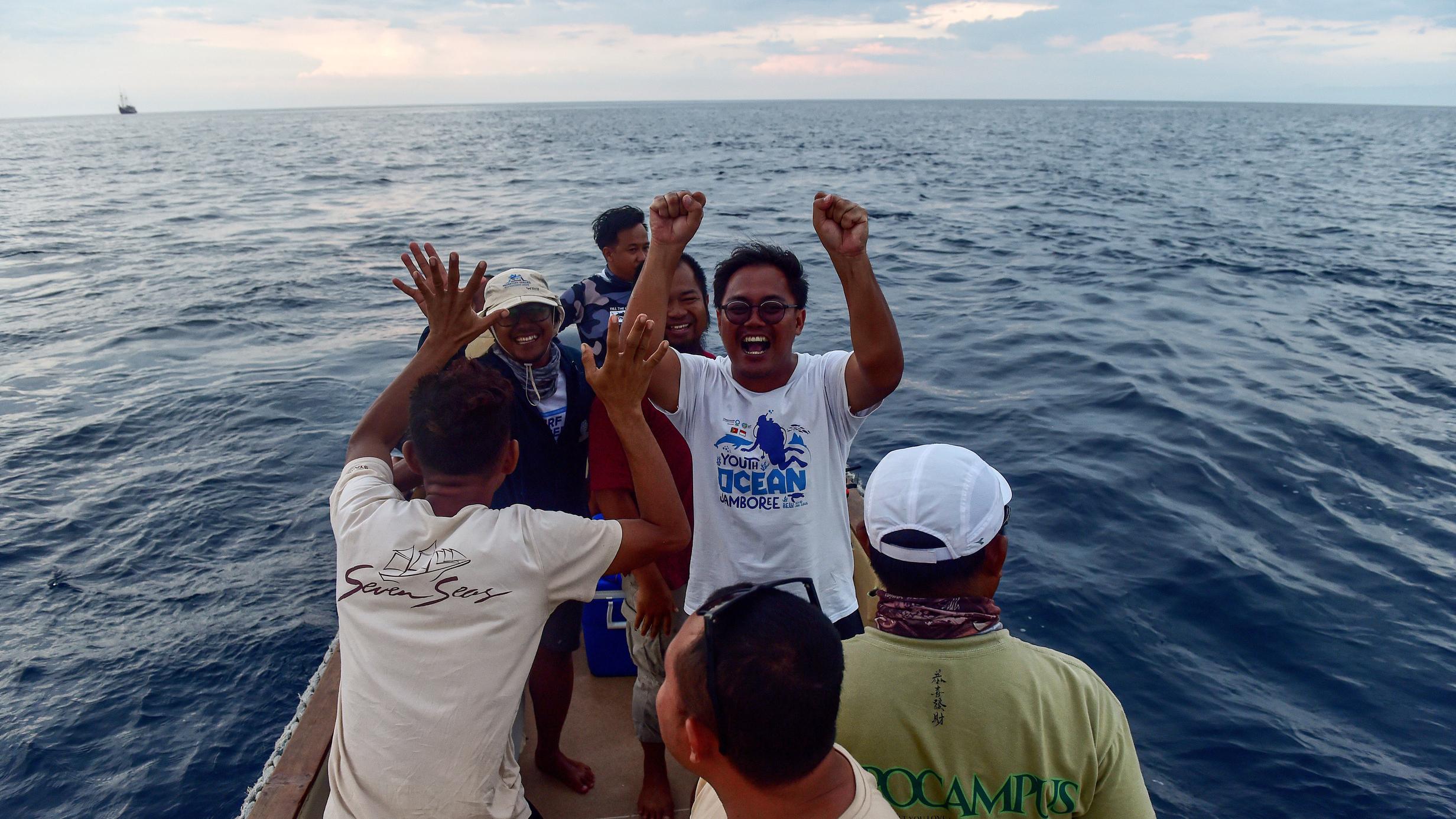
From 300 meters away, Conservation International marine scientist Iqbal Herwata stood on deck, a controller steady in his hands. His eyes were fixed on the screen, following a drone-eyed-view of the waves. The whale surfaced. Herwata pulled the trigger.
A chorus of cheers sounded from the boat.
“When it finally hit, the crew actually jumped into the ocean,” Herwata laughed. “They were swimming, shouting. After all those days — after all that pressure to get it right — we did it.”
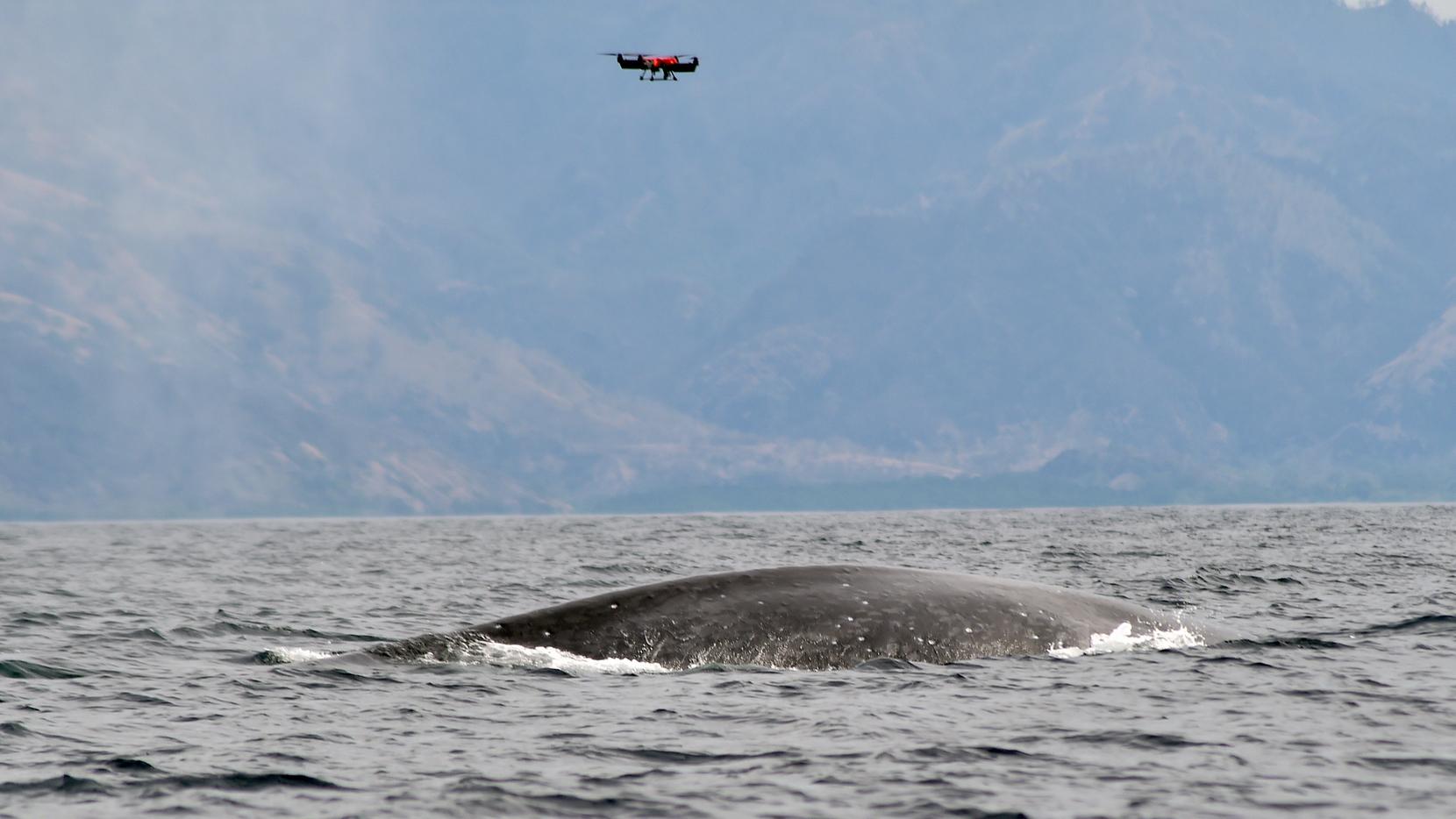
The successful tagging marked a first: a drone-deployed tracking device placed on a blue whale in open ocean — a technique pioneered by Center for Whale Research (Western Australia) and tested in field by Conservation International and its Indonesian partner, Konservasi Indonesia. By replacing air guns and close-quarters pursuit with a precision drone, the team proved it was possible to study the world’s largest animal in a way that is safer, less invasive and far more practical.
See the moment scientists tagged a blue whale:
The innovation wasn’t just the drone — it was what the drone carried.
Traditional whale tags are large and designed to be fired directly into a whale’s body using an air gun. They require boats to approach closely, skilled shooters to deploy them and permits that can take months to secure.
“With air guns, if the shot isn’t perfect, you lose the tag,” said Herwata. “Each one can cost around US$ 5,000. That pressure is always there. With the drone, we can retrieve the tag. It’s safer for the whale — and for the science.”
The new tags used by Herwata and his colleagues are known as LIMPET tags. They are small — around the size of a matchbox — and designed to attach with minimal impact. When deployed from a drone, they eliminate the need to chase whales or fire projectiles from close range. And if a drop misses its mark, the tag can be recovered and used again.
Just as important, the drone-based approach reduces stress on the animal itself. Rather than altering a whale’s behavior through pursuit, the team could observe natural dive patterns, anticipate surfacing intervals and deploy the tag with precision from above.
“If you chase a whale, of course its behavior changes,” Herwata said. “Tagging from the drone makes the data better — and it makes the research more ethical.”
The whale beneath the drone that day was not the blue whale most people picture.
It was a pygmy blue whale, a subspecies that diverged from other blue whales only 20,000 years ago — a mere blip on an evolutionary timescale. Driven north by expanding ice during the height of the last ice age, this population of blue whales became isolated in the Indian Ocean, adapting to warmer waters and different feeding patterns.
“I mean, yes, they’re smaller than the blue whales people usually imagine,” Herwata said. “But ‘pygmy’ is a total misnomer — at up to 24 meters long, pygmy blue whales are still some of the largest animals to have ever lived.”
Today, the pygmy subspecies may be the most numerous remaining type of blue whale on Earth.
As industrial-scale whaling swept through the world’s oceans in the 20th century, blue whales were driven to the brink of extinction. Entire populations collapsed. But pygmy blue whales, which occupy waters that were less intensively hunted, survived in greater numbers than their relatives.
“They survived where others didn’t,” Herwata said. “But that doesn’t mean they’re safe.”
Each year, pygmy blue whales travel thousands of kilometers across the Indian Ocean. Their migration traces a vast loop between feeding and breeding grounds — from western Australia into the deep, semi-circular Banda Sea, rimmed by Indonesia and Timor-Leste.
“We have data for parts of the migration, but we are missing huge parts of the whole cycle,” said Herwata. That gap matters. Without a full understanding of when and where pygmy blue whales travel, it’s difficult to protect the places they depend on most — particularly in busy waters shaped by shipping, fishing and a warming climate.
“To protect them, we need to understand the full journey,” Herwata said. “Not just where they start, or where they end — but everything in between.”
The early data is beginning to answer questions that have lingered for years. From a single pygmy blue whale, the tag has recorded a journey of more than 2,000 kilometers — offering rare insight into how these animals move through Indonesian waters on their return south.
The work to protect these waters is already underway.
With support from Konservasi Indonesia, the government of Indonesia has designated more than 325,000 hectares (80,000 acres) of ocean as a new marine protected area. The waters in Southwest Maluku form part of the pygmy blue whale’s northern range, adding a critical piece to Indonesia’s expanding network of protected seas.
By revealing more of the whale’s migration, further LIMPET tagging could help guide similar protections in other waters that the species depends on, by showing the areas of the ocean where it faces the greatest pressure.
“It’s just one tag — so far,” Herwata said. “But this is proof that we can do this. Now we can improve it.”