

By Ronald Williamson and Barbara R. Blackburn

Everywhere you turn there’s an article about artificial intelligence (AI). Proponents brag about everything it can do, how it increases efficiency and provides leaders with time to do other things. Some of that is true.
Opponents challenge those assumptions and question whether AI is actually useful, whether it inhibits creativity and spontaneity, and whether it actually makes you less efficient. Some of that is true.
 Regardless, AI is a tool that is now embedded in everyday life. We often feel its impact without even knowing it, and we can rely on it to help with routine tasks.
It’s critical for school leaders to understand both the benefits and the challenges of using AI. We believe it will have an increasing presence in schools, in curricular materials, in communication strategies, and in administrative tasks such as monitoring attendance and interacting with families.
AI is an evolving technology. We recognize that the advice we provide today may be outdated in a short while. But we want to look at 5 Do’s and 5 Don’ts of working with AI that are on on our minds right now.
5 Do’s of Using AI
For starters, let’s consider five ways that AI is helpful to leaders. First, we’ve worked with social media posting using AI. Of course you need to double-check anything that is generated, but AI is helpful in saving time with social media posts. For example, we chose a random school and asked ChatGPT to create social media postings based on the website. Here’s a sample.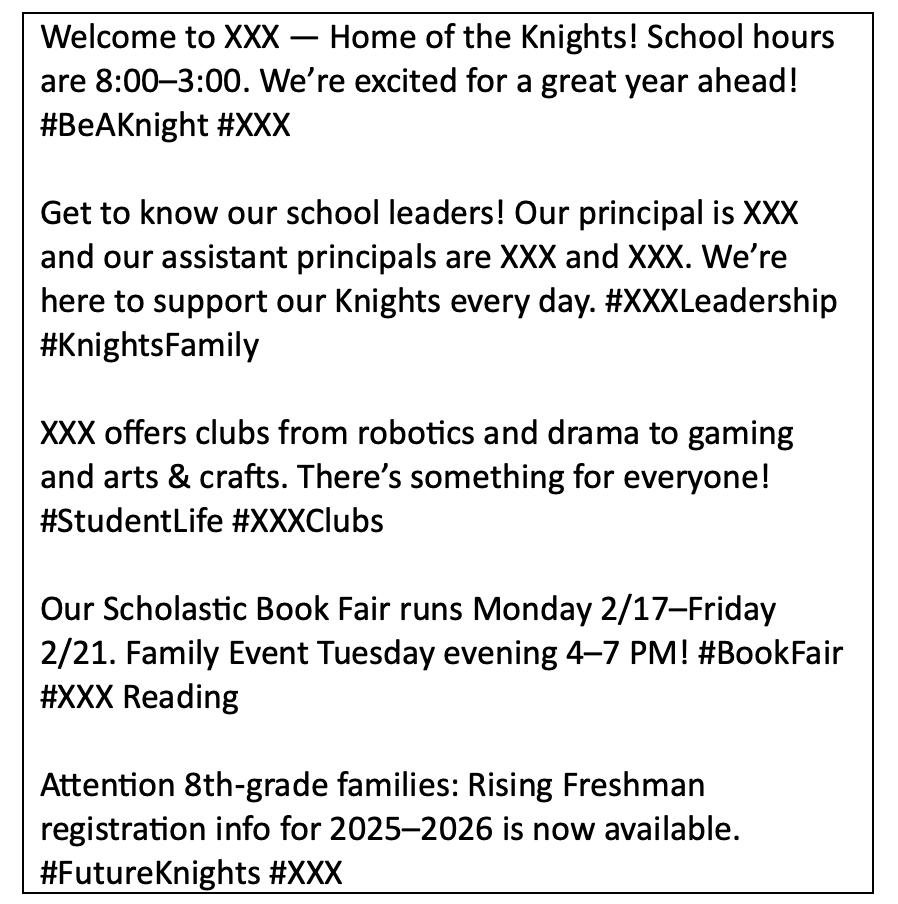 This is an easy way to generate postings without a major time investment.
You can also use AI to generate standard emails or letters that you can customize for individual students. Here’s a sample that addresses a common problem: chronic absenteeism.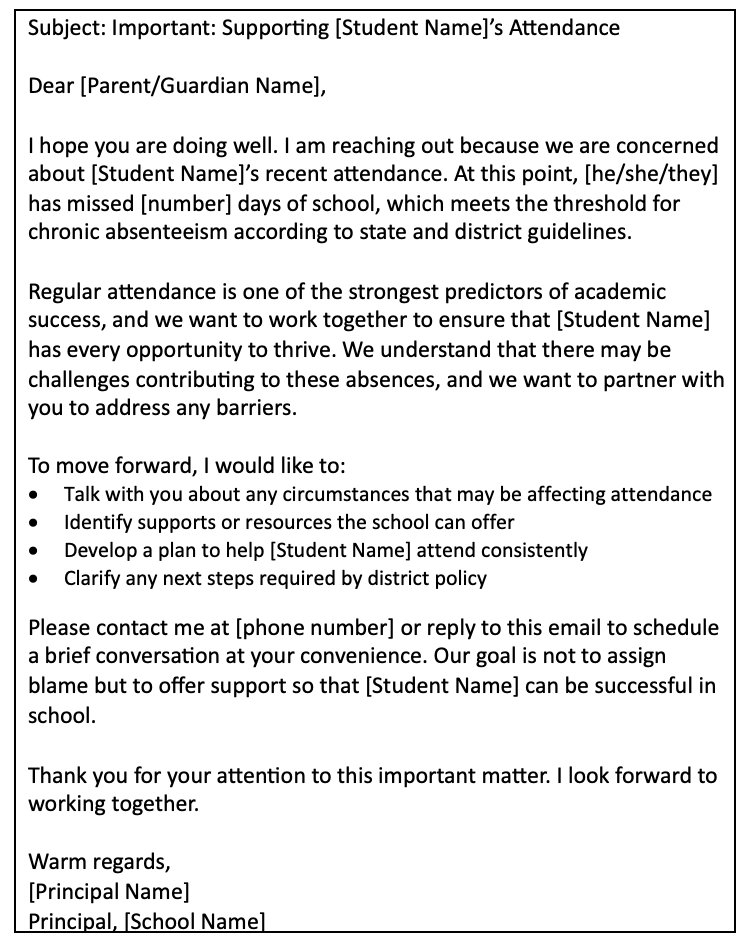 A third option is to use AI to create icebreakers for your meetings. You might wonder whether the suggestions will actually be helpful. We’ve found it best to generate a list of options and then choose the one that fits your faculty. It also frees up your time for more pressing matters.
 Fourth, AI can draft sample emergency preparation materials that you can customize for your school. For example, it can create crisis response protocols, a quick guide for substitute teachers, or a standard press release. You can modify as needed, but working from a sample is easier than creating materials from scratch.
Finally, AI can assist with data analysis. Although any final conclusions should come from you and your team, it’s helpful to have some of the analytics handled for you. There is a wide range of analysis types you can ask for.

 Crafting a Good Prompt
When using AI, well-crafted prompts generate more useful responses. For example, you may ask for “a good letter to parents about absences,” or you might ask for a “positive but concerned letter to send to a parent regarding chronic absences, including a rationale for student attendance and why the parent should contact me.” The latter is far more effective.
What we’ve also found is that there is one key question that makes or breaks the quality of an AI response. After you give your prompt, ask AI “What else do you need to know from me to help you create a good response?” Capitalizing on the AI’s knowledge base to improve the quality of your prompt leads to stronger prompts and a better response.
5 Don’ts of Using AI
The “don’ts” for using AI may seem like common sense, but we’ve seen each create problems for school leaders. First, don’t use AI for teacher evaluation or any other legal issues, such as discipline or employment. Legal actions are too important and too sensitive to entrust them to AI. Plus, AI can make mistakes, and this is not an area where you want an error.
Next, don’t use AI for anything that should remain confidential. There is a lot of discussion going on about about privacy and AI. It’s a serious and ongoing issue. Ultimately, you can’t 100% guarantee that information in AI is private, so always err on the side of caution.
Third, don’t assume AI is always accurate. There are frequent articles in the media about an AI mistake, such as a lawyer using AI and discovering it cited nonexistent cases. AI accuracy is improving as companies “evolve” their agents but mistakes are still common. No matter how small or basic a request is, always double-check the information. Ignoring this “don’t” can cause you much embarrassment or even legal problems.
Also, never let AI take the place of personal relationships. Your personal relationships with faculty, staff, students, parents, and other stakeholders are the foundation for everything you do. Just because AI is convenient doesn’t mean you should always use it. Always prioritize personal relationships over technology.
Finally, don’t let AI take over your job. Your job is critical, and what makes you good at your job are your unique personality, abilities, and skills. Although we believe AI can help you be more efficient, and even effective at times, it cannot replace your experience and your hard-won skill sets. Always be thoughtful about how you are using AI, ensuring that responses reflect you, your unique personality and your beliefs.
A Final Note
Every new technology has a steep learning curve. AI is no different. It’s likely that some of your teachers, and many of your students, are already using the tool. Leaders must understand the ways AI can be beneficial as well as the ways it can be detrimental. Because leaders address critical legal issues involving students and employees, and are responsible for communication with families and community, they must have a clear understanding of AI and the implications of its use.
We recommend subscribing to one of the AI newsletters for education and business leaders. Two that we follow are Axios AI+ and the AI Impact SmartBrief.
 Dr. Ronald Williamson is Professor Emeritus of Educational Leadership at Eastern Michigan University. He is a former principal, central office administrator and executive director of the National Middle School Association (now AMLE). The author of numerous books on leadership, Ron is the co-author with Barbara R. Blackburn of Improving Teacher Morale and Motivation: Leadership Strategies that Build Student Success (2024) from Routledge/Eye On Education.
Dr. Barbara R. Blackburn, a “Top 10 Global Guru in Education,” is a bestselling author of over 30 books and a sought-after consultant. She was an award-winning professor at Winthrop University and has taught students of all ages. In addition to speaking at conferences worldwide, she regularly presents virtual and on-site workshops for teachers and administrators.
Barbara is the author of Scaffolding for Success (Routledge/Eye On Education, 2025) and many other books and articles about teaching and leadership. Visit her website and see some of her most popular MiddleWeb articles about effective teaching here.

