

The civil rights movement of the 1950’s and ‘60’s marked a turning point for how the United States confronted its discriminatory past. In the decades following Reconstruction, the nation’s institutions and laws did little to address – and often reinforced – the racial segregation and disenfranchisement that had come to define Black American life. Civil rights leaders used a combination of compelling stories and powerful photography to successfully elevate graphic examples of injustice into the public discourse. And there were sadly far too many evocative visuals to tell these stories. With these images in full public view, a topic that had long avoided nationwide scrutiny could not be ignored any longer.
The ensuing environmental movement of the 1970’s not only forced a similar national reckoning, but its leaders also used similar strategies to steer broad attention towards the many pollution crises faced by cities across the country. Camera lenses were poised on glaring instances of air, water, and soil pollution. But without a champion to marshal federal debate and elevate these stories, the most striking images would not be enough to compel action, and the environmental movement would face serious risk of stalling.
On April 28, 1970, Cleveland Mayor Carl B. Stokes stood before the U.S. Senate Committee on Public Works’ Subcommittee on Air and Water Pollution and delivered testimonyi that would help redefine the nation’s environmental priorities. As the first Black mayor of a major U.S. city and a national voice on urban inequality, Stokes brought an urgently needed perspective: the environmental crisis was not abstract – it was intertwined with public health, economic opportunity, and decades of policy neglect in America’s cities. His advocacy came at a pivotal moment, less than a year after the Cuyahoga River burned in June 1969, an event that had become a powerful symbol of the nation’s inability to control industrial pollution.
_____________________________________________________________________________________________
I offer our own situation with our own regrettable history of failing to meet and to observe the needs of the environment in which our citizens live…
______________________________________________________________________________________________
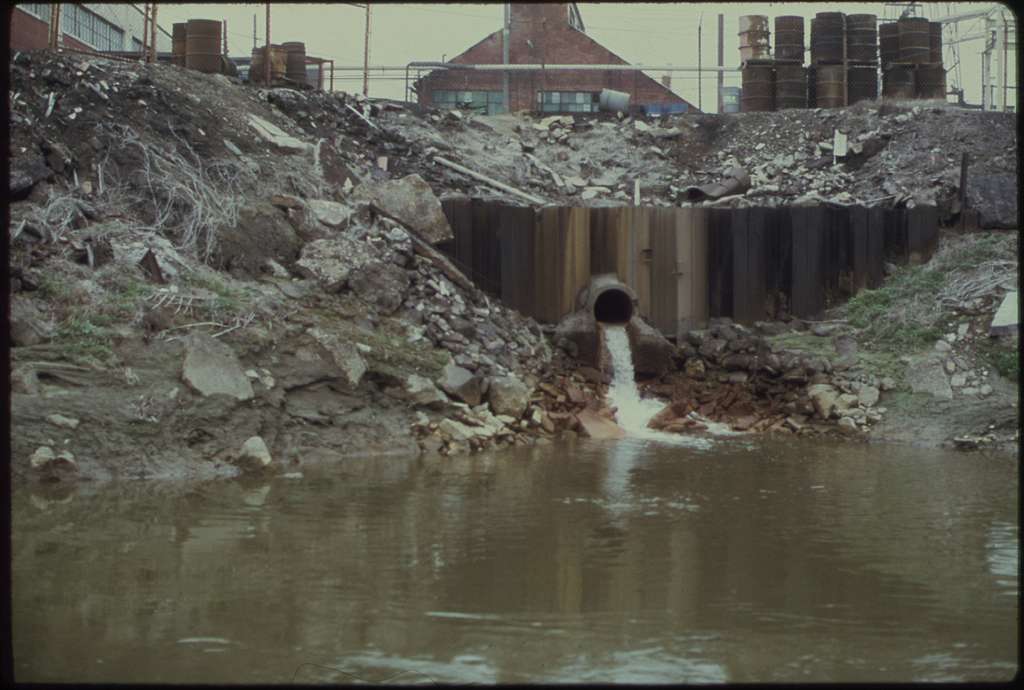
The day after the Cuyahoga caught fire for the 13th time, Carl Stokes led journalists on a tour of the polluted river, making visible what Clevelanders had endured for decades: oil slicks, chemical waste, debris, and water so degraded that fish could not survive. His efforts drew national attention, especially after Time magazine published a widely read feature characterizing the river as so polluted it “oozes rather than flows.” This national spotlight gave Stokes’ Senate testimony additional weight, illustrating that cities alone could not shoulder the burden of cleanup without meaningful federal support.
_____________________________________________________________________________________________
…most States have chosen not to aid cities in the pollution control fight.
______________________________________________________________________________________________
Carl Stokes’ testimony did more than describe Cleveland’s pollution crisis – it reframed environmental protection as an urgent national responsibility rather than a patchwork of local struggles. Stokes argued that cities like Cleveland were bearing the overwhelming financial and logistical burden of water pollution control, while states and the federal government failed to provide adequate support. His concerns reflected real structural gaps in the pre-1972 federal approach, where enforcement authority and funding mechanisms were weak or inconsistently applied. Stokes’ push for a stronger national role aligned with the broader public awakening triggered by events like the 1969 Cuyahoga River fire, which symbolized the failure of fragmented regulatory systems.
_____________________________________________________________________________________________
Under the present program…there is no relation between priorities assigned [by the States] and the areas with the greatest pollution problem…
______________________________________________________________________________________________
A central theme of his testimony was the inadequacy of relying solely on states to set pollution control priorities. Stokes argued that allowing states to assign priorities entirely on their own disconnected the cleanup effort from areas with the most severe pollution. To spotlight this paradox, Stokes contrasted his city’s recent $30 million waste treatment investment against the economically stifling building ban imposed on Cleveland by the Ohio Water Pollution Control Board, noting it was “the same State board which… has not put a dime of its own money into pollution control.” This critique echoed the pattern seen in Cleveland, where decades of industrial waste had overwhelmed the Cuyahoga while state level interventions remained insufficient.
_____________________________________________________________________________________________
…here is one place that Mr. Nixon and I happen to agree, that these pollution control facilities ought to be erected on a watershed basis.
______________________________________________________________________________________________
Since his 1968 election, President Richard Nixon had faced growing pressure to stop the environmental deterioration of farmlands and urban waterways, as well as a need to simplify the fragmented network of regulations governing both state and local entities. Stokes’ testimony noted that although Cleveland often faced scorn for the impaired condition of its Lake Erie shoreline, the city had no jurisdiction or ability to control upstream polluters – whether it be industrial waste from Akron or agricultural runoff from farm communities across the watershed’s six counties. Both men viewed comprehensive federal oversight as the most efficient way to create and enforce uniform pollution control standards for waterways that spanned state, county, and private property borders. Stokes’ call to standardize pollution control across all watershed jurisdictions anticipated major structural reforms that would later be embedded in the 1972 Clean Water Act.
_____________________________________________________________________________________________
All of this is compounded by the fact of what we are talking about: dollars.
______________________________________________________________________________________________
By connecting urban conditions to national environmental failures, Stokes played a key role in reshaping congressional expectations for what environmental legislation should accomplish. His testimony helped validate the need for federal leadership, cross jurisdictional coordination, and legislation with real enforcement authority – principles that were at the heart of the Clean Water Act of 1972. And while the Cuyahoga River fire is often remembered as the dramatic spark of the environmental movement, it was Stokes’ ability to channel that symbolism into concrete policy advocacy that made the moment transformative. As our team has previously noted, the fire alone did not change laws – but the national attention it attracted, combined with the voices of leaders like Stokes, helped generate the momentum required for sweeping reform.

Let’s Stay In Touch!
We’re hard at work for rivers and clean water. Sign up to get the most important news affecting your water and rivers delivered right to your inbox.

