

A MiddleWeb Blog
Just 18 months ago, I updated this blog post: STEM Skills Kids Will Need for Their Volatile Future. (It’s definitely worth the read.) But barely a year later, I’m back – and honestly, I didn’t expect to tackle this subject again so soon.
But here we are.
You see, the future is moving faster than I expected – driven by a game-changing technology we call artificial intelligence (AI). AI didn’t just arrive; it exploded! In less than two turns around our sun. AI has moved from an “interesting new tool” to a technology that’s literally reshaping the ways everyone on this planet will work, learn, and think.
To be sure, technology has always evolved, but today’s changes feel different. The pace is accelerating. Advances are happening in leaps instead of small steps, and each leap forward sparks and speeds up the next one.
So this time I’m asking a bigger question:
How do we prepare kids to succeed and flourish in a future that refuses to sit still?
What will the world be like when your middle schoolers graduate?

Anne Jolly
That’s an interesting conversation starter, isn’t it? Students sitting in your classroom right now will graduate in four to eight years. That’s not far away, but the world they enter will very likely look quite different from the world today, and the changes will be driven mostly by AI.
AI is already becoming a co-pilot – an invisible assistant built into their daily life. Instead of being a separate tool, AI assistants (and agents) may act more like thinking partners. In the classroom you may function more as a facilitator and guide, while your students follow personalized learning paths supported by real-time feedback.
Virtual labs, simulations, and immersive digital environments could become primary ways students learn and explore complex ideas. Meanwhile, in addition to content, teachers will prioritize helping students become proficient in teamwork, problem-solving, ethics, and collaboration. Those skills will be in high demand.
Outside of school, AI-powered devices may anticipate what people need, rather than waiting for commands. Self-driving vehicles will become more common. Health care will include wearable technology that can predict and detect early illnesses. Transformative space technology and advanced manufacturing will be reshaping the work world.
Some forecasts even predict that by 2035 the first fully 3-D printed cars will come off the production line and the first 3-D printed liver will be transplanted into a patient. And the Internet of Things (IoT) will link together about 55 billion connected devices sharing data. That’s almost triple the number connected today.
Note that many of these technologies already exist – they’re simply scaling up. By the time your middle schoolers graduate, a deep shift will be occurring in how people live, learn, work, and create. A group of 300 global technology experts canvassed in 2025 predict that people will change more in the next decade than in any other period in previous history, largely due to the rise and continuing impacts of artificial intelligence.
What does this fast-moving future mean for your STEM students?
Right in the middle of all this change sits STEM education. Workforce reports continue to warn of shortages in STEM-related fields. How will you prepare your kids for a STEM-dependent future? After all, the skills your students develop today will shape how they cope with future challenges.
Try this AI-driven scenario: Imagine a STEM classroom where students regularly work in interactive environments – spaces where technology and students (including teams) respond to each other in real time. Simulations, virtual labs, and collaborative design challenges represent ongoing experiences. Feedback is faster. Exploration is deeper.
Sound good? But consider – AI holds peril as well as promise. Along with this powerful, intrusive technology comes responsibility. To paraphrase a statement by Frank Kaufman, AI gives good people power to be better; and it gives bad people power to be worse.
That idea feels especially relevant now. The same tools that can concoct and spread misinformation can also help your students to create, innovate, collaborate, and solve real-world problems.
As a STEM teacher, you stand in a powerful position to help students think critically about bias, fairness, privacy, and ethical technology use. Students need to recognize misinformation and understand deepfakes (a dangerous weapon). They must consider issues of honesty, equity, access, and integrity with regard to digital tools. Simply teaching students traditional STEM skills won’t be enough. How today’s technology affects our future will be determined in part by how you help today’s students learn to handle it.
The biggest shift in the STEM classroom in the near future may not be the tools available; it may be the mindset. You’ll likely be moving from a classroom that simply delivers information to a classroom that helps students navigate constant change.
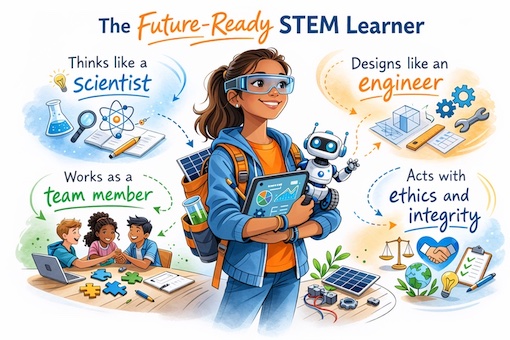
How can you prepare students to successfully navigate rapid change?
That’s an elusive question. Today’s schools are still figuring this out as they go, and teachers are learning alongside their students. Truly, your classroom represents a learning lab where curiosity, innovation, and change never stop. Think about this as you work on building a STEM classroom to prepare your students for their future.
►Teach Non-Stop Learning. I used to imagine continual learning as relaxing with a good book. Now it’s driven by quick, focused, just-in-time comprehension. Your students must understand that learning doesn’t stop when they graduate – it just changes location. Help them learn to ask good questions, use emerging technology responsibly, and continually update their current skills. In their future work world, non-stop learning will be essential.
►Build Technology Literacy and Ethics. Evolving technology will saturate their world, and your students need more than just technology know-how. They need opportunities to practice using it wisely. Check it out: Are they acting responsibly online? Do they recognize bias? Are they showing empathy? Make ethics an intentional and consistent part of your students’ everyday learning. To navigate and manage their world, they need more than technical knowledge – they need wisdom.
►Emphasize Collaboration and Human Skills. As a science and STEM teacher, one of my biggest “aha” moments came from working closely with business professionals. These leaders consistently say they want graduates who can work in teams, communicate clearly, adapt to change, and think ethically. In fact, leaders emphasize collaboration, adaptability, and teamwork more than any technical skill. As you design future-focused STEM experiences, intentionally build these competencies in each lesson. I’ve provided examples of how to build life skills, including ethics, into STEM lessons in Chapter 12 of the new edition of STEM by Design.(Download the free Design Tools for Chapter 12 here.) We need a future powered by citizens who do the right thing. AI is getting smarter. So your students need to become wiser.
►Give Students Room to Invent. Technologies like 3-D printing, AI tools, robotics, and digital design platforms aren’t just gadgets – they’re invitations to create. Are your students creating something new? Testing prototypes and revising designs? This requires time to think, learn, and collaborate. Giving them space to explore and innovate helps students shape the future.
Think About It . . .
The future isn’t waiting until this group of students graduate – it’s already moving into your classroom and your own professional life. The students sitting in your classes today will enter a world that is faster, more complex, and less predictable than ever before. You can’t hand them a roadmap for the changes ahead – but you can help them build the mindset and skills to navigate it with confidence.
When STEM learning blends innovation with empathy, critical thinking with collaboration, and technology with ethics, your students gain more than career skills. They gain higher-order survival skills. These skills can prepare them to lead, adapt, and shape an AI-driven world that is still unfolding. You can’t slow the future down – but you can help your students grow strong enough and savvy enough to meet it.
Anne Jolly began her career as a lab scientist, caught the science teaching bug and was recognized as an Alabama Teacher of the Year during her long career as a middle grades science teacher. From 2007-2014 Anne was part of an NSF-funded team that developed middle grades STEM curriculum modules and teacher PD. In 2020-2021 Anne teamed with Flight Works Alabama to develop a workforce-friendly middle school curriculum and more recently completed an elementary version.

USE THIS CODE FOR A 20% DISCOUNT: SBDMW2
Anne’s bestselling book STEM by Design: Tools and Strategies to Help Students in Grades 4–8 Solve Real-World Problems is now available in a Second Edition (Routledge/Eye on Education, 2025), with lots of new content and fresh teaching strategies. Also visit Anne’s book website, where you’ll find many free resources, including downloadable tools that support every aspect of designing a strong STEM program in your school.

