

This story is part of the Grist series Doom/Mood exploring what the rise of doomerism means for our personal lives and the prospect of climate action more broadly.
Some people spend more time than others imagining what they’ll do when the world ends. Survivalist movements have long urged adherents to focus on the details: How much food and water will you need if the power goes out? Where are the flashlights and extra batteries? What’s in your go bag? For years, this kind of forward thinking was the object of ridicule. Preppers were cast as paranoid, fixated on worst-case scenarios that would never come to pass — remember Y2K?
But six years ago, the COVID-19 pandemic made prepping go mainstream. Suddenly, everyone at the grocery store was calculating how much toilet paper, Lysol, and canned tomatoes they’d need to get through lockdown. These moments revealed the difficulty of knowing yourself in a crisis: I remember a trip to Trader Joe’s with my roommate, the day New York City’s own lockdown was announced, where I instinctively grabbed a bag of frozen meatballs despite never really liking meatballs in the first place. I bought them, and they sat untouched in my freezer for the next 12 months — when I finally made them it was out of guilt, not out of necessity.
The world is no longer in lockdown mode, but the appeal of prepping has arguably only grown. In 2024, in a national household survey, 83 percent of respondents told FEMA they had recently taken at least three disaster preparedness actions, up from 57 percent of participants the year prior. A disaster impacting one’s self or family ranked third in participants’ top worries, behind health concerns and being able to pay their bills.
It isn’t hard to understand why. News alerts now arrive daily with stories about declarations of war (sanctioned and otherwise), political and economic instabilities, and other breakdowns of public life — all against the backdrop of the worsening climate crisis. Indeed, many of us are already living through some form of disruption, in big ways or small.
In a disaster, having enough food and water for yourself and your family is essential; that’s why grocery stores stayed open during lockdown, and why restaurant workers were tasked with fulfilling GrubHub orders before vaccines were available. But food is about more than survival. The ways it sustains us are personal, layered, and hard to untangle. Even FEMA agrees: “Familiar foods are important,” a 1994 preparedness manual from the agency reads. “They lift morale and give a feeling of security in times of stress.” Readers are told to prioritize foods their family “will enjoy” that are also nutritious and non-perishable.
Building a bunker pantry — or better yet, learning to grow your own food — might come in handy even if a full-scale disaster never appears. Rising temperatures are already changing how crops are grown. Becoming even slightly more self-sufficient is useful at a time when global food supply chains are vulnerable to disruptions. Stephanie Rost, a collapsology researcher and Ph.D. student at the University of Gothenburg in Sweden, thinks that as the planet heats up, revealing cracks in our global industrialized food systems, everyone can learn from preppers. “Individuals are going to have to take more personal responsibility for their own food security and survival, much more than they do now,” said Rost.
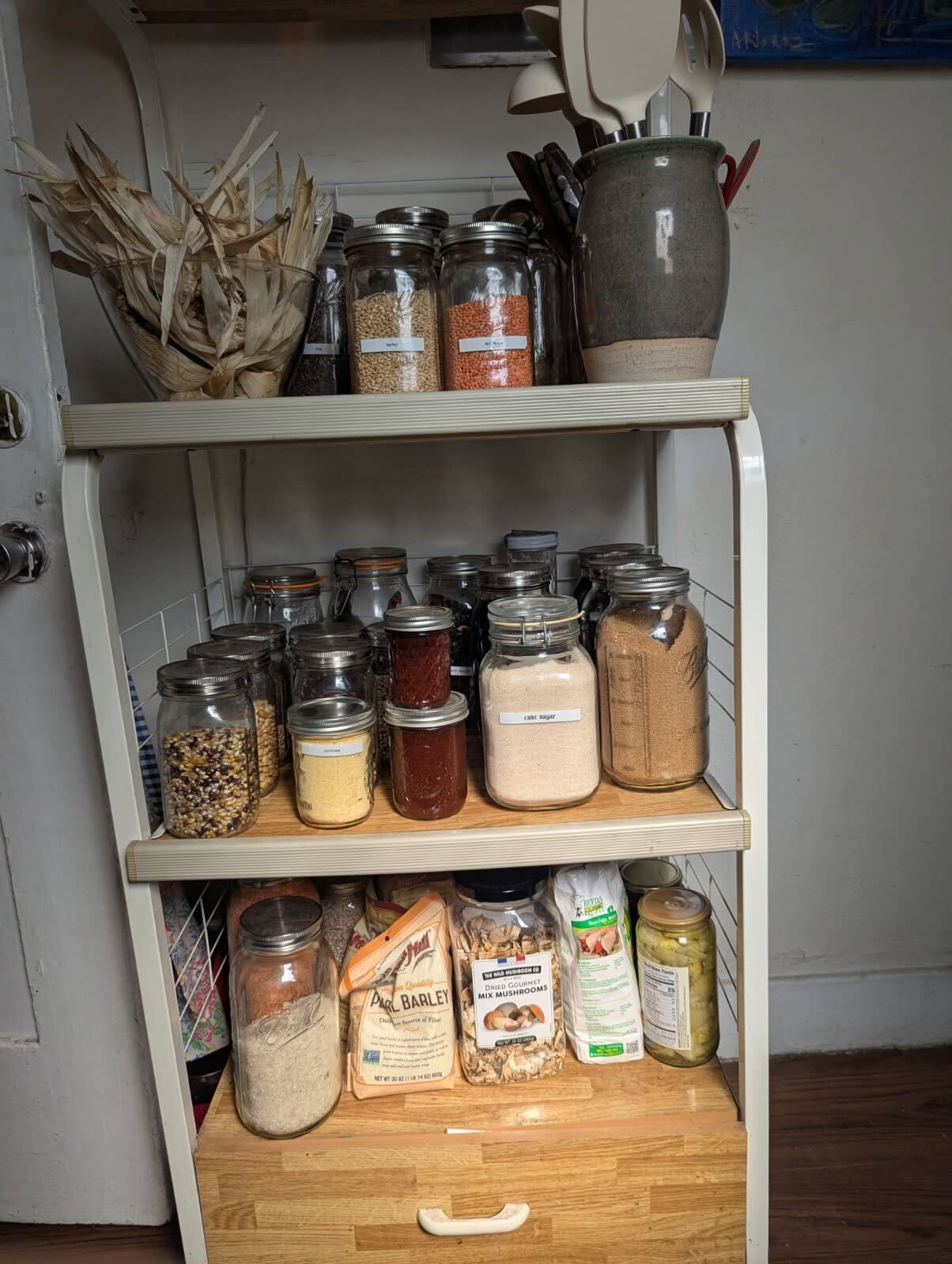
Collapsology researcher Stephanie Rost’s emergency food stores include a mix of dried staples, canned goods, and home-grown foods. Courtesy of Stephanie Rost
Finding joy in thinking the worst
If you don’t know how to begin meal-prepping for the end times, Reddit is a popular first stop. On the thread r/preppers, there are comprehensive guides on how to build up reserves of food and supplies for both short- and long-term emergencies. Posts are helpfully labeled “Prepping for Tuesday” and “Prepping for Doomsday,” so users can find advice that matches their preferred level of intensity. Common prepper pantry recommendations include staple foods like dried beans and legumes, shelf-stable grains, and additional sources of protein like canned tuna in olive oil (it’s important to have healthy fats in your doomsday diet); you also need to have bottled water on hand (ideally three days’ worth) or a way to filter water.
But if you really want to be prepared for long-term emergencies, you’re going to need more than just vitamins, fats, carbohydrates, and proteins. Even the most hardcore survivalists know that failing to include some kind of variety — or treats — in your diet is its own form of short-sightedness. The wartime prepping guidelines distributed by the Swedish government suggest keeping a stock of chocolate and fruit custard. Many posts on r/preppers acknowledge that you have to find ways of staying excited about your emergency food stores. “If you eat the same thing, over and over, you will get burnt out on it. And even if you are starving, you will not want to eat it,” wrote one user.
Another preparedness tip is to consider the comfort of food rituals. Al Nordz has been into gardening and growing fruits, herbs, and vegetables for years — they had previously lived in a very rural part of Northern California — but they didn’t get seriously into prepping until they moved to Los Angeles just before the pandemic. Nordz, who uses they/them pronouns, suddenly found themself stuck at home in a new city, so they started remediating the soil in their backyard and building raised beds. But one thing they love and couldn’t grow at home is coffee.
The solution: strategic stocking. Nordz likes to keep both instant coffee and coffee beans in their freezer for emergencies. The items don’t last forever, but if nothing bad happens, they also follow the maxim of “Eat what you prep.” Nordz and their partner dip into their food reserves during non-emergencies, too: no problem, no waste.
Coffee is not essential, and Nordz knows that. It isn’t “something that’s going to be the difference between getting enough calories for your body to function or not,” they said. “But it is something that makes us feel good.” After all, they and their partner drink it every day.
Nordz’s disclaimer gets to a point that frequently comes up in Rost’s research on societal collapse: Luck favors the prepared, but planning doesn’t guarantee anything. No matter how much prepping you do, you never truly know exactly how or when disaster will occur. Even the most diligent prepper will have to adjust their routines in a completely transformed world. Will there even be time to make coffee in an emergency? When shit hits the fan — or as r/preppers users like to say, SHTF — you just have to make do.
And yet, accounts from people who have already lived through crises suggest that reclaiming small moments of comfort can be a way of asserting dignity rather than denying one’s reality. During war and famine, people have found ways to mark holidays, sweeten bitter food, or recreate familiar flavors with limited ingredients. Last year, I found myself watching social media videos from Gaza in which an 11-year-old girl named Renad Attallah shared what she called “war-time recipes”: bread and chips out of dried macaroni, labneh with powdered milk. She smiled as she cooked, narrating each step. The videos were not escapist. They were instructional, defiant, and quietly human.
The problem with comfort foods or treats like coffee, chocolate, and candy is that they don’t last forever. But some of these constraints can be negotiated creatively. Cocoa powder can last for years after opening if stored in airtight containers. “If you can store the cocoa and the sugar,” Rost said, “I’m sure you can make yourself something chocolatey and sweet” in a pinch.
To endure prolonged uncertainty, you will also probably need to change your disposition. Rost argues it may be necessary to relearn how to experience ordinary food as precious. Fruit can be dessert if you want it to be. “I think we’d probably need to get back to thinking of those things as really special,” she said. “And maybe they would taste really nice if we hadn’t had anything else nice around.”
Planting for adaptation
Rather than rely on existing food systems, some preppers choose to go all in on cultivating food sources that can still function without, say, grocery stores or global trade routes.
Scout Cardinal lives with their partner and toddler in rural Appalachia and has grown vegetables in their home garden for years. Last year, Cardinal, who uses they and she pronouns, grew hearty staples like squash and beans — foods that are both nutritious and have a long shelf life. Some of these veggies, like their homegrown tomatoes, get given away to neighbors or canned and stored to make them last even longer. But Cardinal also decided to plant something fun: Aleppo peppers and Korean red chili peppers, the kind that are used to make gochugaru, a sweet, smoky chili powder.
“These are two of the spices we use most in our cooking at home,” they said.
Homemade dried spices may be a small luxury, but for Cardinal, they honor an adage within the prepper community: Prep the things you already eat. (This advice would have been useful to me the day I sprang for Italian-style Trader Joe’s meatballs I then ignored for a year.)
Keeping a garden — whether you’re prepping for doomsday or not — can also be helpful in an era of climate change. Growing crops like strawberries and melons in your backyard can attract pollinators like bees and butterflies. Planting native grasses and other plants, while also removing invasive plants around your home, can help reduce the impact of invasive species on the local environment. Plus, taking care of even one seedling, whether it’s on a windowsill or in the ground, is a reminder of the sheer amount of work it takes farmers to produce the foods we eat at scale. That reminder might help us waste less food — a worthy aim since wasted food is responsible for 8 to 10 percent of global carbon emissions.
Cardinal identifies as something of a reluctant prepper. “For a very long time, I think I allowed myself to be convinced that my desire to be prepping was a little bit of an irrational anxiety response” to the changing climate, said Cardinal. “And that’s just not true.”
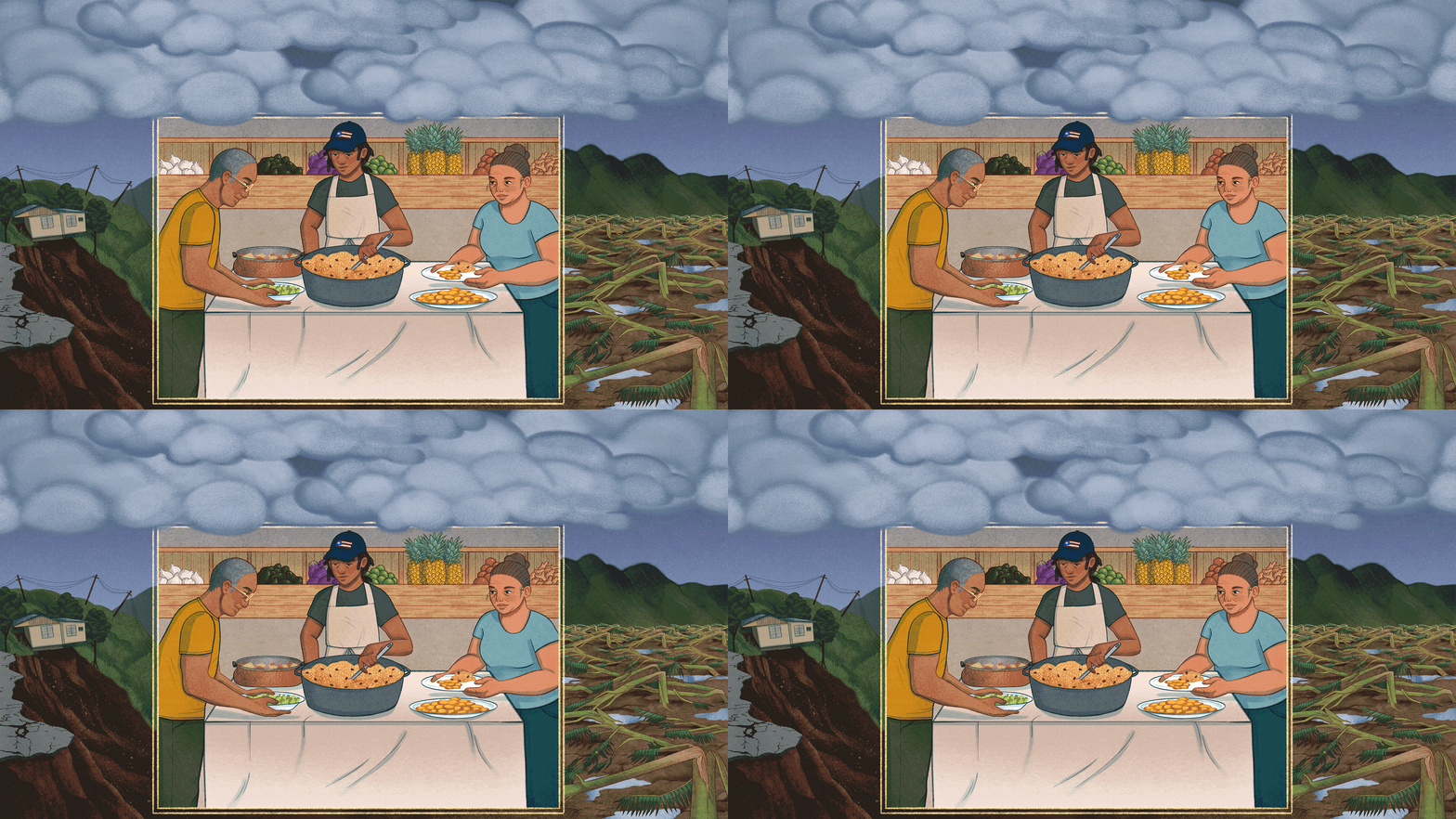
Cardinal has already seen up close how natural disasters have exacerbated food insecurity in their community. During the pandemic, they joined Lonesome Pine Mutual Aid, a community organization based in Big Stone Gap, Virginia. During that time, the group focused on food distribution, hosting free community meals and giving away groceries and hygiene products. But recently, the group has begun to shift its focus to disaster relief and preparedness, after seeing how bouts of extreme weather have battered nearby communities.
In February last year, just a few months after Hurricane Helene, Lonesome Pine hosted an event focused on disaster preparedness: Attendees received go bags with hand-crank radios and learned how to forage edible plants and filter water. They also took home pantry staples, like dried rice and beans. The goal of the event was not just to give things away, but to start talking as a community about how they can come together and help take care of one another through difficult times, said Cardinal.
“We’ve been talking a lot as a group about the need for long-term disaster preparedness, because it’s very clear by the prevalence and regularity of these events that they’re not going to stop happening,” said Cardinal.
Cardinal loves vegetable gardening — the sensory experience of it, the way it naturally helps others. “It’s somebody else’s job to have guns,” they said. “I’m really good at growing food.” They also like working with fiber and textiles, another hobby that’s both enjoyable and could come in handy if disaster strikes. “That’s my goal as far as preparedness goes,” they said. “How can I use this thing that I do for fun, that I do for myself, in a way that makes our community more resilient?”

