

By Frank W. Baker
As I write this, United States and Israel have jointly started a conflict in the Middle East, aimed at Iran, which may end up being long and protracted. The media are already filled with breaking reports and analysis. The U.S. administration is also hinting at other military incursions, including Cuba.
At times like this many adults turn to news sources to stay informed. Our students do too. Finding reliable sources – especially when there is “breaking news” – is always important. And with the advent of AI-generated images and video, critical thinking and media literacy skills become more important than ever.
The website TechWorm recently posted its list of the top 10 unbiased news sources:

We could debate their choices, of course. But it’s pretty obvious to educators that most students do NOT get THEIR news from any of these sites. Today’s teens and tweens rely mostly on social media. Let’s first consider WHERE students get their news, and then I’ll offer some valuable resources for following current events in this era of deepfakes, conspiracy theories, sensationalism and disinformation.
Students seldom visit news sites
The World Press Institute, among others, has found that more than half of students use TikTok, Instagram and X (formerly Twitter) as their dominant and fastest “news” sources. According to WPI, “almost all of them said they do not go directly to the news websites or rely on television as the source of information.”
Experts have said previously that getting news from social media is problematic. Why? Because most of the “news” reported on these sites, is not sourced – in other words, the reader has no clue as to where it originated. A 2022 report from media watchdog Ofcom found that only 11% of 11 to 17 year olds could reliably recognize the signs that indicated a post was genuine. (Source)
Students report they often do not actively seek out sources of information, relying instead on algorithmic feeds, influencers, and celebrity posts. Only about 15% of teens intentionally look for the original source of news, while 50% consume it passively, and a third often miss updates and corrections. (Pew Research: News Audience Demographics)
Speed and ease of access do not necessarily translate to accuracy. Students who depend on social media may not be aware that many news posts they see are simply reposts or reprocessed content, taken (often without permission) from somewhere else – or opinion offered as “fact.” Anyone can post something as “news.” Students need to stop and ask those critical thinking and media literacy questions which are valuable anytime and which all schools need to be teaching.
Right now, students are seeing dramatic images and video allegedly from the Mideast conflict. Without critical thinking/media literacy skills, they may just assume what they are seeing is authentic. That’s the problem. Bad actors take advantage of “breaking news” to manipulate imagery and share it so that it spreads like wildfire – while they gather clicks, sow distrust, or revel in the attention they get.
On my Facebook page, I have recently posted several stories which debunk misleading images and video. For example:
Debunking AI fake images and disinformation about Middle East conflict (BBC Verify)
Disinformation exaggerates Iran’s military successes against US and Israel (France24)
Did the Iranians release footage of their soldiers being blown up by Israeli strikes – and if so, why? (The Jewish Chronicle)

BBC Verify regularly examines images for authenticity (click to read)
What are ‘trusted sources’?
As of early 2026, the most trusted news sources continue to be established wire services and public broadcasters known for nonpartisan, factual reporting, including the Associated Press (AP), Reuters, BBC News, and NPR. These outlets are widely recognized for minimizing bias and prioritizing accuracy in global coverage.
Of course there’s no shortage of news sources in the USA. Many Americans rely not only on the traditional morning and evening network news shows (ABC, CBS, FOX and NBC) but on cable news channels like CNN, FOX News, and MS NOW (previously MSNBC). More recently, we’re seeing the rise of “over the top” (OTT) streaming media services dedicated to news content (Fox One, CNN Max, NBC News Now, Sky News, etc.) And let’s not overlook YouTube, which is rife with news-oriented channels, plenty of which are fake, though some are not.
Many of these network, cable, and streaming news sources provide a mix of news reports and commentary. As you encourage students to give more attention to authentic news sources, helping them draw a distinction between information gathered by reporters and the opinion and analysis provided by news hosts and guest “experts” is an important part of media literacy education. Once again, the core questions recommended by media literacy advocates can help.
News coverage from abroad
One important aspect of news and media literacy is perspective. I would encourage you to give your students opportunities to view the news from the perspective of other nations. The PBS Newshour regularly includes news segments from its partner International Television News (ITN), based in Great Britain.
For other international perspectives, many of us have access to networks such as the British Broadcasting Corporation (BBC), RT (Russia), SKY (Britain), and NHK (Japan) via our cable/satellite systems. Al Jazeera (based in Doha) streams its news live as does Euronews. And I recently discovered (on my DirecTV service) i24 – a Israeli-based news service. A free live stream in English is also available on their official website and YouTube.
The history of war reporting
Check with your school librarian to determine if they have access to books on the history of war reporting, war documentary photography, or memoirs/biographies of notable war journalists. Obviously reporters and photographers put their lives on the line when they go into war-torn areas. A good question for students to consider is: what are the challenges for reporters in covering war and conflict?
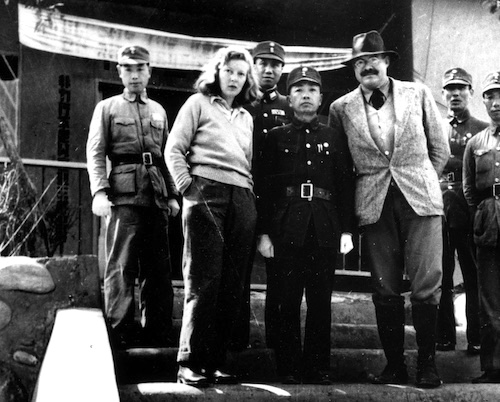
Famed war journalist Martha Gellhorn and husband Ernest Hemingway reported across the globe during WWII, occasionally together. (Wikipedia)
During World War II, CBS journalist Edward R. Murrow, stationed in London, reported live from rooftops as German planes dropped bombs on the city. Your students could read about his broadcasts and listen to one of his reports. Defying the gender barriers of the time, Martha Gellhorn was one of the great war journalists of the mid-20th century – hiding away on a hospital ship during the invasion of Normandy (after being denied credentials) and reporting while she served as a stretcher bearer after D-Day.
With the advent of satellite communications in the early 1960s, vivid same-day television news reporting provided dramatic coverage of the Vietnam War and eventually began to shift national opinion about its necessity. Documentary filmmakers Ken Burns and Lynn Novick’s Vietnam War PBS series offers tremendous insights about war and journalism during the rise of mass communications.
Questioning sources of news information
Students who will be following the news should also be given opportunities to question the reliability of their sources. (This becomes quite clear when we realize that many students have joined adults in forwarding “fake news” via favorite social media networks.) Students should consider who is conveying the information and should listen, watch or read a variety of news sources to get a better perspective.
More than likely, they will hear the word “propaganda” from news sources. Now would be a good time to review what that word means and how propaganda has been used in the recent past.
Students would be wise to pay attention to the words and phrases news groups use to describe the action. I found this news story to be particularly helpful: From ‘preemptive’ strikes to claims of thousands of targets hit, pay attention to how the language shapes the story (Poynter.org).
President Trump has hinted that American “boots on the ground” may be a possibility in Iran. When war breaks out that involves U.S. forces, we can be sure that American reporters, working with the Defense Department, will attempt to be embedded with troops in order to be able to report from as close to the action as possible. This practice became popular during the 2003 invasion of Iraq.
Surveillance or reconnaissance satellites often provide images of conflict areas. In the weeks preceding the conflict, the US government regularly released such images to show the world evidence of an what Iran was doing with its nuclear program. (Example)
A good time to teach geo-literacy
Could your students pick out Iran on an unlabeled map of that region of the world? A recent survey found that only 23% of registered American voters could correctly identify Iran on a blank world map. (it’s twice the size of Texas and the 17th largest country in the world).
How much do your students know about the geopolitics of the region? Now might be a good time to pull up your favorite map and familiarize students with the area.
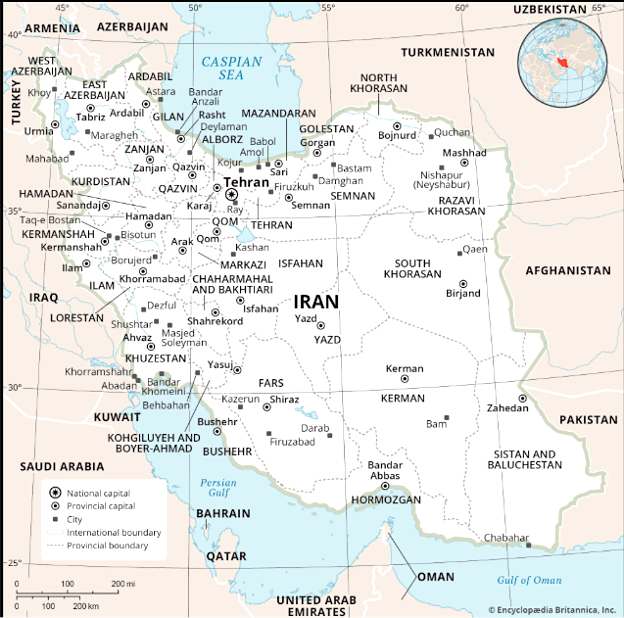
Reuters, the international news service, also offers readers a wealth of visual information, via charts and maps, about the international conflict. See Maps & Charts of the Iran Crisis.
The importance of fact-checking
A recent research study examined the ability of a group of high school students to fact-check war information, specifically war photos, and considered “the pitfalls of overconfidence in education against disinformation.”
The researchers noted that, as they follow war news, students have to navigate a high volume of digital, often misleading, content. Fact-checking develops critical thinking, prevents the spread of misinformation, and fosters media literacy. It’s also vital for responsible citizenship and crucial for “navigating modern digital landscapes.”
Here’s one lesson idea
Have students analyze and interpret a set of editorial cartoons about tensions between Iran, Israel and the United States (or other nations generally). After some review of the current political context (for example, U.S. sanctions vs. military action) and some general discussion about where/how editorial cartoons are used, form small discussion groups and give each group two cartoons, perhaps choosing two different political perspectives.
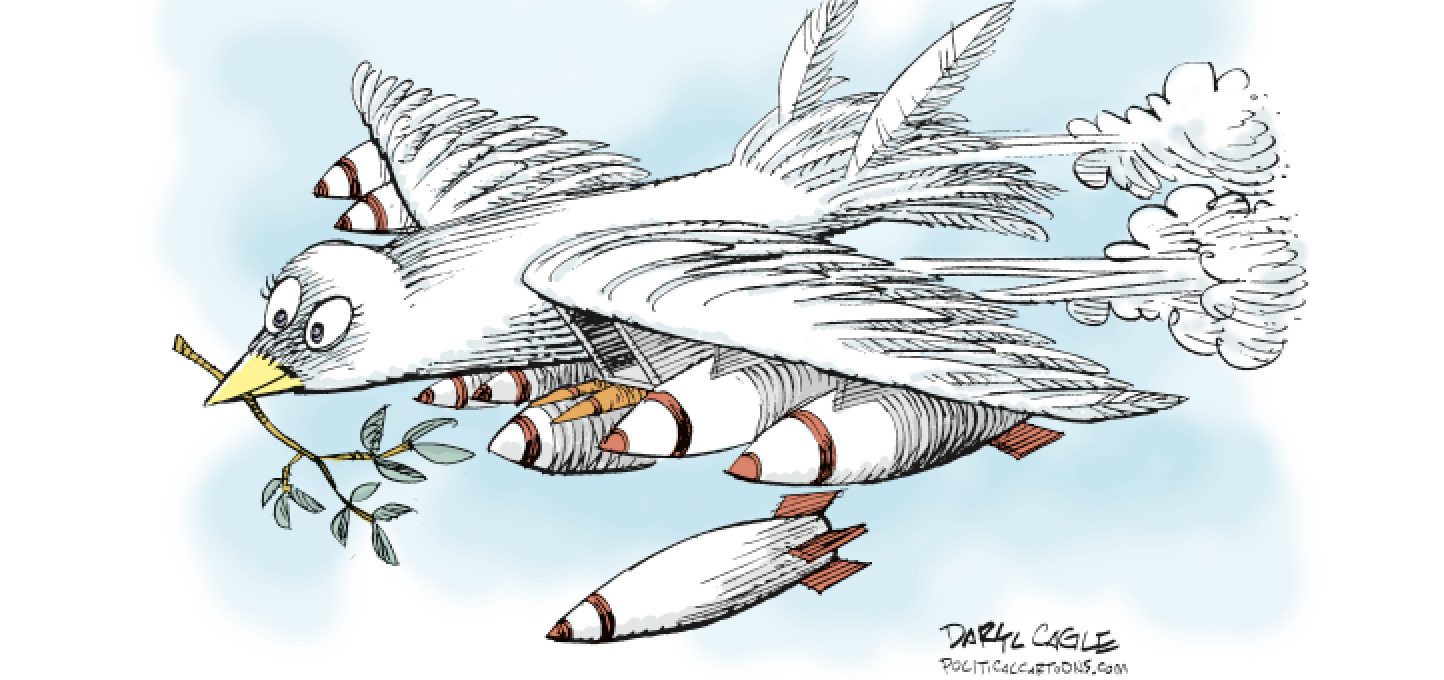
Have students answer questions like: What characters and objects are shown in the cartoon? What words are used? What political issue is being addressed? How are symbols used to represent people, places or things? What message do you think the cartoonist wants to convey? Then have them share the results of their analysis with the whole class.

Cagle Cartoons is a co-op website which shares and licenses editorial cartoons from all over the world, with many different “political leanings.” In addition, cartoonist Daryl Cagle produces a weekly Top 10 list and daily cartoons of his own, which he often analyzes – a real plus for teachers and students. Using cartoons in class for educational purposes, including boosting Gen Alpha/Z students’ appreciation of this unique form of journalism, is fair use.
Additional Teen/Tween News Sources
New York Times Learning Network: Current Events
NYT-sourced news written for adolescent audience; lesson plans.
Best News Sources For Kids
Common Sense Media
6 Top News Sites for Kids & Teens
A public service of the PR Newswire
News For Kids
Created by a teacher for K-6 kids
Teen Kids News
Important topics; less current news
What Do We Know about TikTok?
The New York Times reports regularly on TikTok’s fads and impact.
Of special mention here is CNN-10 – the daily 10 minute newscast produced specifically for middle and high school students. It’s free for educators (and everyone). Here’s a recent example, from March 6th, focusing on the Iran conflict.
 Frank W. Baker, a former broadcast journalist, writes and consults regularly about media literacy education.
Frank has been recognized for his many contributions to media literacy. In 2019 UNESCO honored him with the Global Partnership Alliance for Media & Information Literacy award for his lifelong work. And in 2025 he received the Elizabeth Thoman Service Award for life achievements from the National Association for Media Literacy Education (NAMLE). I
In 2026, Frank was honored with the Anne Frank Award for Leadership in Arts & Letters for his efforts in telling the Holocaust story of two young Polish Jews in the graphic novel We Survived the Holocaust. See his MiddleWeb article to learn more.
For more than a decade, Frank has contributed articles and blogs to MiddleWeb about media literacy. He is also the author of Close Reading The Media – a publishing collaboration between MiddleWeb and Routledge/Eye On Education. He can be reached at fbaker1346@gmail.com. Visit his extensive media literacy website here.

