

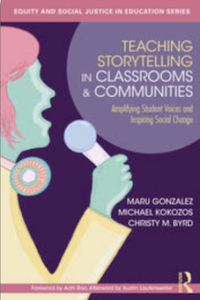
Teaching Storytelling in Classrooms & Communities: Amplifying Student Voices and Inspiring Social Change
By Maru Gonzalez, Michael Kokozos and Christy M. Byrd
(Routledge, 2025 – Learn more)
Reviewed by Melinda Stewart
Maru Gonzalez, Michael Kokozos, and Christy M. Byrd have done more than write a book. Teaching Storytelling in Classrooms and Communities offers us an inspiring and transformative vision for reimagining education through the power of student narratives.
This volume, from Routledge’s Equity and Social Justice in Education Series, is grounded in social justice pedagogy and offers educators both the tools and the philosophical framework to make storytelling a transformative force in schools and community spaces.
It also invites educators to rethink traditional approaches and embrace the potential of storytelling to amplify marginalized voices and foster systemic change.
Broadening Literary Boundaries
 At its core, Teaching Storytelling in Classrooms and Communities asserts that storytelling is much more than a creative or literacy activity. It is an essential way for students, particularly those from historically marginalized groups, to explore their identities, process their lived experiences, and take action against inequity.
Gonzalez, Kokozos, and Byrd draw from a rich array of theoretical foundations including critical pedagogy, Critical Positive Youth Development, and culturally sustaining teaching to show how storytelling serves as a means of reclaiming agency. It is a process that both empowers students and strengthens the bonds within communities.
I greatly appreciated the authors’ emphasis on valuing community, building community and belonging in the classroom, and extending the perspectives and skills beyond the classroom walls. The authors argue that storytelling has the power to break down barriers between school and society, creating opportunities for collaboration between students, teachers, families, and local organizations.
By situating storytelling as an interactive, relational practice, they encourage the creation of spaces that are deeply personal, political, and inclusive. This approach redefines the role of educators as facilitators of dialogue, critical reflection, and action.
Real-world Resources
Each chapter of Teaching Storytelling in Classrooms and Communities is infused with classroom strategies, real-world examples, and poignant student stories that bring the book’s philosophy to life. These stories demonstrate how storytelling can move beyond the classroom as a form of self-expression, acting instead as a powerful vehicle for social change.
The authors challenge the conventional view of education as a one-way transmission of knowledge and instead proposes a model where students’ voices take center stage in shaping both the curriculum and the broader narrative of their communities.
This book offers a refreshing perspective that challenges the limitations of standardized curricula and assessment-driven instruction. Gonzalez, Kokozos and Byrd invite educators to reconsider how they view student involvement, moving from seeing them as passive recipients of knowledge to active participants in their own education. It’s a call to engage with students’ lived experiences, to embrace their diverse perspectives, and to create spaces where all voices are heard and validated.
Elevating Students’ Reality
I found myself reflecting deeply on the school system while reading this book. It speaks to the ways that teachers and traditional educational structures can often silence or marginalize student voices by elevating certain perspectives and values.
More importantly however, Teaching Storytelling in Classrooms and Communities offers a hopeful, practical vision for how we can reshape our classrooms into spaces of healing, resistance, and solidarity through storytelling. It’s about transforming the way we view education itself, by grounding it in empathy, respect, and the potential of young voices.
Teaching Storytelling in Classrooms and Communities is an invitation to listen deeply, teach ethically, and learn with courage. It calls on educators to trust in the power of student narratives and to create learning environments where stories become a launching pad for critical reflection, social change, and community-building.
Melinda Stewart has been an educator for 30 years. She has an MA in Teaching, Education and Learning and has done graduate work in the areas of English as a Second Language, Reading, Spanish, and most recently English Language Arts. She is currently working as a Spanish teacher at Fairmont Junior Senior High School. Melinda is an MEA and AFT professional development facilitator and trainer who has a deep passion for learning and equity.

