

By Kathleen Palmieri
 As an avid reader of professional texts focused on project-based learning and instructional design, I naturally gravitate toward math practices. Works such as Math-ish by Dr. Jo Boaler, Developing Mathematical Reasoning by Pamela Weber Harris, and most recently, Building Thinking Classrooms in Mathematics by Peter Liljedahl, have fundamentally shifted how I teach and, more importantly, how my students learn.
This shift is deeply personal. As a child, I struggled with math and lacked confidence in my abilities throughout my school years. It wasn’t until college that I discovered the joy of exploring numbers and collaborative problem-solving.
Now, as a fifth-grade educator, my mission is to ensure my students leave my classroom feeling confident, collaborative, and equipped to build upon their mathematical knowledge in the years to come.
Gathering insights
This school year, I am taking part in a book study focused on Peter Liljedahl’s book Building Thinking Classrooms in Mathematics Grade K-12. Liljedahl writes, “Learning is not about filling students with knowledge; it is about mobilizing the knowledge they already have. The smartest person in the room is the room. The knowledge you need students to learn is already in the room. We just need to get it moving – we need to mobilize it.” (p. 211)
This was so inspiring and motivating as it helped me realize that collective intelligence is the most powerful resource available.
I took a deep dive into what I had been doing in my classroom and flipped the stage to create a “Thinking Classroom” for my students. I sat down and brain-dumped what I had learned from Pamela Weber Harris and Dr. Jo Boaler, with my new insights from Peter Liljedahl. I worked from the central theme of all of these math leaders, who emphasize that a student-centered classroom is one where students are treated as mathematicians and build their own understanding.
The concept of all three is foundational throughout their texts, which is that emphasis must be placed on students as “makers of mathematics,” not mimickers – something Harris detailed on page 14 in Developing Mathematical Reasoning.
From theory to practice
So, how did I put this into practice? I ordered five vertical non-permanent surfaces (VNPS) – in simpler terms, large student whiteboards – as suggested by Liljedahl. Using dry-erase markers was engaging and less intimidating for my students. Standing versus sitting created a space where all learners in the group were alert and active in the discussion.
I give each member of a group a different colored dry-erase marker so that each could write their name in the upper left corner of the board. Liljedahl suggests one marker per group of three to ensure collaboration, but I use colored markers to inspire each student to help their ideas, questions, or work stand out. It also signals to me who is engaged or being included in the math discussion. No one student is in charge and collaboration is a must.
The groups are randomly created, so all students know I believe they are all capable. I give an initial task and students write it at the top of their board. This is where I tap into Dr. Jo Boaler’s “You-Cubed Thinking Tasks.” Students worked together to discuss strategies, thoughts, and how to solve problems.
As I walk around, I listen in and when asked, “Is this right?” I praise the group’s collaboration and give a hint with a smile as I walk away. This instills in the students that I know they can do it.
If I notice that one group has come up with a correct answer and another has an incorrect answer, (without acknowledging which is which) I have the groups come together to share their work. This is such an authentic learning experience as the math discussion is engaging and lively. Both groups gain new knowledge they can build upon.
Experimenting with problem strings
I also use Harris’s “Problem Strings” as a thinking task for my 5th-grade students. On page 180 of Developing Mathematical Reasoning, Harris defines the purpose of these strings:
“A Problem String is a purposefully sequenced set of related problems designed to help students construct mathematical relationships and organize their thinking. The goal of a string is not to get an answer to each problem; the goal is for students to discover a strategy and use it on the next, more difficult problem.”
While I first used problem strings as traditional lessons, I later adapted them to align with the Thinking Classroom approach. The example provided in Harris’s book started with 2400 ÷ 24.
Students responded with the correct answer of 100, “with the reasoning that when multiplying by 100, the answer will be the original number ‘bumped up by two place values’.”
Next, the students drew a table on their board which emphasized the scaling of 1 to 100 and 24 to 2400 as ‘x 100’.” As they progressed through this Problem String the students worked from the “helper problem of 2400÷24” to move to the next problem of 1200÷24, 1800÷24, 1848÷24, etc. (pp. 96-102)
What ensues is an engaging math activity with students actively dividing using their reasoning, what they notice about the numbers, and what they know as math students. The math discussions are phenomenal!
Here is a number string I created in Canva if you’d like to try this with your class.
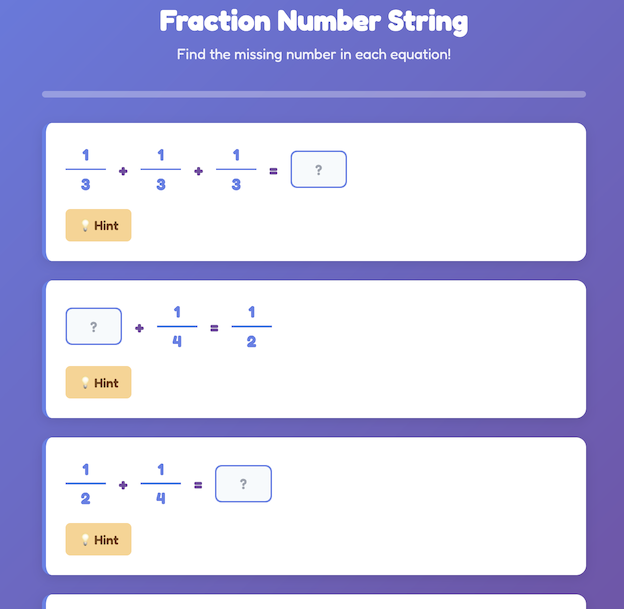 Click to see the complete string
Learning from the masters
Learning and implementing the wisdom of math leaders such as Boaler, Harris, and Liljedahl is exciting for me as an educator and helps bring out reasoning and math confidence in my students.
Best of all: Literally building a thinking classroom has my kids asking to do more math!
I’ll end with this quote that I find inspiring: “A lot of scientific evidence suggests that the difference between those who succeed and those who don’t is not the brains they were born with, but their approach to life, the messages they receive about their potential, and the opportunities they have to learn.” — Jo Boaler, Mathematical Mindsets: Unleashing Students’ Potential through Creative Math, Inspiring Messages and Innovative Teaching
Resources:
My book reviews:
Developing Mathematical Reasoning by Pamela Weber Harris
Math-ish by Jo Boaler
Websites:
My recent article:
Bringing a Lab Mindset to Group Work in Math
Kathleen Palmieri is a National Board Certified Teacher, NBCT Professional Learning facilitator and education writer. She is a fifth-grade educator in upstate New York who reviews and writes regularly for MiddleWeb. With a passion for literacy and learning in the classroom, she participates in various writing workshops, curriculum writing endeavors, and math presentations.
As a lifelong learner, Kathie is an avid reader and researcher of educational practices and techniques. Follow her at Bluesky @kathleenpalmieri.bsky.social. And learn more about her education adventures at www.kathleenpalmieri.com.

