

April 19, 2026 In the weeks since Paul Ehrlich’s passing away, there have been many articles about the change that have occurred since his publication of the Population Bomb, where he warned about trends in risk of famine in India.
Indeed, one of the greatest stories in human history of overcoming food insecurity and famine has been India over the last 50 years. Not only has India grown in terms of food production, but it has diversified its economy, built infrastructure, and increased its GNP, which also supports improvements in long-term resilience. In the 1990s, India turned away the food assistance provided in large quantities by the US Government’s Food for Peace, and India became itself a food aid donor to other countries.
In the late 1960s, India began intensively experimenting with ways to improve yields of key food crops, particularly wheat. A few Indian scientists played an historic, important role in feeding this country which today has more people than any other. The most important was M.S. Swaminathan, an unassuming man who, in his own gentle way, revolutionized India’s agricultural sector.
Swaminathan started out in 1947 working on plant breeding at the Indian Agricultural Research Institute (IARI) in New Delhi. Swaminathan collaborated with US plant breeder Norman Borlaug touring India, breeding Mexican wheat with Japanese varieties. This new crop produced high yields of good quality. In 1964 he earned funds to plant demonstration plots which convinced Indian farmers to experiment with its ue. Further experimentation led to wheat varieties which by 1968 increased wheat production to 17 million tons.
Swaminathan’s lifelong commitment to transparency pushed him to establish various systems of accountability of the institutions he headed; therefore, he placed the entire international rice collection under the supervision of an international rice board even though it was already a part of IRRI, an internationally supervised institute for rice research in the Philippines. Swaminathan would never tire of crediting that the seeds of the green revolution in India were actually sown far back in 1949 in the fields of the Central Rice Research Institute in Cuttack, India long before Norman Borlaug came to India. Working with the UN’s Food and Agriculture Organization, he established a commission for plant-based genetic resources to address issues related to the conservation and sustainable use of genetic resources for food and agriculture. This included plants,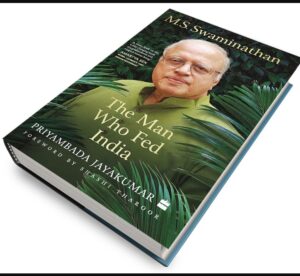 animals, and aquatic organisms. The commission’s focus was on the management of biodiversity. In the 1980s, Swaminathan led, as Director General, the International Rice Research Institute (IRRI). Here he shone as a brilliant and dedicated scientist, an excellent leader, and kind-hearted. Despite occasional setbacks, he persevered in promoting international cooperation in the utilization and conservation of genetic resources. His vision extended beyond yield per hectare. He was a prophet of sustainability long before it became a buzzword of the 21st century. From championing greater participation of women in agriculture to espousing ecological balance, from advancing research in Russian attics to promoting sustainable coastal farming, from advocating for tribal food security to establishing gene banks for endangered crops, his canvas was vast, and his brush precise. Swami Nathan was generous and humane, embodying the best and noblest of the India into which he was born and by which he was shaped.
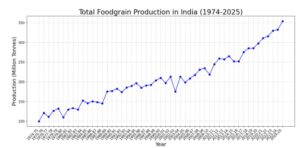
As shown in the graph at right, food production in India has more than kept pace with population growth due to ongoing improvements in applications of scientific methods. In these same last fifty years, India’s population hasalmost tripled, from 520,000,000 to about 1.5 billion today.
India’s agricultural geography has shifted from a northwest “Green Revolution core” (1970s) to a much more broad-based and increasingly central/eastern growth pattern (last decade). In the 1970s, increases in production were largely in the Punjab, Haryana, and Western Uttar Pradesh. More recently, Indian States with the strongest increases in food production:
-
- * Madhya Pradesh – often cited as India’s fastest-growing agricultural state in the 2010s
- * Chhattisgarh – rapid expansion in rice production and procurement
- * Jharkhand – gains from irrigation and diversification
- * Bihar & Eastern Uttar Pradesh – improvements in rice, maize, and horticulture.
The elimination of famine has not meant that there is no malnutrition in India. Fifty years ago half of children were stunted (low height per age) from undernutrition, while today 1 in three are.
Meanwhile, rate of wasting malnutrition (as measured by weight for height) has remained stubbornly high over the last 50% years, by many estimates stuck in the range of 17-18%.
The government’s most current estimate for the national prevalence of wasting (low weight for height) among children under five in India for 2025 is estimated the 5.4% though estimates from prior years are closer to 18% among children. Wasting malnutrition also varies across different areas. For instance, the Union Territory of Lakshadweep reported the highest wasting rate at 11.6%, followed by Bihar (9.31%) and Madhya Pradesh (8.2%).
Much of the growth of production in India has been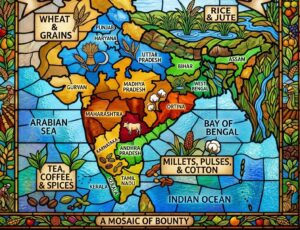 facilitated by increases in application of synthetic fertilizers. This is relevant today because, as reported yesterday, India’s food economy is seriously dependent upon fertilizers from the Middle East that are now blockaded and will be increasingly expensive, which may challenge food production in India this year.
Read more: M.S. Swaminathan in conversation with Nitya Rao: The Ethics and Politics of Science, M.S. Swaminathan Research Foundation Centre for Research on Sustainable Agriculture and Rural Development, 2014.
Charles C. Mann, The Wizard and the Prophet: Two Remarkable Scientists and Their Dueling Visions to Shape Tomorrow’s World (New York: Alfred A. Knopf Inc., 2018).
Priyambada Jayakumar, M S Swaminathan: The Man Who Fed India, HarperCollins India, September 10, 2025

