

Kim Booker never thought much about lead during her roughly 27 years living in Trenton, New Jersey. Born and raised in the once-industrial powerhouse, she first heard about the heavy metal at community meetings organized by the East Trenton Collaborative, a local nonprofit that works on environmental health and safety issues. There, she learned that the prevalence of lead-laden pipes and paint, a legacy of the city’s industrial past, could have contaminated the drinking water in her home and the soil around her property.
She knew that her three-bedroom home was old, making it likely it had lead pipes. Booker noticed the paint on the walls chipping off. And she realized, too, that her late grandmother and sister were both diagnosed with Alzheimer’s, which researchers have tied to lead exposure. She wanted to know if she was being poisoned by the lead in her environment.
With few free, comprehensive testing resources available to her, Booker turned to Shereyl Snider, one of the leaders of the collaborative, who in turn connected her with Sean Stratton, a doctoral student in public health at Rutgers University in late 2023. At the time, he was taking samples of lead to get a clear picture of how lead had contaminated Trenton homes for his dissertation work. Once Booker agreed, Stratton was soon at her home, testing for lead in her paint, yard, and water.
Anna Mattson
When the results came back, Booker learned that her home was — as she’d suspected — contaminated with lead and that she had low but detectable levels of lead in her bloodstream. Stratton’s testing revealed that lead levels in her yard were more than 450 parts per million, above the Environmental Protection Agency’s hazard level. If not for Stratton, she would not have known.
“The city shouldn’t rely on a student to do this work,” Stratton said.
Comprehensive lead testing of the kind that Stratton provided costs upwards of $1,000. Over the past two years, Stratton has tested the soil, water, or paint in more than 140 Trenton homes and has been assembling the clearest, most cohesive picture yet of a crisis that permeates the state. Last July, the EPA added the entire neighborhood of East Trenton to the Superfund National Priorities List after testing found widespread soil contamination in residential yards, schools, and parks. Despite the designation, there has been no comprehensive door-to-door testing effort, leaving residents like Booker to rely on Stratton.
But Stratton’s project is coming to a close. He defended his dissertation in February and will graduate in May, leaving uncertain who — if anyone — will continue the work. Community groups like East Trenton Collaborative worry the neighborhood could lose its only accessible source of household testing.
“We don’t want to stop working together,” Snider said. “I don’t see it ending, but I don’t know how we can continue unless we have big supporters to help support our future endeavors together.”
New Jersey has some of the highest legacy lead burdens in the country. The state has an estimated 350,000 lead service lines — placing it among the top 10 states, behind Illinois and Texas. It has received more than $100 million in federal funds for lead pipe replacements, but it doesn’t address legacy soil contamination, interior lead paint, or proactive household-level screening.
Despite the patchwork of testing options available — blood lead screening through the health department, water sampling through Trenton Water Works, and occasional environmental assessments from state or federal agencies — Stratton said the system rarely functions as a coherent whole.
The state health department conducts home paint surface inspections, but only after a child has been poisoned, which is often first detected by mandatory lead testing. In New Jersey, children are required to test for lead at 1 and 2 years of age. Testing is free from local health departments for kids who are underinsured or uninsured. But older children and adults have to pay their own way.
Trenton Water Works provides lead water test kits for homes built before 1986, but residents must coordinate testing with a private lab and pay for the cost of the analysis, which can run from $20 to $100. No agency reliably tests for lead in soil unless the EPA steps in to investigate.
Each test only addresses a narrow slice of the problem, leaving families with fragmented or incomplete information. Results can take weeks to arrive, if they arrive at all. One resident, Amber DeLoney-Stewart, said she never received her home inspection results from the city, even after blood tests revealed her child was lead-burdened.
Anna Mattson
Without coordination, door-to-door outreach, or a mandate for proactive household-level screening, the burden falls on residents to navigate a maze of programs — and too often, Stratton said, people who need the information most don’t receive it.
“It just doesn’t ever seem to be enough,” Stratton said. “It’s very siloed.”
Stratton’s work reflects a broader pattern in environmental health research across the United States. In some communities concerned about pollution, residents turn to university researchers for help testing soil or water when government monitoring is limited. In Atlanta, for example, a soil-testing project launched by a graduate student at Emory University and community partners uncovered elevated lead levels in residential yards, prompting a federal investigation. And last year, the University of California, Los Angeles, offered free soil testing to residents affected by wildfires. Efforts like these often depend on temporary research projects, meaning they can end when students graduate or grant funding runs out.
Stratton’s research in East Trenton has been supported by two grants — one from the National Institute of Environmental Health Sciences and another directly from the federal government. As the Trump administration cuts billions of dollars of grant money, Rutgers’ Environmental and Occupational Health Sciences Institute saw some grants rescinded entirely. Other projects remain in limbo. But Stratton’s grants somehow made the cut, even with “environmental justice” in their titles. Brian Buckley, the institute’s executive director, said further budget cuts mean far fewer opportunities to continue future research.
“We’ve been playing dodge the bullet,” he said.
Stratton didn’t originally set out to investigate lead contamination. After graduating from Rutgers University with a bachelor’s degree in environmental science in 2015, he worked in environmental consulting in New Jersey, sampling soil, air, and water and designing remediation strategies for contaminated sites. Around that time, Flint, Michigan, switched its water supply from Detroit to the Flint River, and triggered a public health crisis when corrosive water from the river caused pipes to leach lead, exposing more than 140,000 people to dangerous levels of the metal.
A friend who was concerned about the events asked Stratton to sample water at his New Jersey home and send it to a lab to test for lead. The results came back extremely high: more than 78 parts per billion of lead — more than five times the EPA’s action level.
Confused, Stratton began digging through public records, water reports, and federal regulations. He noticed that his own town of East Brunswick was not testing the correct location type. Federal rules require that cities test homes that are most likely to have lead service lines, but Stratton said the agency was largely testing homes less likely to have them. Alarmed at the discrepancy, he began filing public records requests with water utilities across the state to see whether similar gaps existed elsewhere.
“I started arguing with the DEP,” Stratton said, referencing the New Jersey Department of Environmental Protection. “And then I decided I needed to go back to school, because I felt like I needed to get more credibility.”
A spokesperson for the state agency said in a statement that East Brunswick’s lead testing plan follows federal rules that require water systems to prioritize homes most likely to have lead service lines. It added that when there are not enough of these higher-risk homes available or willing to participate, utilities can test lower-risk homes to meet the required sample sizes.
Spurred by what he’d learned about the prevalence of lead contamination, Stratton ran for State Assembly as the Green Party candidate for East Brunswick in 2017. His candidate profile says that he will “continue to fight to ensure that our water is suitable to drink.” Stratton lost the race, but he returned to Rutgers three years later to earn a master’s degree in public health and then continued into a doctoral program.
Anna Mattson
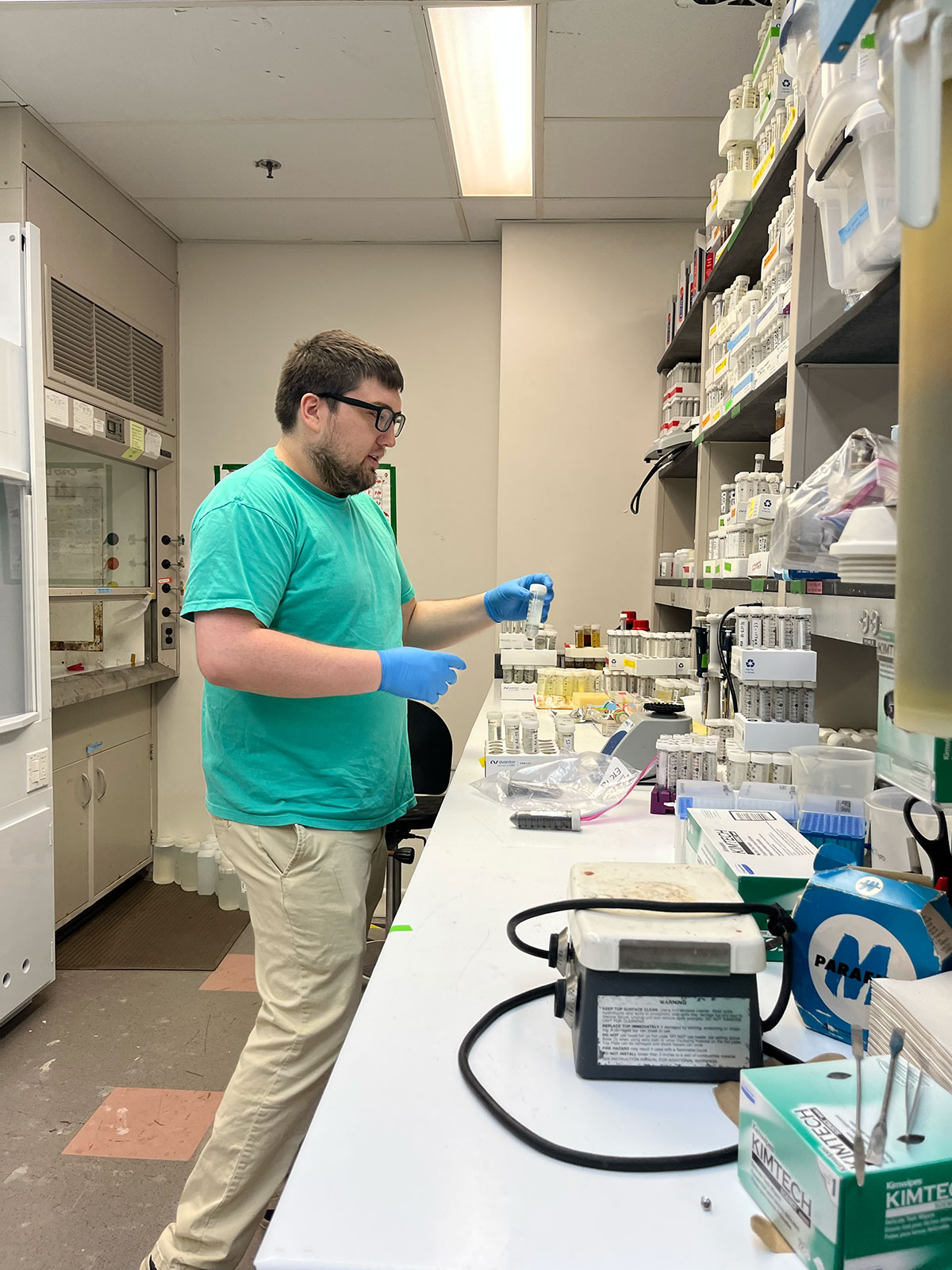
Stratton’s doctoral project had three main objectives: verify whether Trenton residents are exposed to lead, determine where the exposure was coming from, and uncover how residents can reduce exposure. In his testing, Stratton used an X-ray fluorescence gun to scan every wall in a willing volunteer’s home to see how much lead was in the paint. He dropped off water vials for residents to fill in the morning from the kitchen sink — first thing in the morning, before using any water. Out in the yard, he took a small vial and filled it with soil.
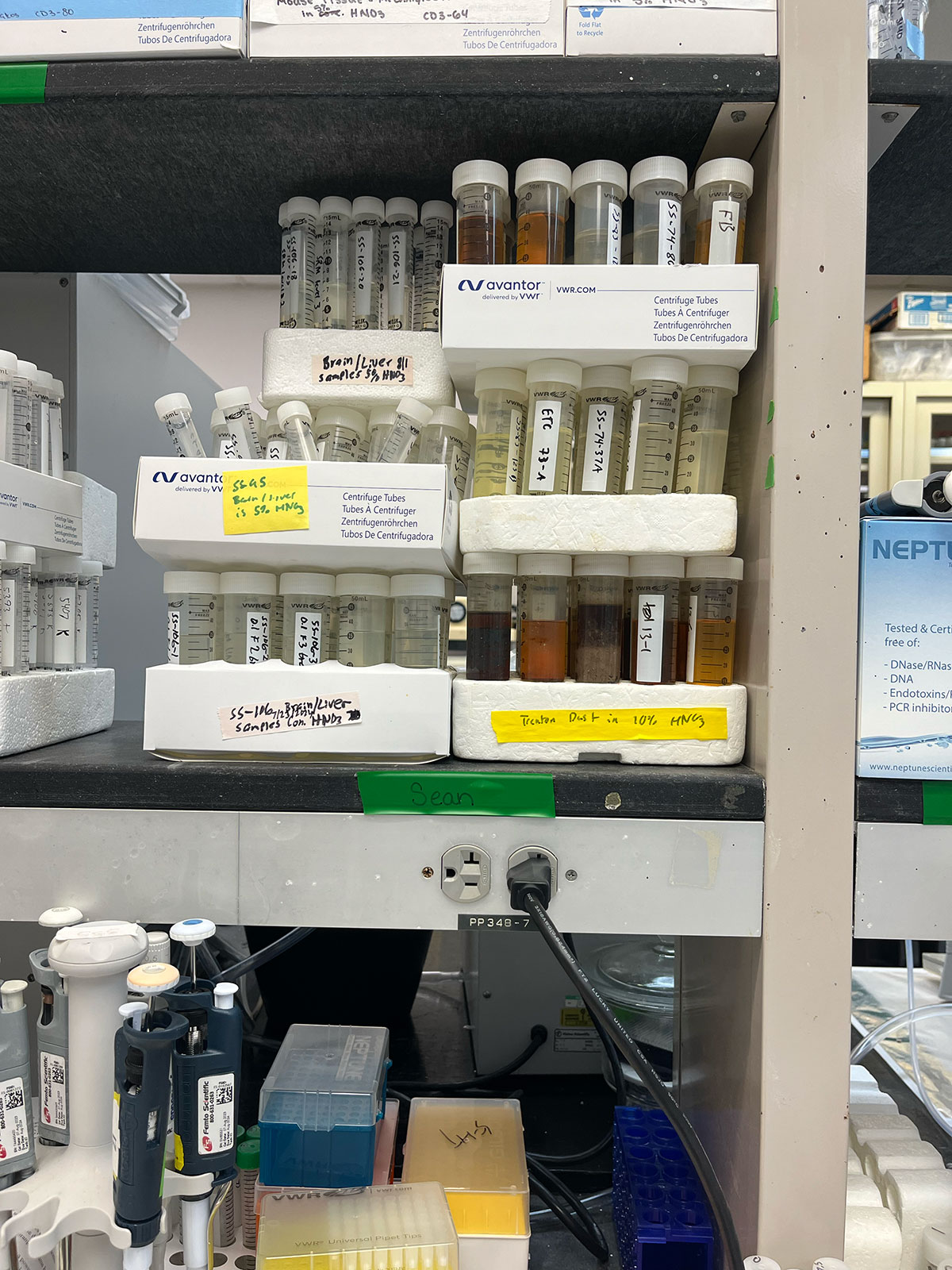
Then he packed up his bag, put it all in the trunk of his car, and made the drive back to the cluttered Rutgers lab, where he would run tests. Afterward, Stratton provided residents with full results, information on what to do next, medical information about where to get blood lead checked, and his phone number, along with his supervisor’s at Rutgers, to call if they had questions.
In late February this year, Stratton presented his findings to a team of Rutgers professors during his official dissertation defense. His findings were stark. Most homes he tested had lead, whether it be in the dust, paint, or pipes. All homes measured for floor dust had detectable levels of lead, with 86 percent of them exceeding the EPA’s action level.
He also found that homes without lead-based paint in Trenton are still at risk of elevated levels because of the legacy lead dust outside. That outside dust in Trenton comes from a myriad of sources, including gasoline, atmospheric aerosols, and coal and soil contamination from its history of lead-based ceramics manufacturing.
He also found that running the tap for five minutes before using the water — a common recommendation from public health experts — was still not an adequate amount of time to flush traces of lead. He suggested, in his results, that lead safety guidelines should expand to include reduction strategies, like using a water filter.
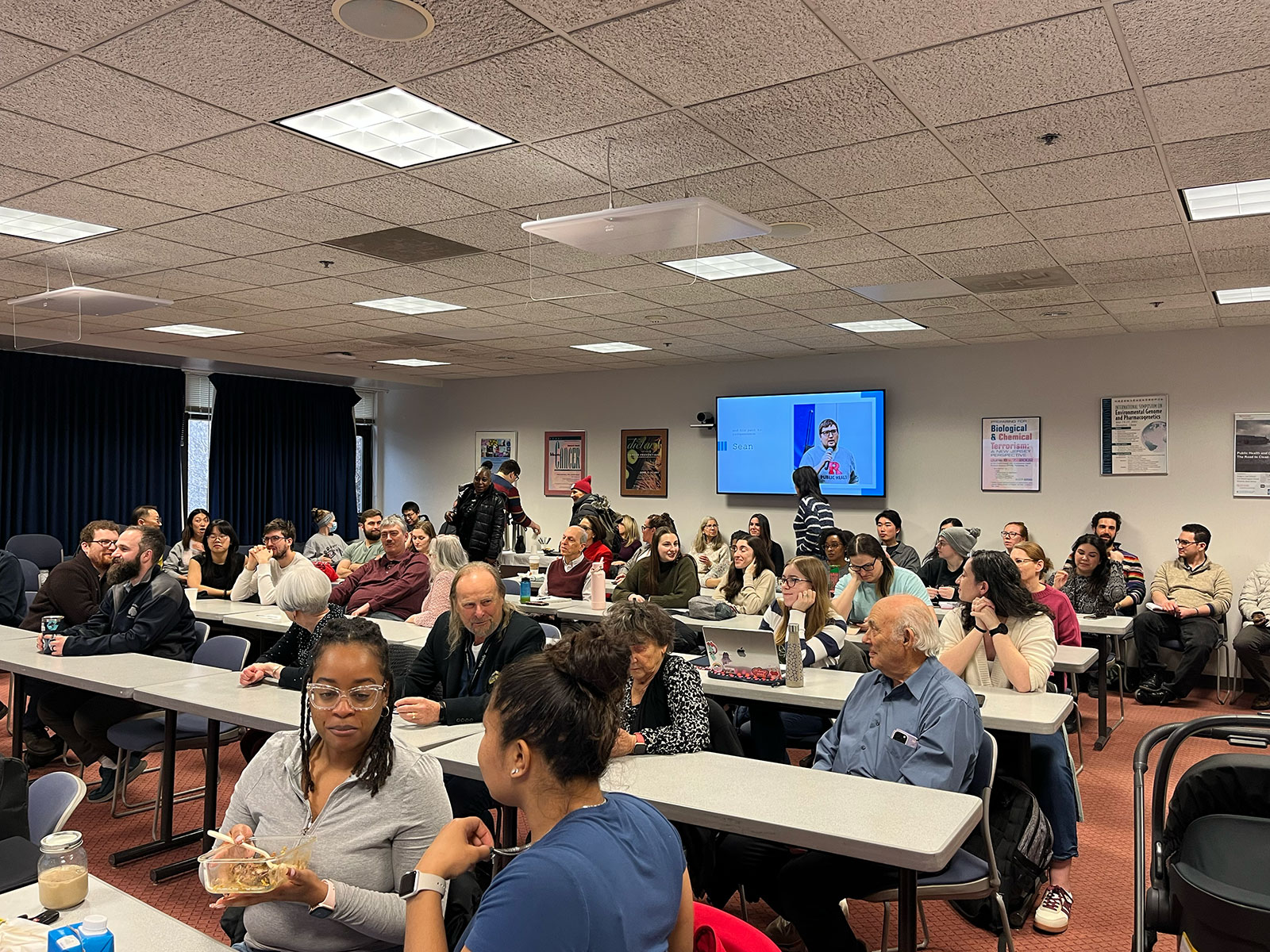
A week later, he welcomed more than 30 people into a Rutgers classroom for a presentation of his findings. He wanted collaborators and community members to celebrate with him. As gifts, he handed out little square 3D printed urban maps of East Trenton, with streets and raised buildings, to those he’d worked with over the years. Among those in attendance were partners who helped connect Stratton with residents, including Snider of East Trenton Collaborative and Anthony Diaz of the Newark Water Coalition.
Anna Mattson
The EPA’s decision this summer to list East Trenton as a Superfund site means a cleanup is coming — but slowly, and only for the soil, not the pipes or the paint. The designation triggers more sampling, long-term soil removal plans, and years of federal oversight. Still, none of that has started yet. A remediation plan hasn’t been developed. And in a state dotted with Superfund sites that have languished for decades, residents know what a long wait can look like.
For now, Stratton’s research has offered immediate answers for concerned residents. Since learning about the lead in her home, Booker has tried to reduce her exposure.
“I use a vacuum to clean my floors and carpets instead of stirring up dirt and dust particles by sweeping,” Booker said. “When my nieces come over and want to run around in the yard, I make sure they remove their shoes when they come inside and wash their hands.”
She said Snider, Stratton, and the East Trenton Collaborative have sounded the alarm on the lead issue in Trenton. Now, she hopes that the community will continue to fight so that the city can be a place where children and families can be healthy and thrive.
“Knowledge is only powerful and beneficial if its effects change,” Booker said. “We can know there is a problem, but without action, the problem simply remains.”

