

As the European State of the Climate Report confirms Europe is the fastest-warming continent and the Arctic the fastest warming place on Earth , the US -Israeli war on Iran has shown the danger of dependency on fossil fuels while a “coalition of the willing”conference in Colombia is pushing the green energy transition ahead.
We are not hearing nearly enough about climate change right now, with war and its economic fallout dominating the headlines. But the European State of the Climate (ESOTC) 2025 report just published by the EU’s Copernicus Climate Change Service and the World Meteorological Organization (WMO), brings us a stark reminder of what climate warming is doing to the planet we live on. “Record heatwaves from the Mediterranean to the Arctic, while glaciers shrink and snow cover declines” is the title of this latest assessment by around 100 scientific contributors. The comprehensive overview of key changes in climate indicators for the world’s fastest warming continent, including the cold high north of the planet, is not happy reading:
“Rapid warming in Europe is reducing snow and ice cover, while dangerously high air temperatures, drought, heatwaves and record ocean temperatures are affecting regions from the Arctic to the Mediterranean”, the authors tell us.
Florian Pappenberger, Director-General of the European Centre for Medium-Range Weather Forecasts (ECMWF) said: “Europe is the fastest-warming continent, and the impacts are already severe. Almost the whole region has seen above-average annual temperatures. In 2025, sub-Arctic Norway, Sweden and Finland recorded their worst heatwave on record with 21 straight days and temperatures exceeding 30°C within the Arctic Circle itself.”
Glaciers in all European regions saw a net mass loss, with Iceland recording its second-largest glacier loss on record; snow cover was 31% below average; the Greenland Ice Sheet lost a staggering 139 gigatonnes (139 billion tonnes) of ice. That is around 1.5 times the volume stored in all glaciers in the European Alps. This ice loss contributes to rising global sea levels, with every centimetre increase exposing an additional 6 million people to coastal flooding.
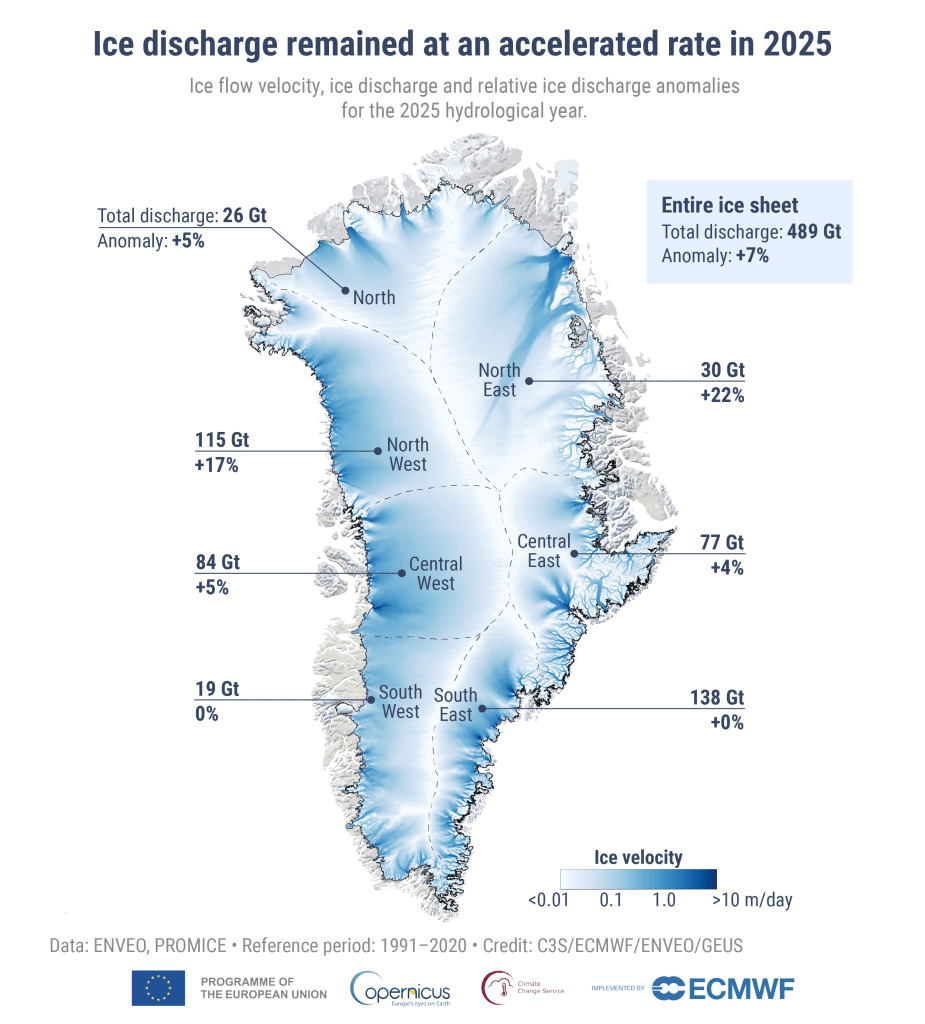
The report shows a continuing trend of rapid warming across Europe’s coldest regions –including in the Arctic and the Alps, where snow and ice play a critical role in slowing climate change by reflecting sunlight back into space.
The report concentrates on Europe, which is warming fastest. The International Cryosphere Climate Initiative (ICCI) provides global context in a white paper on glacier protection and the need for enhanced mitigation and adaptation funding, published on April 22, 2026:
“Globally, glaciers, snowpack and mountain permafrost are losing ice due to the continued pumping of carbon into Earth’s atmosphere. With continued emissions and unambitious transition policies, the world is on track for at least +2.7°C of warming, leading to more than twice as much glacier loss as keeping temperatures below +1.5°C. This warming is already driving extensive loss and damage in mountain and downstream communities around the world, with loss of infrastructure, food and water security.”
Trump as unwitting renewables promoter?
So how are we doing on speeding up that transition towards green energy? The US war on Iraq and the resulting closure of the Strait of Hormuz have done a better job at raising awareness of the dangers of fossil fuel dependency than a library of papers on the subject. Ironically, amidst all the death and destruction he has wreaked, the “drill baby, drill” President may have done the green energy revolution a big favour.
The closure of the key fossil energy transport corridor through the Strait of Hormuz, provoked by the US war on Iran, has thrown world energy markets (and much more) into chaos. Countries relying on oil and gas from the Gulf region have been left high and dry. While some turn to dirty fossil fuel coal for a short-term solution, clearly the key message is that renewable energy, produced close to home, is the way to go.
In an interview with the Guardian, Fatih Birol, the executive director of the International Energy Agency (IEA), argues that “the oil crisis triggered by the Iran war has changed the fossil fuel industry for ever, turning countries away from fossil fuels to secure energy supplies”.
The man widely considered the world’s leading energy economist said a key effect of the US-Israel war on Iran was that countries would lose trust in fossil fuels and demand for them would decline.
“No going back”
“Their perception of risk and reliability will change. Governments will review their energy strategies. There will be a significant boost to renewables and nuclear power and a further shift towards a more electrified future,” he said in the exclusive interview. “And this will cut into the main markets for oil.”
The IEA chief is convinced there is no going back: “The vase is broken, the damage is done – it will be very difficult to put the pieces back together. This will have permanent consequences for the global energy markets for years to come.”
That could be a chink of light in a world darkened by unjustified wars and aggression and increasingly hit by emissions-fuelled weather extremes.
New initiative born of COP frustration
At this very moment, a new “coalition of the renewables-willing” is meeting in Colombia, a “small developing country with a large fossil fuel sector”. Colombia, the largest coal and fourth-biggest oil exporter in the Americas, alongside the Netherlands, with support from more than 50 countries, is hosting the first “Transitioning away from Fossil Fuels” conference in Santa Marta.
The initiative was born out of frustration with the UN climate talks, which are regularly hijacked by fossil fuel giants.
Governments first agreed to “transition away from fossil fuels” at the Cop28 UN climate summit in Dubai in 2023, (already an unbelievably late date in the scheme of things), but have not taken any steps to go about it. Last year’s COP30 in Belem, Brazil, ended without fossil fuels even being mentioned in the final outcome.
The fact that this first installment of a new series of implementation-oriented meetings it is taking place against the background of the US war-induced fuel crisis makes it more relevant than ever. “We, of course, didn’t know that war was going to break out, but we knew the challenges of a dependency on fossil fuels,” said Irene Vélez Torres, Colombia’s environment minister, who will preside over the talks. “This conference comes in the best possible moment.”
The organisers stress the forum is not designed to replace the UNFCCC climate progress or to run formal negotiations. It sees itself as a “sustained political platform for countries ready to deliver implementation-driven action toward an orderly phase-out of fossil fuels.” It wants to be “an innovative, horizontal dialogue that deepens democratic climate governance through meaningful and influential participation by countries and subnational governments, civil society, and other stakeholders.”.
The oil crisis sparked by the US-Israeli attack on Iran, is spotlighting the stark choice world leaders face between oil, gas and coal and the cleaner, safer renewable energy of the future. This is “the moment in which history is going to split,” said Vélez.
No room for sceptics or saboteurs
By bringing together only those who want to make and promote the transition to green energy and excluding climate sceptics and fossil fuel lobbyists, the new grouping aims to push actual progress without relying on the outmoded and self-frustrating consensus mechanisms that repeatedly block the UN COP process.
Admittedly, some of the world’s biggest economies and biggest polluters, including the US, China, India, Russia and the Gulf petro states, are not taking part. But only firm supporters and implementers of the transition away from fossil fuels are welcome. This is a completely different ball-game.
The 54 countries confirmed represent about a fifth of global fossil fuel production and about a third of demand, the Guardian calculates. They include the UK, the EU, Canada, and the joint hosts of the next UN climate summit, COP31, this November, Australia and Turkey. Among the dozens of developing countries confirmed are some of the most vulnerable to the impacts of the climate crisis, such as Pacific islands, but also major fossil fuel producers, such as Nigeria, Angola, Mexico and Brazil.
Getting on the “right side of history”
This conference in Santa Marta will be just the start. The main tangible outcome will be a report by scientists on how countries can make the transition, and one from finance experts from the Global South on how funding can be made available to countries that need it. A second conference is already planned for next year in the drowning Pacific island nation Tuvalu.
Colombia has decided to stop licensing new coal, oil or gas exploration, and is aiming to develop other industries (including renewable energy), focus more on tourism and boost agriculture. “We want to invite people to be on the right side of history,” Vélez said. “The right side of history is to go greener, to go more sustainable, to go more interconnected.”
Colombia is threatened by the loss of its last glaciers unless the fossil fuels phase-out speeds up.
Still, some of the conference participants, including Norway, Mexico and Nigeria, are planning to expand fossil fuel production in response to the Iran war. “The risks of fossil fuel dependency have literally exploded in front of us,” said Claudio Angelo, head of international policy at the Observatório do Clima thinktank in Brazil, talking to the Guardian. But he warned the climate crisis was slipping down the lists of government priorities – a tendency that the conference “has to counteract”.
IEA chief Birol, “as the longtime head of the global energy watchdog, (…) one of the most influential voices on governments globally”, told the Guardian the vastly changed future outlook presented expanded opportunities for renewable energy but also dangers that could throw progress on the climate off track.
He acknowledges that continuing high fossil-fuel prices could tempt developing countries to turn to coal, but stresses that solar is competitive with coal on cost and is growing faster.
Renewables on the up
A “return to coal” by some countries in the wake of the Iran war is likely to be far more limited than thought, according to a new analysis by thinktank Ember, published by Carbon Brief on April 28th.
Separate data shows that, to date, there has been no “return to coal” in 2026.
In fact, the decline of coal power in some countries and the potential for global electricity demand growth to slow down could mean coal generation continues falling this year.
Experts told Carbon Brief that “the big story isn’t about a coal comeback” and any increase in coal use is “merely masking a longer-term structural decline”. Instead, they say clean-energy projects are emerging as more appealing investments during the fossil-fuel driven energy crisis.
Coming back to that European State of the Climate Report discussed at the start, Samantha Burgess, Strategic Lead for Climate at ECMWF concludes:
“The ESOTC 2025 paints a stark picture: the pace of climate change demands more urgent action.
“With rising temperatures, and widespread wildfires and drought, the evidence is unequivocal; climate change is not a future threat, it is our present reality.”
The Report notes some encouraging new records. Renewables supplied nearly half (46.4%) of Europe’s electricity in 2025, with solar power reaching a new contribution record of 12.5%
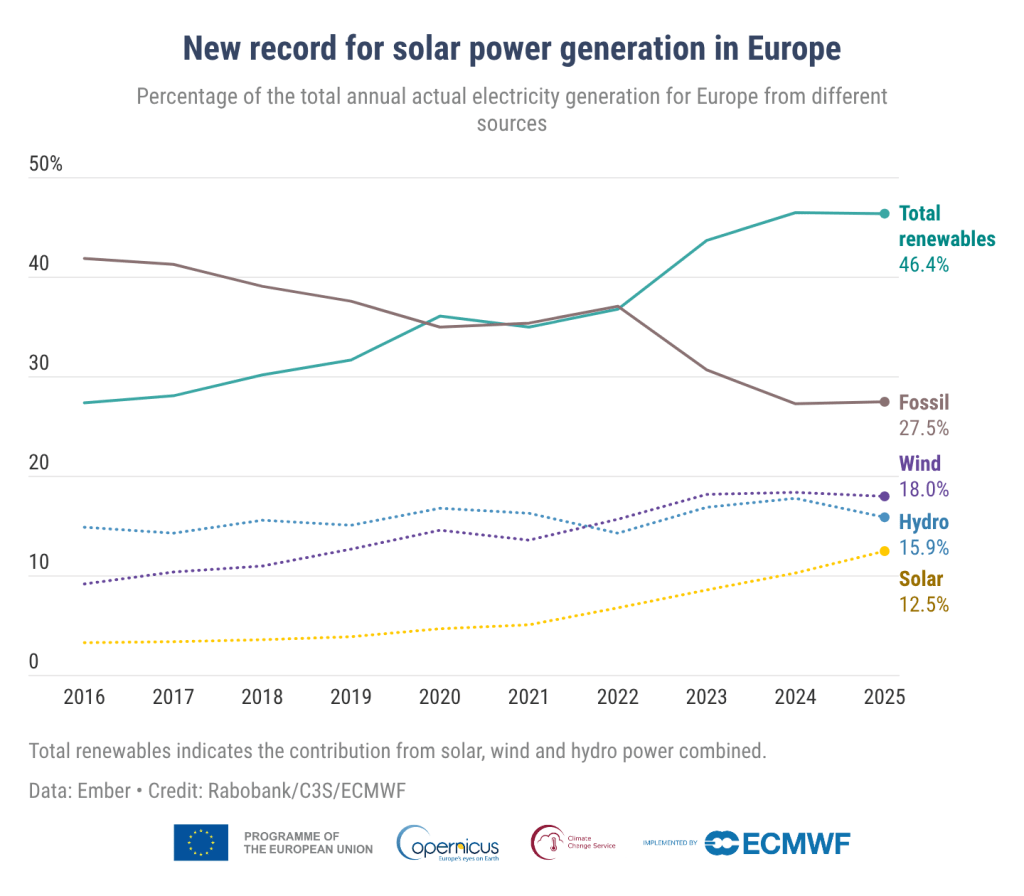
Renewable energy has overtaken coal to become the world’s largest source of electricity in 2025, according to think tank Ember. Fossil-fuel generation fell by 0.2% in 2025, the thinktank’s latest annual review says, with wind and solar alone meeting 99% of the growth in electricity demand last year.
While generation from fossil fuels has occasionally fallen year-on-year in the past, Ember says this is the first time it has happened due to the structural shift towards clean power, rather than due to economic crises or other one-off events. That is a significant development.
Record solar generation in particular was key to pushing fossil fuels into reverse, increasing 30% year-on-year – meaning it met 75% of global electricity demand growth in 2025 alone, the think tank finds.
Light from China
Carbon Brief highlights a policy document published by Chinese government leaders on April 22nd – Earth Day – calling for stricter controls on fossil-fuel consumption and greater oversight of heavy emitters.
It has been interpreted by experts as a signal of China’s ongoing commitment to climate action and a bridging policy between the 15th five-year plan, published in March, and future thematic and sectoral five-year plans expected to be published in the months and years ahead.
One expert told Carbon Brief that this is the first high-level document to explicitly link decarbonisation efforts with energy security and industrial development.
Given the key role of China both as a top emitter and a driving force behind the technologies we need to transition, these are very positive developments.
The US-Israeli war on Iran is showing us the downside of depending too heavily on fossil fuels. Reports on the State of the Climate and daily coverage of warming-induced extremes and disasters show us the foolishness of burning fossil fuels full-stop.
I’ll come back to energy economist Fatih Birol for an inspiring closing thought here. Building renewables, is an option “I never heard that anybody ever regretted”, the IEA chief says. “I don’t see any downsides for renewable energy.”
Let’s take it from there.

