

The world’s largest fish is also one of the ocean’s great vanishing acts.
For years, scientists have wondered where whale sharks go to feed, reproduce and grow. Now, a decade of satellite tracking data is beginning to reveal the answer — and it has major implications for their survival.
The new study, led by Konservasi Indonesia, Conservation International’s local partner, tracked more than 70 Indo-Pacific whale sharks in waters spanning 13 countries and the high seas. What they found were wayward migrations — each shark charting its own course — which may offer clues to a global mystery: how an animal the size of a school bus has remained so elusive.
“Other migratory species tend to follow a script,” said Iqbal Herwata, Konservasi Indonesia marine scientist and lead author of the study. “Whale sharks have never made sense. Until now.”
Safe havens in a vast ocean
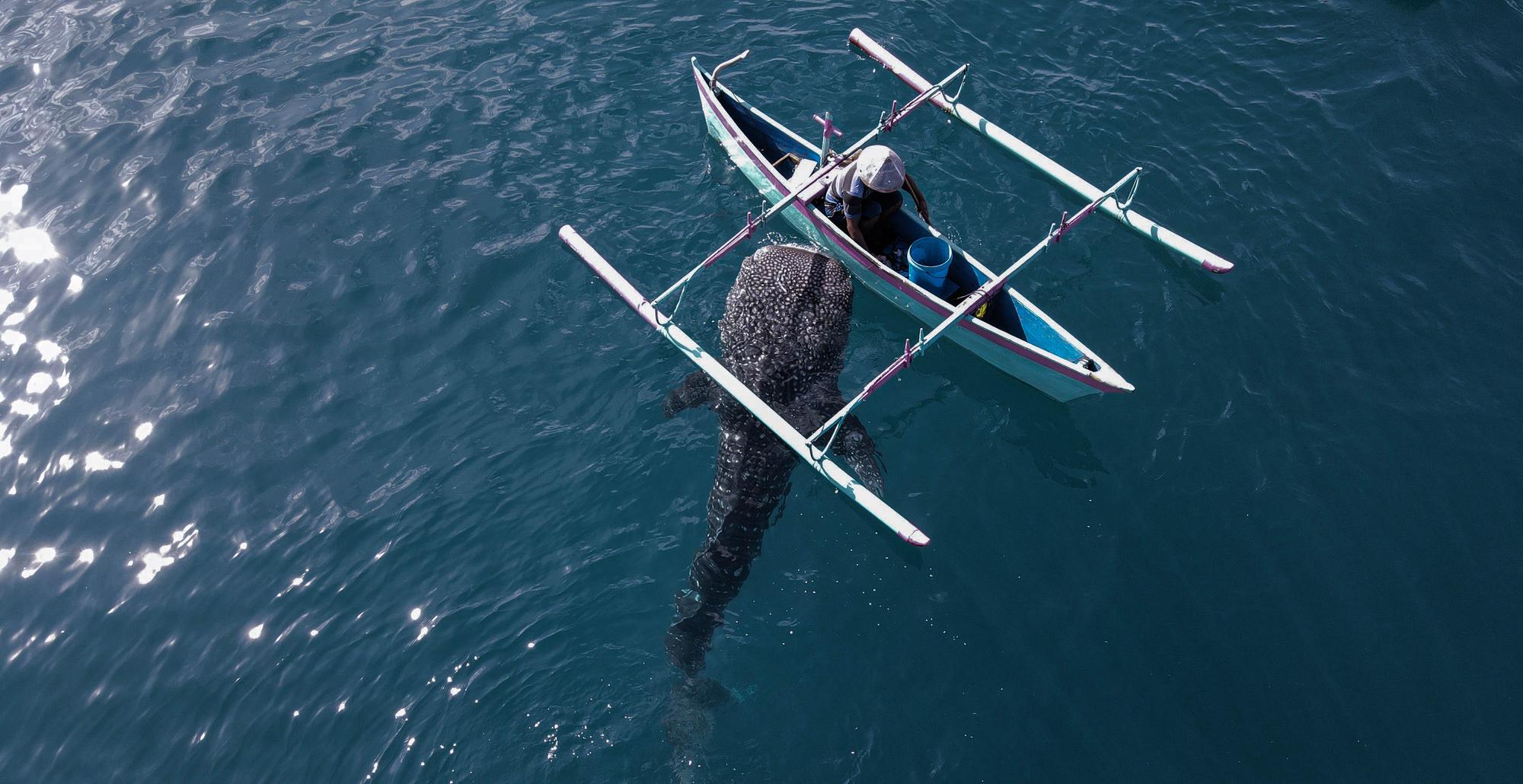
Indonesia’s Saleh Bay and Cenderawasih Bay are two of the only known habitats where whale sharks live year-round.
Both bays are reliable refuges — shelters from the open ocean, where cold, nutrient-rich water rise from the deep and fuel blooms of the plankton and krill that whale sharks depend on. But that abundance is not constant — and when it fades, some sharks leave.
What happens next comes down to an individual risk-reward calculation, Herwata said.
“They are taking a risk, moving far away from the relative safety of the bay,” he said. “The fact that they make that trade suggests the food reward on the other side is substantial enough to justify the danger. We believe there is something special happening beyond the bays — perhaps a particular diet, a seasonal feast. Something is making that risky journey worthwhile.”
Unlike many migratory species that travel in groups or follow fixed seasonal corridors, whale sharks are solitary — and that individuality shows in their movement patterns. Some sharks remain in coastal bays for years without leaving. Others strike out on journeys spanning thousands of miles.
“Individuals from the same bay might behave entirely differently,” Herwata said. “We’re just now piecing together why.”
Life across borders
For adult whale sharks, the open ocean holds a particular pull. They tend to seek out deeper water, hunting around seamounts and submarine canyons where food concentrates in ways scientists are still working to understand.
More than 40 percent of adult male habitat, the study found, falls in the high seas — waters beyond any country’s jurisdiction, where protections are thin and enforcement is nearly impossible.
The study also shed new light on the species’ most vulnerable life stage. Females appear to give birth near low-oxygen zones, where the absence of predators offers protection for newborns.
The same research team recently documented neonate whale sharks — just months old — in Saleh Bay, suggesting that after birth in the open ocean, the youngest sharks make their way to the bay’s sheltered waters. Scientists say this pattern offers the strongest evidence yet that Saleh Bay may be the world’s first known pupping and nursery habitat for the species.
“What’s clear is that whale shark conservation cannot stop at national borders,” Herwata said. “A significant portion of their habitat, during a critical period of life, is in the high seas — areas that function as migration corridors and opportunistic feeding zones linked to seamounts, canyons and eddies. Protecting these habitats is critical to maintaining connectivity and sustaining the population.”
When whale sharks leave the safety of the bays, they enter a world of competing dangers. Over the past 120 years, Indo-Pacific whale shark numbers have plummeted between 50 and 79 percent, driven by fatal collisions with ships, bycatch, and illegal fishing.
Yet the researchers say that trend is not irreversible. The population has a chance to recover if critical habitats are protected and conservation efforts are sustained and scaled up.
Protecting the Indo-Pacific population, which accounts for 75 percent of all whale sharks, will require coordination between the 13 nations the sharks travel through and protections across the open ocean, possibly through the United Nations-backed High Seas Treaty.
“There is hope for whale sharks to recover,” Herwata said. “But only if we act together. Protecting critical habitats is essential, and that means collective action across every country these animals pass through. Whale sharks don’t see borders.”

