A Conversation with Sarah Goodyear and Doug Gordon, of The War on Cars Podcast
GAIA hosted Sarah Goodyear and Doug Gordon — co-authors of Life After Cars and hosts of The War on Cars podcast — for a conversation about transportation system change, the limits of EV electrification, and what genuine mobility justice could look like.
Watch the full recording https://www.no-burn.org/greening-transport-beyond-evs-from-swapping-engines-to-swapping-systems/?utm_source=rss&utm_medium=rss&utm_campaign=greening-transport-beyond-evs-from-swapping-engines-to-swapping-systems. Listen to The War on Cars https://www.no-burn.org/greening-transport-beyond-evs-from-swapping-engines-to-swapping-systems/?utm_source=rss&utm_medium=rss&utm_campaign=greening-transport-beyond-evs-from-swapping-engines-to-swapping-systems. Get Life After Cars https://www.no-burn.org/greening-transport-beyond-evs-from-swapping-engines-to-swapping-systems/?utm_source=rss&utm_medium=rss&utm_campaign=greening-transport-beyond-evs-from-swapping-engines-to-swapping-systems. Learn about GAIA’s batteries program https://www.no-burn.org/greening-transport-beyond-evs-from-swapping-engines-to-swapping-systems/?utm_source=rss&utm_medium=rss&utm_campaign=greening-transport-beyond-evs-from-swapping-engines-to-swapping-systems.
The conversation opened with the book’s central provocation: cars ruin nature, they ruin society, and they ruin childhood. And it quickly turned to the question at the heart of GAIA’s own battery waste work: if we’re serious about fixing this, is swapping the engine really enough?
The 1:1 EV replacement story
Doug was direct: “That highway is still there. The traffic is still there. The money it costs to insure the automobile you’re driving is actually going to go up with electric vehicles, because they’re more expensive to repair.”
Sarah pointed to one of the book’s more striking examples — tire particle pollution. Researchers in Washington State traced mass die-offs of Coho salmon to a molecule released by tire degradation that washes into waterways. “Tire particles are one of the two largest causes of plastic particulates in the environment — showing up in our bodies, in our brains, in our children’s bodies.” And the heavier the vehicle, the worse it gets.
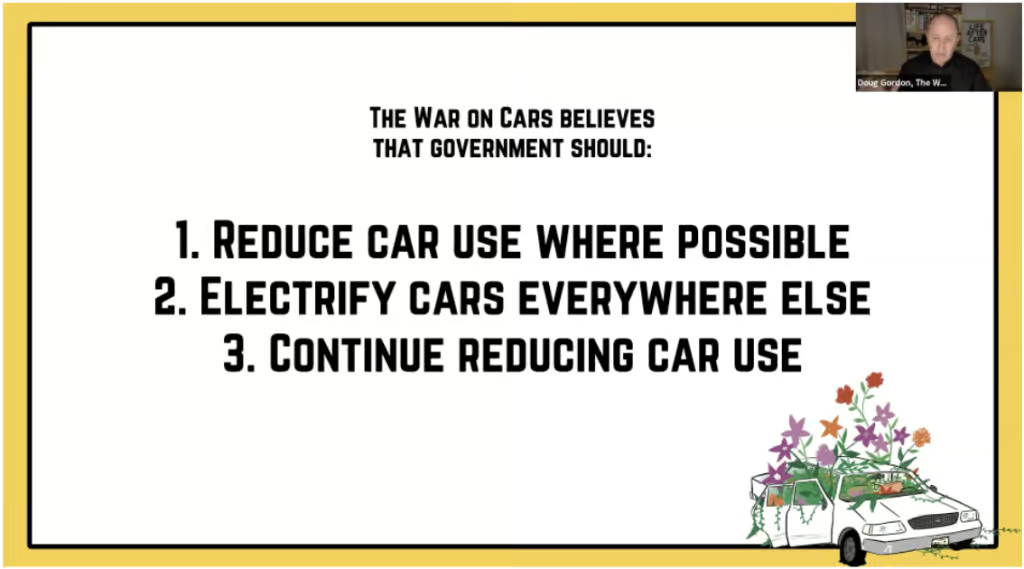
Doug offered a reframe that ran throughout the conversation: “The V in EV does not have to stand for car. It stands for vehicle.” The battery power needed to move one electric pickup truck could instead power approximately 300 electric bicycles. “When we talk about limited resources and minimal footprint on the earth, electric bicycles are a really good way to think about it.”
Breaking the taboo
Asked why challenging car culture remains politically untouchable, Doug offered a memorable analogy: “If you ask Americans, do you like your health insurance company? They’ll say no. Would you like to change it to national healthcare? Oh my god, no, that’s too scary. We all hate this system, but we can’t imagine it could be better, because most Americans haven’t experienced it.”
On EV marketing, Sarah was pointed: “None of the Super Bowl ads talked about pollution or the climate. It was the same nonsense you see in traditional car ads.” Fear, she argued, is what both the car industry and the EV industry profit from.
What change actually takes
Doug pointed to Ghent, Belgium, where a mobility plan faced such fierce opposition that the deputy minister had a police detail before it launched — and where, on day one, people asked why it hadn’t always been that way. Sarah noted a generational shift: “The politicians we’re meeting are young and unapologetic. For so long, transit advocates were seen as a nuisance by elected officials. These politicians see our movement as a constituency to be served. That is a radical shift.”
Waste, transportation, and common cause
Responding to GAIA’s question about connecting zero waste work to transportation advocacy, Doug drew a direct line: “It’s not just the lithium and cobalt — it’s the steel, the iron, the plastic, the glass. That new car smell is horrible chemicals leaching into your body and your lungs.” Sarah framed it more broadly: “The work that faces our generation is repair. It is so wasteful to be constantly building new roads and new infrastructure. How can we repair the fabric of our communities and build a healthier consumption cycle — not just chewing up brand new land and stuff to then throw it away?”
A closing note
Doug ended with a statement of intent that felt like the book’s thesis in miniature: “We are never wagging our fingers at the individual. We want to punch up and not down. The goal is to make cycling, transit, and walking feel like the default choice — because it has the least friction. You just hop on your bike or walk down to the corner and get on a bus. That’s what we’re going for.”