

We hope our research can help build a bridge based on concern for more just green spaces, but also on the knowledge of shared passion for the outdoors, as a step toward new modes of governing human and nonhuman worlds.
*The essay below draws upon the authors’ research article, ‘Just’ cruising in liberal Denmark: ambiguities at the nexus of queer intimacy and public green area management, recently published in the Journal of Environmental Planning and Management.
When we introduce the topic of our recent collaborative research, most people assume that we are attending to the very real environmental problems associated with massive cruise ships arriving to the harbours of Denmark’s capital city, Copenhagen.
But what caught our interest of late is the other type of cruising: deliberate encounters in public spaces for spontaneous, often anonymous sexual intimacy.
A global phenomenon, the term “cruising” as code for such encounters has been around since at least the 1960s (most popularly in Anglophone, Western countries) and stems from the related “cottaging” documented in the U.K. as far back as the early 1800s (Levine, 2022). Mostly associated with gay male urban communities, cruising is popular in bars, saunas, gyms, shopping malls, libraries, highway rest stops, public restrooms― and public urban and peri-urban green areas (McCann, 2023; Humphreys, 1970).
There are many drivers of cruising. While it should certainly be examined in context, it is widely characterized as a reaction to the ongoing hegemony of heteronormativity, where the illegality or stigmatization of homosexuality drives it into hidden spaces. But cruising can also constitute agential resistance to heteronormativity― including its Western colonial heritage (Salehin and Vitis 2019; Solis 2020). Cruising has also been characterized as a “voluntary, risk-taking leisure activity” (Richardson 2024: 94) and a set of activities imbued with the thrill of pleasure “hidden in plain site” (Kenyon 2024), which importantly reminds us of the playfulness and joys of the activity for many participants.
The pejorative historical construction of cruising by men “as illicit and dangerous acts that degrade” public outdoor areas― from parks to forests to beaches, across rural to urban landscapes― is well documented (Gosine 2010:150; Castells and Murphy 1982). This “degradation” has been typically cast in both social (immorality) and environmental (pollution, littering) terms. Heterosexual public sex has also been chastised, but as justice scholar Andil Gosine (2010:168) points out, it is far “less energetically scandalized” than homosexual acts, particularly those amongst men.
Yet, Denmark is a country well-known for its liberal attitude concerning freedom of sexuality. A frontrunner in legalizing same-sex sexual activity (in 1933), the country features some of the most extensive lesbian, gay, bisexual, and transgender (LGBT) rights in the world (ILGA-Europe 2023). Denmark is also ambitious with its public green areas, where public outdoor management organisations share concern for both ecological and social wellbeing. These goals, alongside the aim of including residents in planning and management, align with the broadly conceived “Danish values” including trust in public institutions, equality across gender, income, and sexuality, and even the universal accessibility of Danish green areas (Denmark 2024a, b); AAU2024).
Denmark is, however, not without its share of discriminatory, even violent attacks on persons identifying within the broad LGBTQ+ community. Neither is heteronormativity absent in continuing to shape norms of contemporary citizenship (Nyegaard 2017), childhood education, and eventual sexual and gender identities (Thorfinsdottir and Jensen 2017).
Nonetheless, cruising is a longstanding, popular activity in Danish urban areas; an online map refers to 17 popular spots across greater Copenhagen alone[i]. This led to wonder whether and how discriminatory heteronormativity may come to bear on nature management praxis, particularly in sites where cruising is prevalent? Specifically, we wanted to know how urban green area managers understand and respond (or not) to cruising activities, and what challenges they face in meeting diverse users’ interests and demands.
We also believed that insight into cruisers’ experiences with, and their needs and desires in relation to, green area management would be invaluable. Not least so, considering the widespread absence of queer perspectives in cruising-oriented scholarship (Kenyon, 2024), not to mention the practical difficulties of accessing respondents.
With an empirical focus on cruisers and public outdoor managers across four sites around Copenhagen, our work thus examines whether and how public green area managers consider cruising in their management practices, and how those practices align with the interests of those in the cruising community. We aspired to constructively inform green area management, but to avoid drawing unwanted attention to cruisers and cruising― especially given some of our eventual findings.
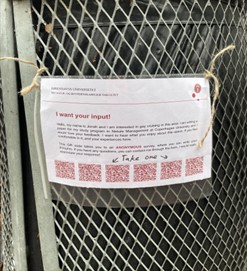
As interdisciplinary researchers motivated by justice perspectives, and sharply aware of the problematic legacy of academic work on cruising (most infamously by sociologist Laud Humphreys in the 1960s[ii]), our methodological approach was of great concern. Our solution to reach cruisers was an anonymous survey clearly explaining our research purpose. Concretely, we posted signs with QR codes to the survey up to three times in multiple active sites across four green areas in and around Copenhagen, over the span of three seasons (spring to autumn). We received 45 useful responses (image 2).
We also interviewed seven managers from the four public outdoor areas. We requested to speak with additional managers but were denied, being told, for instance, that it was known amongst them that we had spoken to some, and this should be sufficient. We understood that their time was scarce, but we had to wonder if, in some cases at least, the rejection was telling of disinterest in and/or discomfort with the topic. Those we spoke with gave their informed consent, and we shared a draft of the article with two of them to strengthen the research validity.
Inspired foremost by an environmental justice lens, we aimed to reflect on the nature and perpetuation of injustices that may be both distributional and procedural (Walker 2012). We further mobilized a queer ecology lens to help illuminate “queer” encounters and relations with nature that are often invisible to the predominantly heteronormative gaze (Mortimer-Sandilands and Erikson 2010), yet that may be essential to fostering some forms of recognition and inclusion by authorities of this ambiguous “user group”. We share some of our most important findings in what follows.
Manager perceptions and practices
Through interviews, we firstly show that despite Denmark’s claimed liberal attitude toward sexuality, and despite the predominantly tolerant attitude amongst managers we spoke to, some perceptions and practices trend toward intolerance, accompanied by serious misunderstandings and aggressive tactics. For example, one manager described cruising as: “they find some prostitutes, boys, or whatever and do very strange things that not many people would find normal”. He further described cruisers as “very sad people, that are always somewhere else than they’d rather be.” Another referred to different activities altogether, gathering “nude-marchers”, “flashers”, and prostitutes under the same umbrella.
Not only revealing the lack of understanding of cruising’s specific history and characteristics, but such depictions also problematically associate cruising with illegal and non-consensual sexual activities. One may also have revealed a moral judgement by describing cruising as associated with “taboos (…) a hidden vice they are living out”. Such perceptions are harbingers of problematic management approaches, as we also delved into.
We first inquired whether they had received or heard about complaints about cruising from other users. Complaints were, in fact, rare: only two cases were mentioned. The first was well-known: a complaint filed by a neighbourhood council about cruising near a residential area. The other came from a young horseback rider who ventured off-path, where she encountered something… unexpected.
In reaction, the managers responsible for the first complaint decided to close a parking lot serving the cruising area and to permit dog training nearby (image 3). Cruising relocated as intended, a fact which did not seem to perturb them.
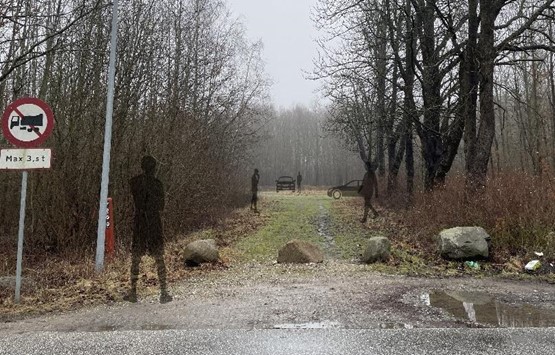
The reaction to the second complaint also resulted in an active attempt to drive cruisers away. But this time it assumed a more aggressive form. Uncomfortable with venturing into this known cruising site, “this is too ugly, we don’t want to, no way”, as one manager recounted, a private company was hired, workers arriving “in white coveralls, like painters use”, and with his encouragement, they used cameras to scare cruisers off. This was the same manager who expressed major misunderstandings. He further recounted that he has suggested camera-based deterrence to colleagues elsewhere and is considering advancing the approach with the use of drones.
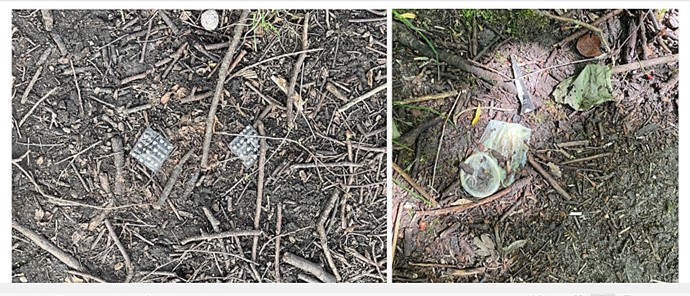
Beyond reacting to the few complaints, several managers have taken it upon themselves to pre-empt or to address cruising-related issues they already encounter directly, e.g., litter. Litter issues follow many user groups, but the type of litter associated with sexual acts, e.g., used condoms, can be especially provoking (image 4).
Yet at least one manager praised cruisers: “they build themselves, they clean themselves, that’s more than other users do.” The hazards of litter are not unknown to cruisers themselves, and some cruisers do strive to tidy up both to avoid unwanted attention by authorities and for the sake of ecological care (image 5) (as we elaborate upon further below).
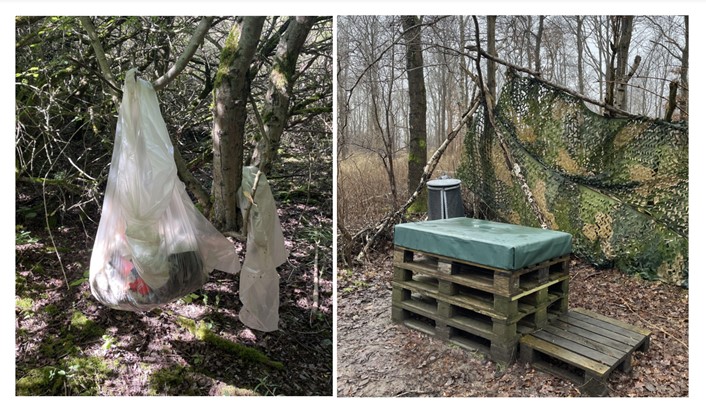
Nonetheless, cruising deterrence as a pre-emptive action against problems like litter and user conflicts also emerged. And despite the claimed dual intention for both social (e.g., recreation) and ecological (e.g., biodiversity) goals, a balance in practice is easily upset. For instance, shrubbery was removed in at least two of our sites (image 6). This is a widespread move against cruising, including in Copenhagen (Bengsten 2013). Research in Copenhagen, Boston, and London adds that ecological damage in popular green cruising areas, or plants deemed by authorities as “out of place” (sometimes an act of botanical-based defiance by cruisers), are often simply an excuse by park managers to cut down screening shrubbery (Nowak and Roynesdal 2021).
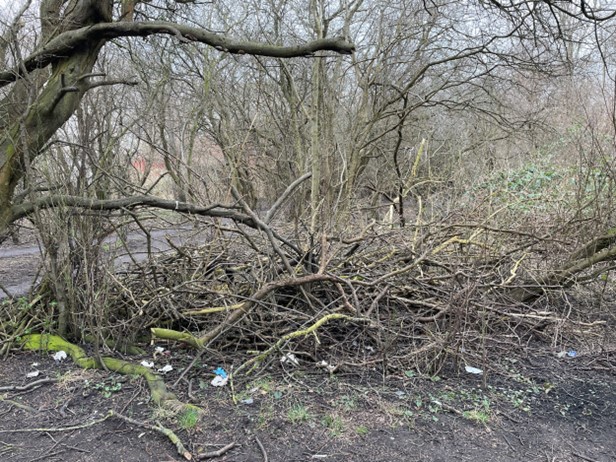
Further strategies deemed “less confrontational” in at least three of our sites centred on making the cruising areas attractive to other users. Examples include permitting dog-training activities (mentioned previously), the establishment of new footpaths through cruising areas, and the construction of a playground.
Yet all of this comes with ecological costs, as acknowledged by another manager: “this [shrubbery]… it’s great for birds and animals who like to hide, so we’re not too fond of making it more transparent like that”. That responses like underbrush removal, more fencing, and paving are, in fact, more environmentally destructive than gay sex has also been raised in the cruising scholarship (e.g., Gosine 2010). This makes evident the harmful environmental impacts of heteronormativity, and thus the urgency of a queer ecological approach to green space management (Bingham-Hall, 2025).
Insights from cruisers
Our survey provides a glimpse into this largely unknown assembly of men to document both the joys and insecurities of cruising today. Notably, our demographic questions made evident that most respondents spoke from the position of the middle-class Danish gay man (a group perhaps more confident to answer such a survey), and this is important to keep in mind with regard to the results ahead (we note exceptions where relevant in our academic article).
For instance, most of the 45 respondents affirmed that they felt they had the right to be in these areas. Yet a few also expressed uncertainties, e.g., “It is getting harder and harder to cruise”, and “Yes, but with the feeling that it’s on borrowed time.” Only two of the respondents had ever been told to leave, one by authorities and the second by other users, while a few others had been questioned by authorities or told to cover up.
Many cruisers strive for discretion from the broader public. This surely shapes their preferences with engagement with managers― namely, avoidance! Still, a non-negligible 28% of respondents would like to be asked about their needs and preferences by authorities. The means are critical; respondents suggested a variety of modes to give voice, from physical suggestion boxes, to online questionnaires, to representation on their behalf by LGBT+ associations. “...Just so it is anonymous”, as one stated plainly, and most emphasized.
In terms of desired changes, most indicated a largely “hands-off” management, “less fences”, and tidying only for ease of access. Several articulated this specifically in relation to the perceived “naturalness” of minimal management, e.g., “Leave nature be and grow and express as it will. The private places become created by the users and that’s the beauty of it. It’s very organic in its nature”. To us, this sentiment echoes a queer sensuality in this context, drawing together calls for freedom of sexuality as for more unruly landscapes and unhindered non-human flourishing (also see Gandy 2015).
We further inquired into why they cruise, in general, and in the specific place where our survey was distributed. We hoped such questions might shed light on issues of environmental justice concern, for example, the persistence even in Denmark of need-based cruising (e.g., for someone from a cultural or religious community with a homophobic tendency) and so concerns of access. Yet we wanted to leave space for drivers who also go beyond exclusions, and into the realm of queer sensibilities and pleasure.
We only received several intimations of potential sexual oppression, e.g., “Can express my sexuality”, “I don’t have other places”, and “Secrecy from my partner”, in addition to multiple references to the “discreteness” offered by the sites. Yet most referred to the fun; many mentioned convenience. One response that captures these well: “The hunt is exciting. It’s non-committal. Quick sex and so on with today’s program. Many good experiences with cruising.” A few referred to the challenges of online hookups, like catfishing, that cruising can alleviate.
Finally, several described their appreciation of the biophysical environment, e.g., “Light, air, nature, and maybe that extra something”. Twenty respondents referred specifically to the natural environment in response to an added prompt on what they like about the place itself. From references to sun, fresh air, the quiet and calm, trees, or just “beautiful nature”, some articulated what we might interpret as particular to the cruising experience, e.g., “Nature, open sky, community of peers, adventure, exposure, validation, higher self-esteem”.
In an open-comment prompt for final thoughts, some concerning impressions came forth: A ‘Danish’-identifying man noted,
“There seem to be a lot of immigrant men who are in the closet and use these places. I wish it was easier for them to live out their sexuality.” Others expressed concerns reflecting longstanding issues faced by cruisers in many countries: “I worry that the older narrative of the LGBT+ community is coming back. Paedophilia, etc.”, and “[I] feel the city administration is chasing the homosexuals and deliberately closing places and bothering with everything they can”.
Together, these comments reflect our earlier point that despite Denmark’s liberal sexual identity, cruising remains a somewhat risky endeavour. Still, a final comment noted simply, “I love cruising and it will always be part of my everyday”.
What would embracing cruising do for nature management?
Our combined results make it evident that concerns of environmental justice in relation to cruising are absolutely relevant for nature managers to consider in their work across Greater Copenhagen’s outdoor areas. While we know that the ambiguities of cruising are part of the fun for some, this is not a universal driver, and while not fully concretized in our survey results, given the limitations of the method, there are intimations that some engage in cruising due to constraints to express their sexuality elsewhere. This is not a stretch to assume, even in “liberal” Denmark, in light of ongoing struggles of freedom of expression by LGBTQ+ identifying persons in the country (DIHR 2024).
All managers we spoke to seemed aware that cruising will persist, though their rhetoric ranged from acquiescence to apparent regret, e.g., “It’s our impression that all the measures above have had a limited to no effect on the amount of cruising (…) we are just pushing the problem around between us.” A key issue emerged in our work around what exactly constitutes “offensive behavior”, a legal though ambiguous term. Like outdoor sex, public nudity is permitted in Denmark, but “to exhibit indecent or or arouse public outrage”[iii] is forbidden. Yet, subjective assessments of “indecent or offensive” behaviour and “intention to offend” are made not only by an aggrieved party. They are also made by these managers, imbued with authority to ignore or respond to complaints through a host of less to more aggressive means, as we documented, with the justice implications those entail.
Such questions of what constitutes legitimate behaviour in public spaces (and who gets to decide) segue into a longstanding discussion that many readers of The Nature of Cities are familiar with. This, of course, extends beyond sexuality norms and intersects with multiple social categories of distinction that structure oppressions vs. privileges- including the ability to enjoy public (green) spaces. We cannot help but recall other research (also in an urban green space in Copenhagen) that pointed out how the popular urban renewal ambition of creating spaces ‘for all’ too often falls prey to an artificial inclusivity that even unintentionally benefits only a segment of the population (Rutt and Loveless 2018). Rutt and Loveless (2018) rather call for ‘spaces for all’ as an alternative policy goal, with the critical distinction of aspiring for everyone to have access to some public spaces they desire, with differences acknowledged and accepted- even if not entirely understood (to paraphrase the justice scholar Iris Marion Young).
We are further inspired by queer ecology perspectives that challenge not only the injustice of queer exclusions, but moreover the “dominant imaginaries of nature and environment” and of ‘appropriate’ sexual behavior that uphold those exclusions (Kinkaid 2022:4). This invites us to reflect upon how such sentiments effectively preclude a societal acceptance of cruising, as just another (legitimate) outdoor recreational activity that one would simply turn and walk away, as from bird watchers, to avoid causing disturbance.
Noting cruising’s role in combatting loneliness and isolation and generating connection and joy, legal scholar and cruiser Marcus McCann (2023) demands a legality that not just protects cruisers from harm, but also affirms the possibilities for thriving lives. Provoking thought on alternative modes of governing Danish green areas, we wonder what such management would look like if the benefits of cruising and outdoor intimacy were embraced and celebrated, rather than tolerated at best (also see Bingham-Hall 2025). We also suspect that most managers know little about how cruisers share in such nature-appreciation. We hope our research can help build a bridge based on the knowledge of shared passion for the outdoors, as a first step toward new modes of governing for human and nonhuman worlds. As one survey respondent implored, “Let us play and have fun”!
A closing call for more (care-full) research attention on cruising
While we could document some differences amongst cruisers according to a few indicators of social distinction, further research should go deeper in illuminating the experiences of various groups. An intersectional analytical lens is essential (Crenshaw 1991). Greater attention to non-White and non-Danish cruisers is highly needed in this context, where Denmark’s racialized surveillance regimes and anti-immigrant rhetoric and policies are mounting (Amnesty 2024; Ritts and Rutt 2023), which could suggest an exacerbated targeting of cruisers of colour.
An intersectional analysis could also explore how trans, non-binary, disabled, and others facing exceptional marginalization today experience cruising (or perhaps are inhibited from doing so), and how this relates to and is maintained in nature governance norms (as well as being reproduced within queer communities via prevailing queer hierarchies; Callander, Newman and Holt 2015). Such inquiries would benefit from an approach that can surpass the constraints of the survey, such as ethnographic inquiry, and must be undertaken with extreme care, perhaps in collaboration with queer organizations.[iv]
Rebecca Rutt, Jonah Christner, and Lisbet Christoffersen
Copenhagen, Cincinnati, and Alnarp
[i] The website referenced has closed since acquiring this figure. Previously Gay-cruising.com, a similar site, Cruisinggay.com, provides similar figures as of late 2024.
[ii] Laud’s book Tearoom Trade: Impersonal Sex in Public Places, helped reconstrue understandings of who cruised (also well-respected ‘family men), and many myths of its supposed harms, such as to non-participants. Yet Laud also misrepresented himself to his subjects, and even revealed identities by tracing license plate numbers, leading to his work being a reference point for unethical research.
[iii] Several interviewees referred to this, although there are no specific guidelines defining ‘offensive behaviour’ for the use of public area managers, only legal guidelines and definitions that public authorities can use to assess conditions. Foremost §232 in the Criminal Law, and its interpretation (Folketinget – Svar på spørgsmål 189 (REU), 2010-11)
[iv] In Denmark, the organization Sabaah (https://sabaah.dk/) works to improve the conditions for LGBT+ people with an ethnic minority background, and Handi-Lgbtq+ (https://www.facebook.com/profile.php?id=100008881669214&fref=ts) supports homosexual disabled persons. Both could be appropriate partners in research or efforts by public authorities.

