

The latest addition to Seattle’s already impressive public transit system opened to great fanfare this spring when more than 200,000 people rode the Crosslake Connection light rail line.
Its March 28 debut was second only to the parade that followed the Seahawks’ Super Bowl victory as Sound Transit’s busiest day ever. Trains now glide across Lake Washington on what is believed to be the world’s first electric rail line that spans a floating bridge, linking the city with Bellevue and Redmond, and doubling the frequency of stops in the heart of Emerald City.
Those same tracks will carry tens of thousands of fans downtown to Lumen Field for the six World Cup matches the city will host between June 15 and July 6. Kirk Hovenkotter, who leads the transit advocacy organization Transportation Choices Coalition, has no doubt that Seattle’s sustained commitment to public transit helped it become a host city.
This summer’s spotlight follows an earlier snub. When the World Cup came to the United States in 1994, Seattle hoped to host matches at Husky Stadium but came away empty-handed.
In the 32 years since, the metropolitan area has grown from 2.5 million people to more than four million. Its transportation infrastructure has boomed as well. Steady investment that began with voter approval of the Sound Move transit package in 1996 helped launch light rail in 2008 and turn Seattle into one of the country’s most ambitious builders of public transit. This summer’s World Cup became the deadline for opening the Crosslake Connection.
“Our region hasn’t been preparing for the World Cup for 18 months,” Hovenkotter said. “It’s been preparing for 18 years.”
Seattle is one of 16 cities, 11 of them in the U.S., that will host matches in a tournament FIFA, the sports’ sanctioning body, expects to draw more than five million fans. Several are using the event as an opportunity to open rail lines, redesign bus networks, and make other changes that will benefit residents long after the final match. Some cities used the tournament as a deadline. In others, it helped build support for projects or push delayed efforts over the goal line.
These investments come as rail and bus systems nationwide continue recovering from the steep ridership decline sparked by the pandemic while confronting aging infrastructure and a dire financial outlook. In a country that is less supportive of mass transit than other nations, the World Cup has become an unusual catalyst for change.
Plenty of stadiums remain disconnected from public transportation, of course. But what’s happening in places like Seattle and Atlanta shows that a mega-event like the World Cup can strengthen transit systems — if the investment starts long before kick-off.
The World Cup’s infrastructure legacy has often been more cautionary than celebratory. Past tournaments have raised questions not only about human rights violations and environmental harm, but about whether host cities deliver the public benefits they promise. Brazil and South Africa, for example, failed to fulfill the mass transit commitments they made.
Such disappointments often reflect a broader problem: Host cities plan first for the event, then for the people who live there, said Simon Kuper, who wrote World Cup Fever and has attended nine World Cups. He likens it to hosting a wedding. “Let’s say it’s at the house,” he said. “You paint the house, you fix the toilet, you fix the door that wasn’t working, you redo the kitchen.”
But the transit needs of 80,000 fans differ from those of residents. “You risk overinvesting in the route to the stadium and not in what makes residents’ lives better every day.”
Seattle followed a different plan. The $1 billion Crosslake Connection was not built for the World Cup –– the money came from a funding package voters approved in 2008, 14 years before Seattle’s selection as host city –– but Sound Transit used it as a deadline for finishing a project that was three years behind schedule.
“It was like, ‘We’re going to do everything. We’re going to move heaven and earth. We’re going to be working every shift to make sure that when the world is here, our flagship bridge and our double capacity are ready to run passengers,’ and they were,” said Henry Bendon, a public information officer with the agency.
Courtesy of Sound Transit
Building infrastructure matters, but so does helping people use it. Brian McCullough, who lived in Seattle from 2014 until 2020 and is now an associate professor of sport management at the University of Michigan, said communication will be key to the system’s success.
Here, too, Seattle has a blueprint. When it hosted the 2018 Special Olympics USA Games, McCullough helped with a campaign encouraging athletes, coaches, and caretakers to use alternative transportation. The plan included providing them with free rides on the city’s expansive light rail system. It worked: Initially, 78 percent of participants planned to rent a car, but in the end, only 7 percent did. Sound Transit has an extensive messaging campaign geared toward soccer fans, including signage in the languages of the countries playing in Seattle.
That lesson is shaping preparations for the World Cup that could further benefit residents, too. Sound Transit expanded its airport bus service to provide 24-hour rides to and from Seattle. The Legislature funded an intercity bus between Pasco, a city in the state’s rapidly growing southwestern corner that is hosting a tournament event, and Spokane, which is hosting an Egyptian team with one of the sport’s biggest stars. It also increased frequency on other routes throughout the state. Hovenkotter hopes those improvements are here to stay.
“It’s going to be hard to disinvest in this once these start running and people start benefiting from it,” he said.
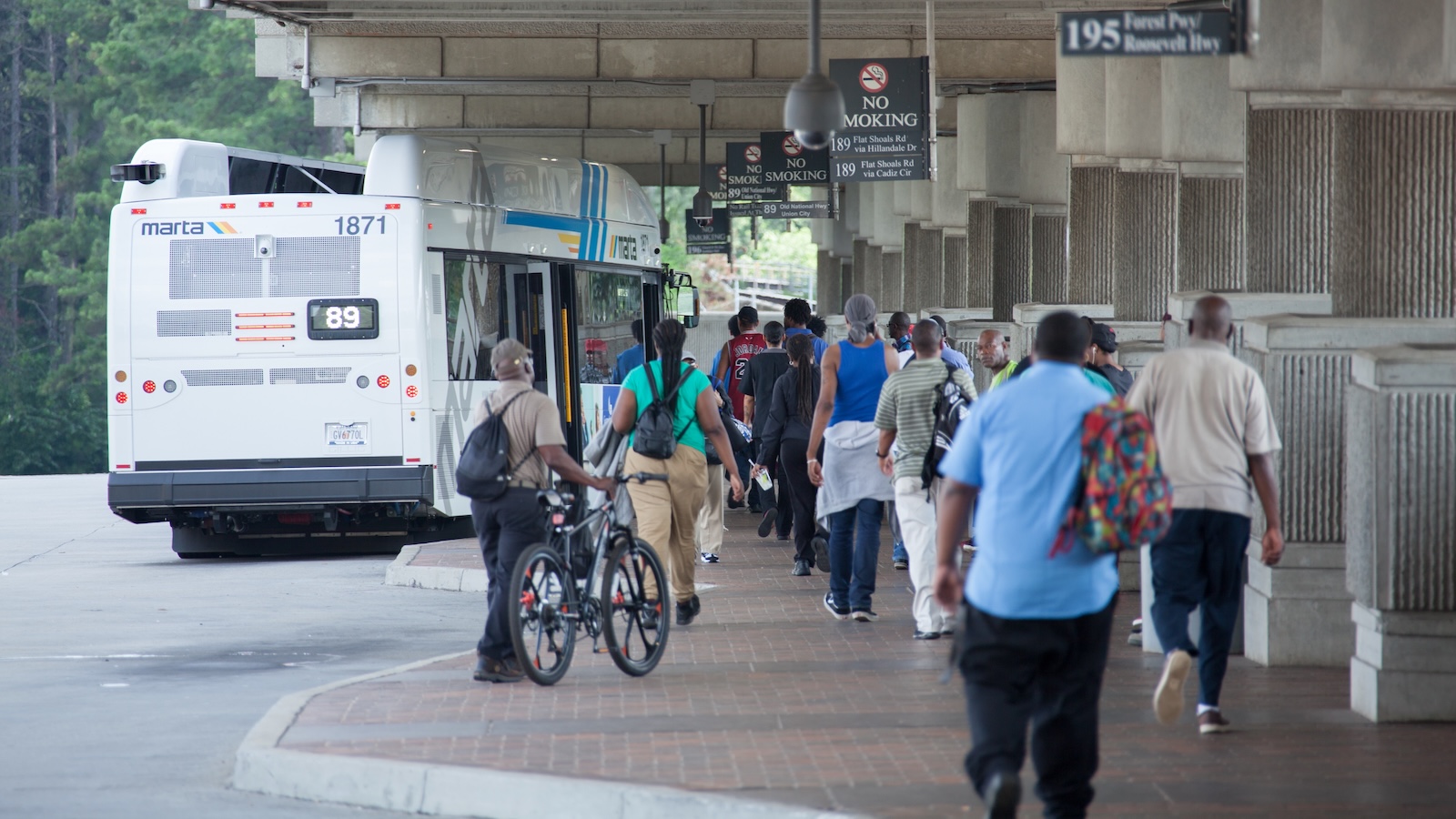
Some 2,600 miles to the southeast, another city is preparing for an influx of soccer fans. The Metropolitan Atlanta Rapid Transit Authority, or MARTA, is rolling out a major redesign of its bus network and preparing new railcars with expanded capacity, moves that will move more people more often during the event — and long after it.
Like Seattle, Atlanta did not make the list of 1994 World Cup host cities. But two years later, it faced a bigger transportation challenge: the 1996 Summer Olympics. MARTA added 7 miles of rail to ensure everyone got around efficiently.
Today, the system, which typically carries more than 5 million passengers per month, has 48 miles of track and more than 1,500 miles of bus network.
Soccer fans will discover a system overhauled first and foremost to serve residents. Beginning in 2021, MARTA started working with the community on the first revamp in 40 years. The remake launched in April, and although it cut the number of bus lines from 113 to 81, the agency said the change increased the number of residents who live within a quarter mile of a stop. It also nearly tripled the number of residents living near a route with buses that arrive every 15 minutes, according to MARTA.
MARTA also added a rapid transit line in downtown Atlanta and introduced 12 on-demand “microtransit zones” in which vans provide short rides within each zone.
Metropolitan Atlanta Rapid Transit Authority
The rail system saw similar changes. MARTA plans to update all 224 train cars, some of which have been in service since the 1980s, with more spacious interiors starting in June. Each four-car train will carry 752 passengers, a 13 percent increase. That will be a boon during the tournament, given that four stations are within walking distance of Mercedes-Benz Stadium.
The World Cup provided an incentive to move quickly. “Folks around here figured out if I want to get my projects some priority … I need to say ‘I want to do this for the World Cup,’” said Rhonda Allen, the agency’s deputy general manager.
Not everyone is convinced these projects will benefit the community, however. Bakari Height, co-founder of the transit advocacy group MARTA Army, said transit has stagnated since the Olympics, with only two stations added. He called the new trains a “subtle upgrade” and the bus redesign a “sour point” because it cut routes. He doubts the system will handle the World Cup.
“I don’t know if they’re really ready,” he said, “and for sure, not ready for these crowds.”
In some cities, the changes are smaller, but still practical.
The Massachusetts Bay Transit Agency will open an expanded station near Gillette Stadium in Foxboro this month. The $35 million project adds an additional platform that improves accessibility and allows the station to handle more cars. Caitlin Allen-Connelly, executive director of the advocacy group Transit Matters, said the upgrades will benefit people headed to New England Patriots games and concerts long after the tournament ends. “There was definitely a need to make beautification and accessibility standards to be able to accommodate this level of service for the World Cup,” she said.
That said, moving all those soccer fans around will impact residents. The MBTA is also reducing commuter rail service on most lines during the tournament. The transit agency said it has “made some minor reductions and adjustments” to service on non-game days to account for the need to reconfigure trains and make other changes to suit the influx of riders to the stadium to watch matches.
Kansas City Streetcar extended its southern service by 3.5 miles last fall and opened a 0.7-mile northern extension in May. While the line does not reach Arrowhead Stadium, it will help soccer fans reach the “Fan Fest” events that accompany matches. Shuttle buses will carry fans from there to the stadium. Tom Gerend, executive director of the Kansas City Streetcar Authority, said the city highlighted the growing system in its host-city bid and that the tournament provided additional pressure to finish projects. “We’re certainly using the World Cup as motivation to make progress and to have these services up and running in time,” he said.
Whether transit projects for the World Cup provide lasting gains often depends on who pays for them — and whether cities keep investing after the tournament ends.
So far, the federal government has done little to help host cities with this. The Department of Transportation allocated $100 million in March, or roughly $10 million per city — far too little to transform most transit systems. FIFA does not contribute anything toward transportation costs. That’s forced cities to seek funding elsewhere, including the fare box. The Massachusetts Bay Transportation Authority plans to charge $80 for round-trip train tickets to each World Cup match in Boston, while NJ Transit will charge $105 for round-trip tickets to games in New York.
Balsam Nehme, director of sustainability at Sidara Collaborative, a firm that advises on large-scale infrastructure and sustainability projects, said the World Cup can bolster greener transit if cities use it to test new ideas and accelerate existing plans. That can mean short-term fixes like shuttle buses or long-term investments like light rail, she said, so long as they fit broader sustainability goals. The priority, she said, should be “long-term system-level thinking.”
For Gerend, the most important question was what would be useful after the fans left. Kansas City, he said, avoided spending big on permanent event services with little long-term value. That meant using the World Cup as a deadline, not a blueprint. “Let’s invest our resources in permanent solutions that are part of a long-standing, regional plan that will have staying power.”

