

STEM by Design: Tools and Strategies to Help Students in Grades 4-8 Solve Real World Problems, 2nd Edition
By Anne Jolly
(Routledge/Eye On Education, 2025 – Learn more)
Reviewed by Michelle Schwartze
It is clear that Anne Jolly has a passion for and thorough knowledge of STEM education. This can be seen through her book STEM by Design: Tools and Strategies to Help Students in Grades 4-8 Solve Real World Problems, 2nd Edition.
In the first chapter, titled “Why Teach STEM?”, she describes the disconnect between the way we teach subjects currently in K-12 schools with how students are expected to interact in the real world.
The statement, “Our schools are turning out graduates who can do math and science in the classroom, but we are not producing graduates who know how to integrate these subjects to engineer solutions for problems,” (Jolly, 2025, p.3) is a pretty key reason to read this book and learn more about STEM education and how to incorporate it into the classroom.
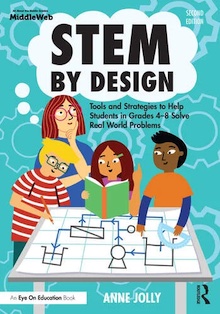 This book focuses on what STEM education is, what should be included in a STEM lesson and STEM program, and how to select STEM challenges. Throughout the text there are also chapters on aspects of STEM such as including diverse students, using the Engineering Design Process, life skills, integrating technology, and what types of assessment to use. The text itself is inviting, easy to read and follows a logical progression.
There are some “Think About” boxes throughout the text where the author gives a reflection question from the chapter. Some of these even suggest collaborating with colleagues. One example is on p.60 where it says, “Take time to mull these over and recognize some characteristics of STEM lessons. Then engage some of your colleagues in a discussion about STEM lessons.”
While I appreciate the moments to stop and reflect on the content, it sometimes made it seem more like a professional development book that should be purchased and reviewed with others instead of read individually. Thinking about how STEM is collaborative, though, this does fit the style that Jolly is advocating for.
STEM as a way of thinking
I appreciated Jolly’s frankness throughout her writing. One example is her constant emphasis that STEM is not a science or math lesson. I have heard many comments from teachers that they are incorporating STEM, but then when you look at their lesson it is really just a science lesson. There is so much more to STEM than that – it really IS a way of thinking.
All of the components Jolly mentioned are ones that I emphasize with my preservice teachers when teaching them the definition of STEM education. She explains them in a clear way and in Chapter 5 uses a checklist to evaluate whether lessons are fully STEM or not. She goes further to share three examples where the reader can use the checklist to evaluate whether or not they would be considered true STEM lessons. I liked how this was interactive and really helped the reader to visualize what a good STEM lesson would look like.
Throughout this text there are various links with documents and QR codes that take you to some of the resources. There is also a dedicated website filled with resources from the book.
While I like the access to online resources and the opportunities to print worksheets and examples, it was sometimes overwhelming within the physical text because there was not always a device nearby where I could look at some things right away. The publisher does offer an e-text option. All of the links were up to date which was helpful.
Tools well worth the read
Overall this is a very informative and easy-to-read text about STEM education in grades 4-8 that I think all middle school teachers would benefit from. It is written in such a way that you could easily make it a book club for educators and work through some of the chapters.
As a professor of preservice teachers, I am definitely going to use some of these resources to guide my students through learning what STEM is and how to teach it in middle school. Do not expect to walk away with example lessons, but you will walk away with the tools and resources necessary to either find quality STEM lessons or begin to write your own!
Michelle Schwartze is an Associate Teaching Professor at the Missouri University of Science & Technology. She teaches and advises elementary and middle level preservice teachers. Earlier she taught for 13 years in grades ranging from 3rd to 8th, mostly in the subjects of math and science.
Much of Michelle’s current work is in the area of STEM as she is a Project Lead the Way Launch teacher trainer, teaches a STEM methods course for her preservice teachers, and leads STEM lessons at the local middle school. She has presented at numerous conferences on educational and STEM related topics. You can find more information about her at https://sites.mst.edu/mschwartze/.

