

There’s an increasingly narrow strip of marshland in New Orleans that hardly anyone lives on, but without it, hundreds of thousands of people in Louisiana will face far greater risks from storms and floods.
The area, commonly called the New Orleans Land Bridge, separates Lake Pontchartrain from the Gulf of Mexico and stretches from New Orleans East to St. Tammany Parish, a distance of roughly 20 miles. Like much of Louisiana’s coast, it’s disappearing at a rapid rate.
The on-again, off-again effort to restore the land bridge could get a jump-start next year with a $101 million project aimed at reviving a large patch of marsh that protects the mouth of Lake Pontchartrain, a shallow estuary whose waters swelled with a storm surge during Hurricane Katrina in 2005, contributing to catastrophic flooding in New Orleans.
“This land bridge is one of the most critical natural barriers protecting the city of New Orleans,” said April Newman, a project manager for the Louisiana Coastal Protection and Restoration Authority. “Without it, the New Orleans levee system would be much more vulnerable to overtopping or breaching.”
Around 1.5 million people who live around Lake Pontchartrain and the adjacent Lake Maurepas, including residents in Baton Rouge and other cities near the two lakes, receive protection from the land bridge. Failing to restore it could mean the loss of the land bridge within 50 years, said Kristi Trail, executive director of the Pontchartrain Conservancy.
“Maybe that’s not in my lifetime, but it’s definitely in my children’s lifetime,” she said. “That’s pretty wild to think about.”
Christiana Botic / Verite News and Catchlight Local / Report for America
The land bridge includes the Interstate 10 bridge between New Orleans and Slidell, several fishing camps, and the Bayou Sauvage Urban National Wildlife Refuge in New Orleans, the largest national wildlife refuge that’s completely within a city. The area hosts a variety of fish, crab, birds, and other wildlife.
Louisiana is losing the equivalent of one football field’s worth of land every 100 minutes, according to the U.S. Geological Survey. It’s a complex problem, but key factors include erosion from storms and oil canals, sinking land, sea level rise, and levees, which cut wetlands off from land-restoring river sediments.
The most recent New Orleans Land Bridge project, completed in 2025, restored about 275 acres of marsh south of Fort Pike, a crumbling, 200-year-old fortification that bears the scars of several hurricanes. The entire land bridge is about 57,000 acres, roughly four times the size of Manhattan.
Earlier this month, a state and federal panel announced plans to restore 1,320 acres of the land bridge along the Rigolets, a narrow channel linking Lake Pontchartrain to the Gulf. The project, slated to start next summer, would rebuild land with about 5 million cubic yards of sediment dredged from a nearby lagoon. The restored area would be reinforced with plastic fabric “mattresses” filled with crushed limestone, an increasingly common tool in Louisiana coastal restoration projects that helps stabilize shorelines and blunt wave erosion while allowing water to pass through.
The final phase, set for completion in mid-2029, calls for planting native grasses and roseau cane, a plant with thick roots that anchor the soil and tall stalks that comb out river sediment, accumulating it to form new marshland.
The project’s $101 million budget would come from a fund created with nearly $9 billion that BP paid in penalties and settlements after the Deepwater Horizon oil disaster in 2010. The fund is overseen by the Louisiana Trustee Implementation Group, a panel that includes a host of state and federal agencies.
Louisiana’s “coastal master plan” calls for investing more than $1.1 billion in projects to restore the New Orleans Land Bridge. That amount of money would revive about 29,000 acres, according to the plan.
While the latest project doesn’t come close to what’s needed, it’s a step in the right direction, Trail said. “It’s happening in pieces, parts and phases, but it’s really important to do,” she said.
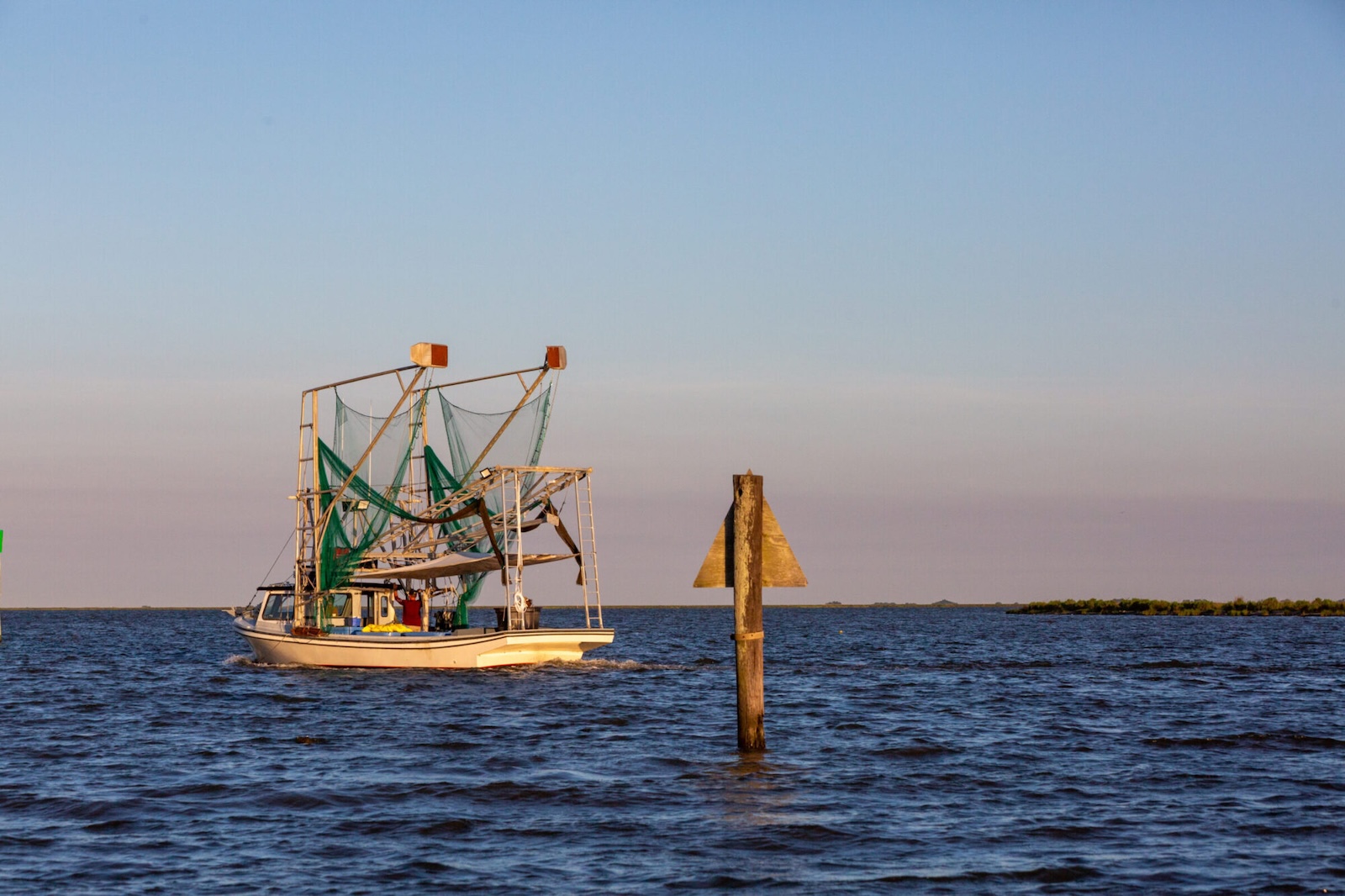
Christiana Botic / Verite News and Catchlight Local / Report for America
The state plans to spend $1.54 billion on 143 coastal restoration projects during the 2027 fiscal year. Excluded from next year’s plans are two long-awaited Mississippi River sediment diversion projects. The diversions, which would have cost nearly $5 billion over several years, were canceled in October by Governor Jeff Landry, a Republican, over concerns about rising costs and the possibility the effort might threaten oyster and shrimp fisheries.
Trail said the New Orleans Land Bridge project won’t be funded with money freed up by scrapping the diversions. But with billions of dollars now potentially available, the coastal authority plans to focus on similar land-bridge restoration projects and rebuilding barrier islands elsewhere along the coast.
“We’re losing land bridges just like we’re losing land all along our coast,” Trail said. “This one is particularly important because it does a daily job of protecting [New Orleans] from waves that can flood our lakefront. And when we get hurricanes, it’s one of our first lines of defense.”

