


By Melody Ifechi Enyinnaya, Community Development Advocacy Foundation
Every evening in Nigeria’s cities, smoke rises from open dumpsites. It is easy to mistake it for burning waste, but it’s not. It is methane, one of the most potent greenhouse gases, silently escaping into our atmosphere at an alarming rate from mountains of rotting organic waste.
Nigeria generates between 25 and 32 million tons of municipal solid waste every year. Less than a third gets collected. Almost none of it gets properly treated. The rest ends up in open dumps, where it rots, releasing gases that accelerate the very climate crisis our communities are already battling. I know this, not just from research. I know it from standing in those communities.
Between 5 and 7 June 2026, I was in Istanbul, Turkey, to attend the Zero Waste Forum, a global gathering of waste practitioners, scientists, policymakers, and community advocates.
For well over three days and twenty-two sessions, I heard the same urgent message repeated from every corner of the world: the waste sector is one of the fastest, most cost-effective places to act on climate change. And the action needed is not complicated. It is mostly being blocked.
‘’The waste sector is one of the fastest, most cost-effective places to act on climate change’’
One session’s title stayed with me long after I left the room: “Organic Waste Is a Methane Story, Not a Waste Story”. The science is stark. When food scraps, market waste, and agricultural residues are dumped in landfills/dumpsites, rather than composted or reused, they decompose without oxygen and release methane gas. The fastest way to reduce these emissions is simply to stop putting organic waste in the ground. This is not a solution for tomorrow, but for now, because there indeed is a climate emergency.
Back home in Nigeria, some communities in Lagos, Abuja, Benin City, and Jos are already doing exactly that. These communities in the different cities are not communities that appear on international climate agenda. They are agrarian communities where households generate organic waste daily, including food scraps, crop residue, and market leftovers, and where, until recently, this waste had one destination: the dumpsite.
In 2024, members of the Global Alliance for Incinerator Alternatives (GAIA AFRICA) in Nigeria, CODAF, GKF, SEDi, PAVE, CfEW and SRADev launched the Multi-Solving Action for Methane Reduction in Nigeria (MAMRN) project in communities across Lagos, Abuja, Benin City and Jos. The name describes exactly what the project stands for; it solves multiple problems at once. Climate, Waste, Livelihoods, Food security, and Governance all through one system.
At the centre of that system are the Material Recovery Facilities (MRFs), purpose-built community hubs where household and market organic waste is collected, sorted, and transformed. Organic matter becomes compost and animal feed. Plastics are recovered for recycling. Nothing goes to the dumpsite. The methane that would have risen from those rotting heaps of waste simply never forms. But the facility is only part of the story.
In Istanbul, Elizabeth Nsimadala, President, Eastern Africa Farmers Federation (EAFF), made a statement that stopped me mid-note: “Zero waste is in the soil, not in the trash”.
In Nigeria, smallholder farmers are being trained through the MAMRN project to compost organic waste rather than burn or dump it. When a farmer composts crop residue instead of setting it alight, three things happen simultaneously: methane emissions fall, chemical fertiliser costs decrease, and soil health improves. These are not three separate wins. They are one decision, understood correctly. The farmers in the MAMRN project do not need to be convinced that their soil matters. They already know it.
What the MAMRN project provides them is technical support, community infrastructure, and market connections that make composting economically rational, not just environmentally admirable. This is what the global conversation in Istanbul kept circling back to: the most effective zero waste solutions are not the ones imported from outside. They are the ones built around what communities already know, already need, and already have the capacity to do.
There is a community of people in every Nigerian city who have been practising resource recovery for decades without recognition, equipment, or protection. They are Waste Pickers. Every day, they move through markets and streets collecting plastics, metals, and organic matter that would otherwise end up in a dumpsite.
By one estimate, informal waste workers divert millions of tonnes of recyclable material from landfills globally every year. They do it without government remuneration. Without a formal contract. Without data being kept on their contribution.
“Zero waste is in the soil, not in the trash”, Elizabeth Nsimadala, President, (EAFF)
In Istanbul, a session on Global South zero waste leadership described waste pickers plainly: they are not a problem to be managed. They are climate actors. They deserve recognition, integration, and resources.
MAMRN project implementing organisations began to drive this work seriously prior to Istanbul.
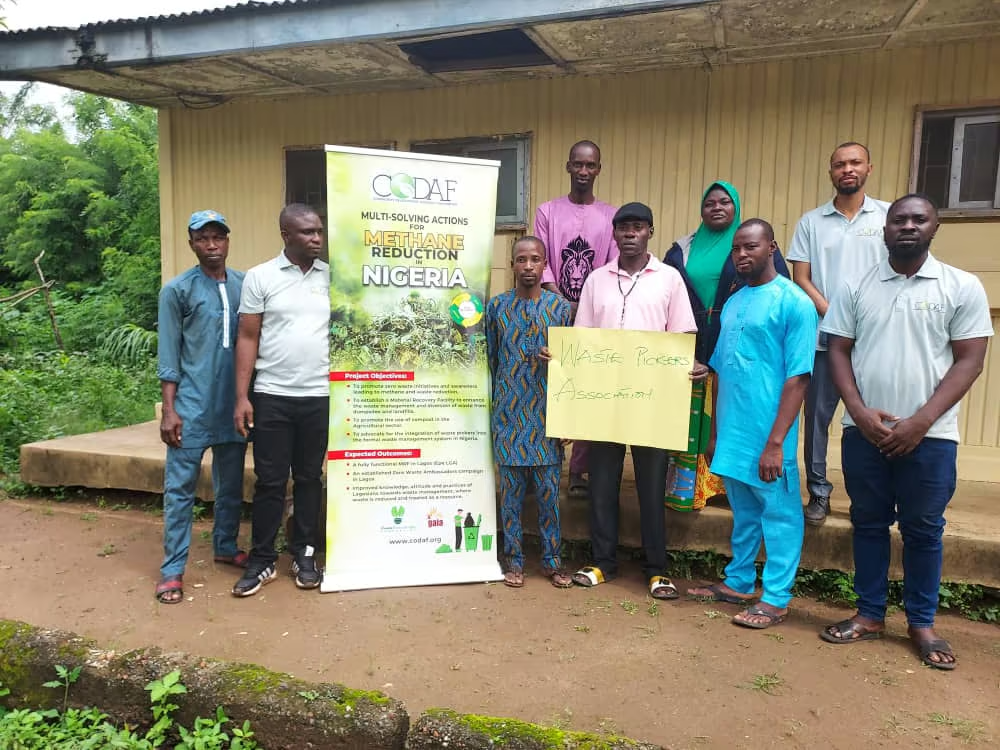
At the launch of the Zero Waste Parliament in Lagos, a community governance body was created under the MAMRN project to give residents a formal voice in waste policy. The President of the Association of Scraps and Waste Pickers of Lagos was elected as its first Speaker. Not as a symbolic gesture. But as a statement of fact, the people who understand waste best must lead the institutions that govern it.
The Parliament brings together waste pickers, farmers, women, youth, and community leaders to identify problems, propose solutions, and engage government institutions and policymakers on the policies that affect their communities. It is not waiting to be consulted. It is leading, and when the Parliament engages government agencies on waste policies, it is not asking for a favour. It is demanding accountability. This is what zero waste governance looks like when it is built from the ground up.
When people hear the phrase “zero waste”, they often imagine a distant, utopian future. A lifestyle trend for the privileged. A technical aspiration that requires perfect infrastructure and unlimited funding. The MAMRN project sites are evidence that it is none of those things.
Zero waste in those communities looks like a market woman bringing her food scraps to the MRF instead of throwing them into an open drain. It looks like a farmer spreading compost instead of buying chemical fertilizer that they cannot afford. It looks like a waste picker sitting in a Parliament chamber, putting a name and a face to the tonnes of material he recovers every week. It looks like a community that has decided its waste is a resource and built a system to prove it. None of this happened because the government mandated it. It happened because a community was organised, informed, and supported to act.
We will not pretend the system is complete or that the challenges are solved. Nigeria’s waste policies remain fragmented. Enforcement is weak. And the climate finance that could scale projects like MAMRN from one community to many more remains largely out of reach for frontline organisations.
In Istanbul, I sat in a session titled “Governing Zero Waste: From Political Commitment to Climate Delivery”. The core message was uncomfortable: governments have made enough commitments. The problem is delivery. Civil society cannot afford to wait for political will; it must build it.
Nigeria has pledged methane reduction targets under the Global Methane Pledge. It has signed international climate agreements. But commitments made in conference rooms do not move waste off dumpsites. Community-built systems do.
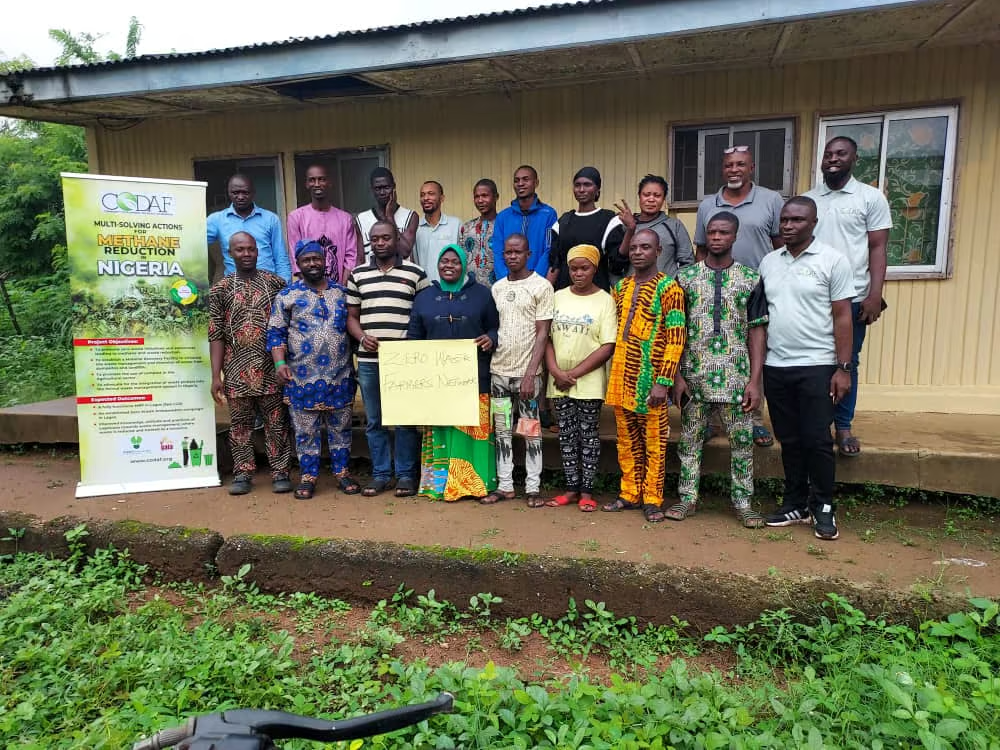
The MAMRN project is proof that those systems can exist. An MRF, A Zero Waste Farmers Network, A Zero Waste Parliament, Zero Waste Ambassadors moving through households, changing how families think about what they throw away. These are not pilot schemes waiting for government approval. They are working models waiting to be scaled.
Scaling them requires money, and the global system is failing communities here.
At the Forum, every conversation about finance ended the same way: the money exists, but it is not reaching the organisations doing the work. The Green Climate Fund, multilateral climate mechanisms, and circular economy investment are operational tools.
But the frontline groups in Nigeria and across Africa that are building zero waste systems from scratch face structural barriers that keep that finance out of reach. National governments receive the funds. The funds do not reach communities. This has to change. Not some time in the future, but now. Because the climate window is closing, and the solutions are already here.
The zero waste transition will not happen at scale until climate finance flows to the communities already doing the work, not just to the governments that promise to.
Nigeria does not need to wait for a perfect policy environment or unlimited resources to begin solving its waste crisis. It needs to scale what is already working. The MAMRN project is proof that community-based zero waste systems are not aspirational.
They are operational, they reduce methane, they strengthen livelihoods, they build governance, they include the people most often left out of the climate conversation, including waste pickers, smallholder farmers, market women and put them at the centre of the solution.
What the global community did in Istanbul was name, with great precision and urgency, the future we need. What GAIA’s Nigeria members and the community we serve are doing is building it. The zero waste future is not waiting to be invented. In pockets of Lagos, Abuja, Jos, Benin-City and in communities across the Global South that the world rarely looks at, it is already alive.
In Nigeria, the zero waste future is not coming. It is here and working.
That is the kind of future worth fighting for.
ENDS.

