

By Lien De Brouckere, Global Batteries Lead, GAIA
The typical story about second-life EV batteries goes like this: EV batteries degrade, and instead of being sent for recycling, innovative companies give the viable ones a next-best life as stationary energy storage for another 10+ years — storing solar energy, shaving peak demand, keeping the lights on during outages. It’s something that we at GAIA strongly advocate for, and that’s why I visited Moment Energy’s new Megafactory 1 outside Vancouver late last month.
I went to understand the state of the sector, what’s working, and where policy is falling short. What I didn’t expect was to walk away with an even more compelling story: repurposing surplus new EV batteries, outcompeting recycling companies for feedstock, and the need for more education about the key role stationary batteries play – whether new or repurposed – in reducing reliance on fossil fuels.
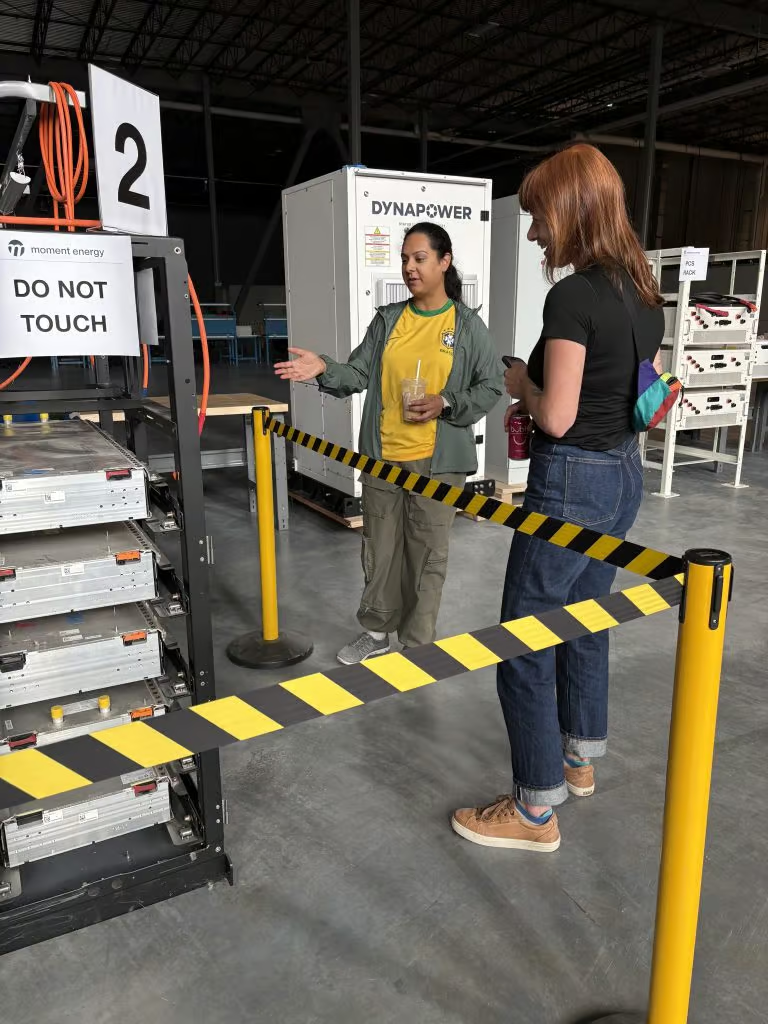
Moment Energy is one of a small number of companies worldwide repurposing retired EV batteries at commercial scale. Their new facility in Surrey, BC is the world’s largest second-life battery operation, manufacturing 1 GWh of battery capacity by 2030. Sumreen Rattan, one of Moment Energy’s co-founders and Chief Operating Officer, graciously hosted me at their facility that had just been inaugurated the week prior; staff and equipment were still at their other facility.
The Overproduction Problem
Here’s what caught my attention: today, Moment Energy’s primary feedstock isn’t retired EV batteries, because there are just not enough of those yet. It’s surplus battery production — cells and packs manufactured for EVs that were never installed in a vehicle, a direct consequence of the past few years’ massive overproduction. The large wave of genuinely end-of-life EV batteries is still ahead of us, with 953 GWh of capacity expected globally by 2030. Right now, the repurposing sector is partly running on the overflow from a manufacturing boom that outpaced demand.
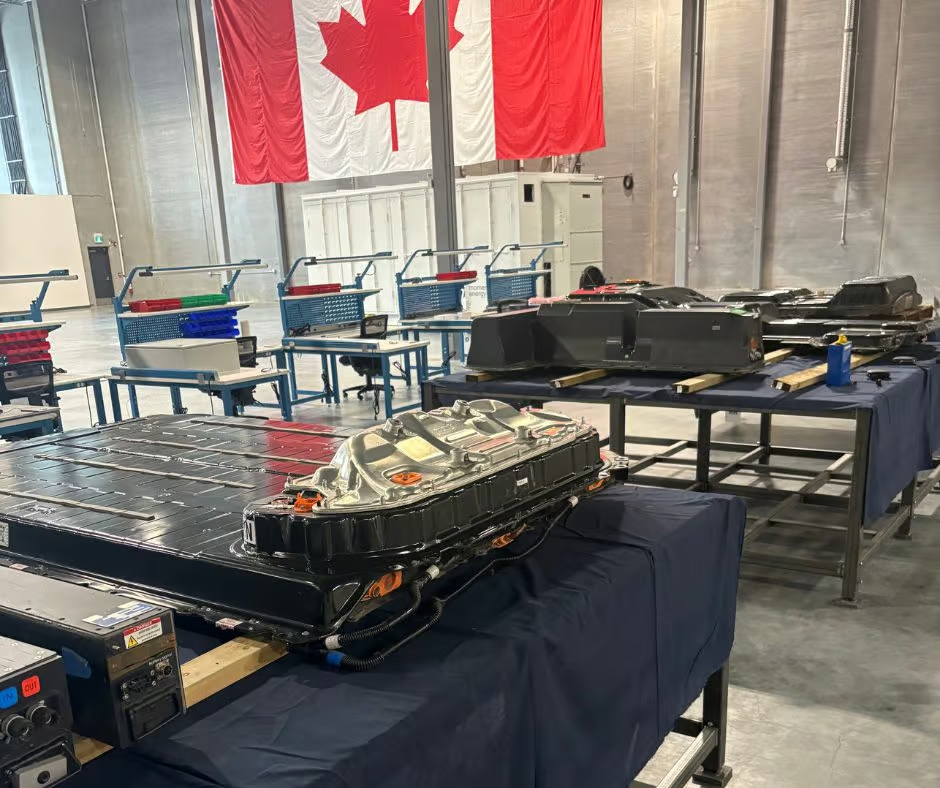
This matters for how we frame the problem. Battery waste isn’t only about what happens at the batteries’ end-of-life — it starts upstream, with how many batteries are produced in the first place. GAIA has been drawing attention to the massive scale of battery overproduction – 2 to 5 times global demand – in our work on mineral demand reduction, and it was striking to see it show up so concretely on the factory floor.
Outcompeting Recyclers — On Price
The other dynamic I learned about is how Moment Energy acquires batteries to repurpose. They work directly with OEM automakers, typically collecting retired batteries frequently at an average of 80% state of health. A battery leaving a car at that level of health isn’t worn out; it’s just no longer suited to the high-performance demands of an EV drivetrain. For stationary storage — where a battery sits in a stationary unit cycling energy, rather than accelerating a vehicle — it has potentially decades of useful life ahead.
Moment Energy covers all collection and transport costs, built into their business model. In some cases, they receive batteries at no charge, with logistics as the only cost. This means Moment Energy is competing with recyclers at the point of acquisition — and winning on economics. Recyclers typically charge OEMs for collection. Moment Energy doesn’t. For an automaker deciding where a battery goes, that’s a meaningful difference, and it’s one that policy should reinforce rather than leave to chance.
What the Megafactory Does Differently
The facility is designed to operate under UL 1974 certification — the safety standard for evaluating and grading repurposed or remanufactured electric vehicle (EV) batteries — and backs its systems with a 10-year warranty. These aren’t incidental details. They’re the difference between a product that can be deployed in grid-connected places such as hospitals, airports, and commercial buildings and one that can’t.
What is more, the Surrey facility is fully vertically integrated: batteries arrive, are tested at the cell level, assessed for second-life viability, repacked with Moment Energy’s own battery management system, assembled into commercial units, and shipped — all in-house.
One genuinely new capability is a cold environment chamber that accelerates battery degradation down to 60% state of health. This might sound like an obscure technical detail, but it matters: almost all existing industry modeling of battery performance stops at 80% SoH, the point at which a battery leaves an EV. Repurposers have largely been operating without good data on what happens after that. Moment Energy is building the testing infrastructure to understand the full second-life performance curve. No one else is doing this at commercial scale.
The Real Education Gap
One exchange from the visit has stayed with me. I asked whether the public and the market still needed convincing about second-life batteries — whether customer skepticism was a significant barrier. Sumreen Rattan pushed back on the framing.
“The education we need to do isn’t really about second-life batteries,” she said. “It’s about batteries in general — helping customers understand how storage saves them money through peak shaving and demand charge reduction. Once they get that, the second-life question takes care of itself.”
The examples that brought this to life were instructive. Moment Energy’s systems have been deployed alongside diesel generators in remote locations — including an island resort where their battery reduced diesel runtime by 75%.
I was accompanied on the visit by Matthew Tonello, Project Executive at Consigli Construction Co., Inc., who is exploring whether and how Moment Energy’s systems could replace diesel generators in a university and a playhouse project currently in the design phases. This was a concrete illustration of what Moment Energy is selling to commercial and industrial customers facing cost penalties when demand spikes. I learned that the goal isn’t simply to swap one power source for another. What Moment Energy is really selling, increasingly, is participation in a broader energy management logic: a system that can anticipate when a building or facility is about to hit a demand peak, automatically shift to drawing power from the battery, and dial back grid or generator draw before costs spike. This kind of automated load management builds a strong financial case for batteries within a smarter overall energy infrastructure system.
This education gap is a useful corrective. The conversation in civil society and policy circles often centers on convincing people that repurposed batteries are safe and reliable. But for many potential customers, the threshold issues — why would I want any battery storage at all and how do I use it? — are important first questions to address.
Where Policy Is Falling Short
Moment Energy has an active policy team in the US and Canada, although this doesn’t yet extend to Extended Producer Responsibility (EPR). That’s not unusual for a company at their stage, and it makes it all the more important that civil society organizations are present in the rooms where these frameworks are being designed.
Sumreen shared three important policy gaps to address.
There is no waste management hierarchy. In most jurisdictions, nothing requires that a battery be evaluated for second-life viability before it goes to a recycler. Recyclers compete for the same feedstock and have well-established collection infrastructure that gives them a structural advantage. Codifying a highest-and-best-use principle — second-life before recycling — would change the incentive structure in ways that market economics alone won’t deliver.
Data doesn’t travel with the battery. Assessing whether a battery is viable for repurposing requires its history: state of health, charge cycles, active faults, internal monitoring data. That information typically lives with the automaker and isn’t transferred when the battery changes hands. Without it, repurposers are partly testing blind. Battery passport frameworks need to address this directly, and civil society should be pushing for provisions that make this data accessible to the repurposing sector.
Tax incentives are doing heavy lifting — inconsistently. In the US market, Investment Tax Credit eligibility has been decisive for Moment Energy’s competitiveness against cheaper imported alternatives. But ITC rules weren’t designed with second-life batteries in mind, and eligibility isn’t always certain. Explicit policy design here — rather than leaving repurposers to navigate rules built for new battery manufacturing — would do more to level the playing field.
What Comes Next
The repurposing sector is further along than many people realize — commercially viable, technically credible, and already out-competing recyclers on price for batteries that have years of useful life remaining. The feedstock wave is coming. The infrastructure is being built. What’s lagging is the policy environment.
For those of us working on battery waste, the task is ensuring that the frameworks being developed now — on extended producer responsibility, battery passports, safety certification — treat second-life as a genuine priority not only for retired EV batteries, but to leverage surplus batteries.

