

July 26, 2026 By Stephen Sellers What began as a single day of strikes on February 28, 2026 has become one of the longest and costliest U.S. military engagements in decades, and the humanitarian toll on Iran’s youngest children has deepened rather than resolved. Nearly five months on, the threat to child nutrition described in our initial briefing has moved from a fear we anticipated to documented reality, compounded by a currency collapse, a leadership crisis, and a war whose ceasefire has repeatedly failed to hold.
Hunger Notes reported large-scale population displacements in February. Most of 3.2 million Iranians who were displaced have returned home. A residual caseload of displaced remains from destroyed housing: 149,528 civilian units damaged (according to the Iranian Red Crescent, in June); ~400,000 people had homes directly affected. Only ~9,000 were still in tracked shelters in June.
Iran’s safety net appears to be effective at reaching vulnerable children, and preventing rates of wasting from increasing. The Iranian Welfare Ministry food-basket program, Phase 34 (17–18 July 2026), which provides the most recent concrete figure, identifies 180,826 malnourished children aged 5–59 months who are enrolled for subsidized food baskets (152,788 in “very needy” households + 28,038 “moderate need”).
Malnutrition is worsening in the provinces Hunger Notes flagged as most vulnerable
Sistan-Baluchestan, which was named in our February briefing as an already-strained border province, remains the hardest hit by hunger. Up to one-third of children under five in the province now face severe malnutrition. Many families subsist on little more than bread and tea, and the loss of free school meal programs has left some students too depleted to concentrate in class or attend at all. Nationally, child stunting continues to concentrate in Sistan-Baluchestan, Kerman, and Hormozgan, alongside a parallel crisis of; roughly 30% of pregnant women are failing to gain sufficient weight during pregnancy.
The war has not ended — it has cycled through ceasefires that collapsed
After more than five weeks of fighting, the United States and Iran agreed on April 7–8 to a ceasefire that also encompassed Israel. U.S. President Trump extended it indefinitely on April 21, but both sides violated it almost immediately. A June memorandum of understanding sought to reopen the Strait of Hormuz and formally end the war within 60 days. Instead, fighting resumed in July after Iran struck three commercial vessels that had bypassed its pre-approved shipping route. By mid-July, the U.S. President had declared the ceasefire over following a new round of strikes after Tehran targeted vessels in the strait, and as of July 18 there was no sign the renewed fighting would end soon; a week of intensified strikes had left the ceasefire in tatters. Adding to the instability, Iran’s Supreme Leader Ali Khamenei was killed and buried after marathon funeral ceremonies. His son and successor, Mojtaba, has not appeared publicly since taking over leadership.
Overall food production is up this year, or near average according to the U.N. Food and Agriculture Organization. The Government is purchasing large amounts of wheat, but remains constrained in being able to pay farmers. Iran has imported 22 Metric Tons of food, with Russia as the main source.
Iran’s food supply (production plus imports) has recovered over the six months, while household food security has deteriorated sharply due to inflation and the collapsing value of the Iranian currency, the rial.
A collapsing currency has turned food into a luxury for many
The economic backdrop against which malnutrition is now unfolding is far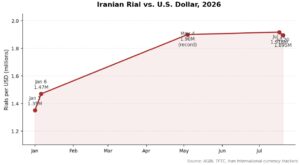 worse than in February. Iran’s currency, the rial, approached 1.95 million to the dollar on July 20 down in value by roughly a third since January,with the IMF projecting nearly 69% average inflation and a contracting economy for 2026, leaving the official minimum wage worth only about $87 a month. Iran has not published GDP data since 2024, and a nationwide internet blackout has made even the country’s own statistics hard to verify from outside.
Food prices have increased 140% year-on-year, with flour up 170% and rice up 220%. One dollar bought roughly 1,350,500 rials on January 1; by July 20 it bought nearly 1.9 million. This means a household purchasing-power collapse layered directly on top of the wartime disruption to food imports described in our original briefing.
The blockade of the Strait of Hormuz is squeezing food and fertilizer supply chains region-wide
More than 90% of Iran’s annual trade passes through the Strait of Hormuz. The strait’s effective closure, combined with a subsequent U.S. blockade, has cut off up to 70% of Iran’s export revenue. The damage is not confined to Iran. Since the end of February, roughly 3.9 million tons of fertilizer exports, about 30% of the Gulf states’ annual fertilizer trade, have been suspended, and shortage risk keeps rising the longer the strait stays closed. The war continues to choke deliveries of fuel, fertilizer, medicine, and aid shipments transiting the Middle East, forcing the World Food Program and Save the Children to reroute aid around restricted waterways, adding weeks of delay and millions of dollars in cost.
The war’s humanitarian shockwaves have reached far beyond Iran’s borders
Perhaps the starkest change since February is how far the malnutrition impact has traveled. This past March, Hunger Notes projected that increases in fertilizer prices would result in reduced food production worldwide, and resulting hunger.
Save the Children, the nonprofit, projects that every $5 rise in oil prices tied to the conflict wipes out a month’s worth of life-saving humanitarian aid for nearly 40,000 children. . In Nigeria, children who had recovered from malnutrition are relapsing: hospital records in Sokoto show nearly 40 children previously treated since February back under treatment, with many more undocumented, as families lose income to war-driven fuel price increases.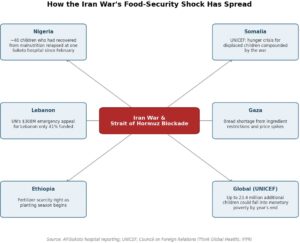 Hunger Notes, UNICEF, Reuters, and the Financial Times have warned that a continued war will likely push up to 23.4 million additional children worldwide into monetary poverty by year’s end.
What has changed, and what hasn’t
The core vulnerabilities identified in February include Iran’s large under-five population, pre-existing pockets of wasting and stunting concentrated in Sistan-Baluchestan and other border provinces, a food supply chain dependent on imports now vulnerable to blockade, and a government historically wary of Western humanitarian NGOs — have all held true and intensified. What has changed is the scale and duration: a war many observers once expected to last days or weeks instead approaches its fifth month with no durable ceasefire, a currency in freefall, a change in the country’s top leadership, and malnutrition effects now documented as far away as Nigeria and Somalia. Without a lasting cessation of hostilities and a functioning channel for food and medical imports, the compounding crisis facing Iran’s youngest children, and the children of countries dependent on the same shipping lanes and aid budgets, shows no sign of leveling off.
Humanitarian aid to Iran is relatively small. Domestic organizations, such as the Iranian Red Crescent Society, provide most aid. In April 2026, the ICRC delivered more than 170 tons of relief supplies, followed by another 18-ton shipment in June, UNICEF continues to provide child health, nutrition, vaccines and hygiene.
Further Reading:
FAO’s Global Information and Early Warning System

