

August 2, 2026 At the 2025 roundtable about America’s comparative advantages for solving hunger, food insecurity and nutrition overseas, organized by World Hunger Education Service with other sponsors, participants agreed that America should keep providing quantities of “Ready to Use Therapeutic Foods” (RUTFs) as a magic bullet for fighting hunger.
Indeed, aid agencies, foundations and the U.S. Government have provided more and more of this peanut-based, fortified paste around the world in programs of “targeted feeding” that enroll children suffering from wasting (“acute”) malnutrition, which is life-threatening. Wasting malnutrition is one of the top three main causes of deaths in famines, refugee flight, and complex emergencies.
HISTORICAL BACKGROUND: Over the last half century, NGOs, governments, and INCAP in Central America have experimented with novel new approaches toward developing foods that best save the lives of severely malnourished children and ensure their recovery. For most of that time period, the standard food for supplementary feeding for undernourished children has been porridge, frequently corn or wheat-based porridge, supplemented with vegetable oil and sugar. The USG. report, Beyond Child Survival, cataloged other earlier initiatives such as Fafa in Ethiopia and Likuni Phala in Malawi, which were effective at treating malnourished children.
A major step forward came in 1996, when Michel Lescanne of Nutriset and French pediatric nutritionist André Briend came up with a new formulation called “Plumpy’Nut” that closely matched the WHO-recommended formula, “F-100” for inpatient (hospital) treatment of malnourished children. For children with shrunken stomachs and limited appetite, it optimized the child’s chance to survive and recover from malnutrition.
Plumpy’Nut, produced in France by Lescanne’s production organization, Nutriset, was designed to have a long shelf life, to be appetizing for even malnourished children with reduced appetite, to taste good, and to have the right balance of fats, vitamins and minerals that a malnourished child should have. The idea was to create a food that could be handed to a family once a month, with sachets that a small child could open and eat each day.
Plumpy’Nut became the first in a line of products collectively referred to as “ready-to-use therapeutic foods”, which share similar nutrient compositions and are now used at large scale by groups like UNICEF, MSF, Concern, Action Against Hunger, and Save the Children.
In the last two and a half decades these RUTFs have become a core part of a new model for reaching children with malnutrition, known today as “Community Management of Acute Malnutrition,” or “CMAM.” This model does not require family members to take time to bring young, malnourished children to a central feeding center, which had been the previous main model. Children are still observed, measured and given medical attention, but monthly, not daily, and via an outpatient, or mobile community model.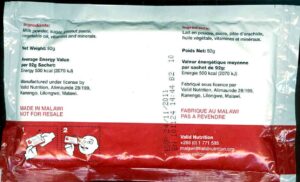
NGOs give families supplies of these 92-gram sachets at a community clinic, mobile van or displacement site. The child eats the paste directly, without cooking, clean water, refrigeration, or admission to a hospital. A standard sachet supplies approximately 500 kilocalories and comprises: Peanut paste, Skimmed-milk powder or other dairy ingredients, Vegetable oil, Sugar, and vitamins and minerals from a commercial premix powder.
CONSCIOUSNESS
There’s something about RUTF and Plumpy’Nut that resonates with people and encourages them to donate. Plumpy’Nut has proven to be popular among the public, media and donors. World Vision uses Plumpy’Nut to focus attention and drive private fundraising. A CBS 60 Minutes episode about the use of Plumpy’Nut in Niger, West Africa was reportedly the most popular episode in the decades-long history of that television show.
SCALE AND COVERAGE
While UNICEF promotes supplies of RUTF across lower-and middle-income countries (LMICs), it is too expensive for poor households to purchase and does not reach most of the children who need it. Most RUTF has been used in emergencies, where international NGOs tend to be more present, and where malnutrition is often more concentrated. Despite the increased scaling of RUTF, in most years 80% of malnourished children don’t get any.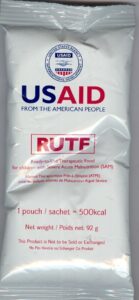
In the last few years, governments have been increasingly supportive of RUTF, increasing donations to UNICEF and NGOs to several hundred million dollars worth. The Eleanor Crook Foundation has sought to engage private foundations and companies to donate. RUTF is on the approved commodity list of foods that NGOs can request from Food for Peace at USDA.
PRODUCTION
In the early 2000s, there was essentially one qualified international source of RUTF, i.e. Nutriset in France. Nutriset and donors have encouraged other factories to start up.
By 2025, UNICEF reported more than 20 suppliers across Africa, Asia, Europe, and the Americas. Roughly half of UNICEF-procured RUTF is estimated to be from suppliers in low- and lower-middle-income countries such as Ethiopia Burkina Faso, Kenya, Madagascar, Niger, India, Haiti, Sudan.
In the United States, there are three certified producers: Edesia in Rhode Island, recently profiled by Hunger Notes; MANA Nutrition, based in Georgia, and Tabatchnick, in New Jersey. Between 2022-2024, Edesia shipped over 6 million cases (or 900 million sachets) of RUTF, while MANA shipped 300 million packets.
COSTS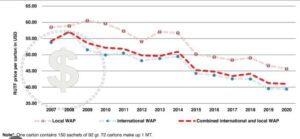
Costs of producing RUTF had been steadily declining from the 2000s to 2020, as seen in the graph at right. However, the cost of food ingredients, such as dairy milk, has increased in recent years, forcing up the cost of producing RUTF.
Production in LMICs has been limited by the high costs of quality control, ensuring none of the food is contaminated, and the import costs of key ingredients. The costs of production locally often tend to exceed the costs of importing from France, the U.S., Norway, India, or South Africa.
UNICEF is the world’s largest buyer of RUTF, at around 49,000 metric tons each year, deploying cartons to some 3.5 million children. A graph of estimated annual production of RUTF appears at right.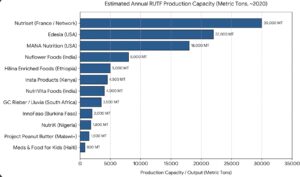
ALTERNATIVES
As noted in the recent Hunger Notes article about Tufts University’s Food Aid Quality Review, controlled studies of field effectiveness and efficiency suggest that more children could be reached, and lives saved, with other formulations and foods, taking into account the cost. For example, Tufts noted that Corn Soy Blend Plus was more efficient in the recovery of wasted children.
NGOs are partnering with researchers in finding new solutions. Edesia Nutrition is working with Action Against Hunger in “Novel RUTF” development, such as alternative protein sources (e.g., plant-based soy/maize to replace or reduce expensive milk powder) for lower cost, local producibility, climate resilience, and acceptability while meeting nutritional specifications. They are pursuing microbiome-directed enhancements (e.g., via partnerships with OpenBiome, a U.S. nonprofit microbiome research organization) to incorporate beneficial microbial communities or prebiotics into RUTF-like products.
Ongoing field research is testing the scalability, bio-utilization, and overall benefits of RUTF variants. One experimental form is MDCF-2, a microbiota-directed food based on chickpeas, soy, and green banana, recently noted in the New England Journal of Medicine. This MDCF-2 represents a new line of thinking, with fewer calories as it reframes “recovery” to include the microbiome, the plasma proteome, address environmental enteric dysfunction, and durability — not just weight-for-height.
The dairy ingredients in/of RUTF are expensive. Alternatives that do not use milk replace it with crystalline amino-acid fortification, with alternative bases such as oats or fish. A recent fish-based paste (NumTrey, Cambodia) matched weight gain among children, when compared with standard RUTF, but suffered intra-household sharing/acceptability problems (other children ate it).
Many locally-produced variants increase the density of the least-expensive inputs. Mark Moore of MANA wrote, “Most of the newer, lower-cost formulas achieve savings by increasing the cheapest ingredients. Sugar and oil are incredibly cheap most everywhere.” But, he continues, “If this were my child who was severely malnourished, would I rather have a product built primarily around sugar and oil because it is cheaper, or would I rather have the original formulation with 35-40% peanuts and other more nutrient-dense ingredients?” 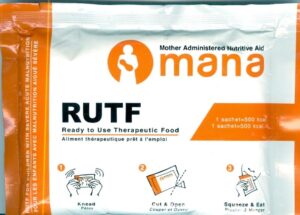
The Mark Manary Lab has promoted a new formulation that adds pre-formed DHA (omega 3) needed for brain development. Using more omega-3 fatty acids and less omega-6 fatty acids adds 6-15 IQ points to every child treated. Trials in Malawi suggest it led to superior cognitive, brain outcomes 6 months post treatment, compared to standard RUTF. An MFGM-enhanced variant adds milk fat globule membrane to support brain development. Separately, a rice-bran-enriched RUTF (SEHAT) was tested in Indonesia and showed increased weight gain among children.
Other advances include the use of additional inputs, as child recovery may be limited due to bacterial infection and gut inflammation, not just nutrients. An oral antibiotic has been seen to reduce the death rate of children from 7% to 3.5% So, amoxicillin (antibiotic) provision improved recovery and cut mortality. An azithromycin trial in Niger hinted at mortality benefit in underweight children, tempered by antimicrobial-resistance concerns.
– Contributed by WHES board member, Steven Hansch

