

The Community Development Advocacy Foundation (CODAF) is a Nigerian NGO bridging the gap between policymakers and grassroots communities on environmental issues.
CODAF tackles climate change through innovative zero-waste initiatives, converting organic waste to compost using Black Soldier Fly technology while training Zero Waste Ambassadors and the Zero Waste Farmers Network in zero-waste and agroecological practices.
CODAF holds extractive industries accountable by exposing environmental violations by mining and oil companies in the Niger Delta and the Northern and South Eastern parts of Nigeria.
Through our projects, capacity building, and policy advocacy rooted in the African Charter on Human and Peoples’ Rights, CODAF empowers communities to defend environmental rights and manage resources sustainably without marginalization.
In this article, part of a series, we spoke with Richard Bini, the Executive Director of CODAF, about their work as a partner in Epe, Lagos State, for the MAMRN project.
Thank you for joining us, Richard. Several organizations carry out the project through different activities, but with the same goal. Can you share some insights on best practices for collaborating with other organizations on a project in Nigeria?
CODAF’s collaboration approach centers on strategic partnerships that amplify impact while respecting local leadership.
As a member of GAIA, CODAF leverages local organisations, including GAIA members and non-members, to strengthen local methane reduction initiatives and bring diverse, aligned expertise to community-level implementation in Epe.
Our collaborative model emphasizes:
- Integrating GAIA’s technical knowledge with CODAF’s grassroots engagement expertise to reach local institutions and non-GAIA members.
- Ensuring local organizations support rather than direct local initiatives
- Complementary strengths where other organisations/institutions are blended into our idea and belief, including universities providing aligned research, government agencies getting involved in creating policy pathways via our zero-waste parliament structure, while GAIA members contribute zero-waste technical capacity.
- Regular stakeholder meetings align diverse actors, including other organizations around our common goals.
This approach transforms partnerships into genuine collaboration where communities remain primary decision-makers while benefiting from expanded resources and knowledge.
Could you share some perspective on the current waste crisis in Nigeria and how this project aims to address this?
Nigeria is currently facing a severe waste management crisis that is as much about the climate as it is about public health, with most communities lacking proper disposal infrastructure, leading to massive dumpsites that generate methane.
In Lagos State alone, Lagosians generate thousands of tonnes of waste weekly, with organic waste decomposing in open dumps that act as “methane bombs”, polluting air and water while contributing significantly to climate change.
Do you have a personal milestone or favourite moment in this project so far?
A standout milestone for us was our final groundbreaking on the construction of the Epe Material Recovery Facility.
Watching a site once abandoned and dilapidated transform into a structured hub for resource recovery was incredibly powerful. It made our vision for methane reduction tangible; we weren’t just talking about abatement; we were building the solution.
But the real magic happened when we launched the Zero Waste Parliament. Seeing the room filled with the entire waste value chain, government officials, zero waste ambassadors, and our Zero Waste Farmers Network was a “pinch me” moment. These groups are now a unified movement. Our favorite part is seeing our farmers and ZeWA championing the message, showing how organic waste from the MRF is literally reviving their soil.
What is the path forward for your organisation and possible next steps from this project?
Our goal is to scale the “Epe model” into a national blueprint. We want to see a decentralized Material Recovery Facility in every local government, moving Nigeria away from the era of toxic mega-dumpsites.
We also hope to see the Zero Waste Parliament become a permanent advisory body that can influence national policy directly. We also want to expand the Zero Waste Farmers Network so organic compost becomes the default choice for Nigerian agriculture. We’re moving from a single project to a nationwide movement for justice.
We have seen these key themes emerge in this project (Organic Waste Management, Infrastructure Development, Waste Picker Integration, Capacity Building and Awareness Raising, Local Government Engagement, National Policy Advocacy and Emissions Monitoring. Could you share experiences (as applicable) on any of these topics within this project so far?
Our journey in Epe has shown us that you can’t fix the waste crisis without first addressing the human crisis. That is why Waste Picker Integration is at the heart of everything we do. We are currently developing a Waste Picker Integration Manual. It’s designed to guide both communities and the government on how to transform informal work into dignified, green jobs.
On the Infrastructure and Organic Waste front, building the MRF was our “proof of concept.” It turned the abstract idea of methane reduction into something people could touch. We’ve watched organic waste, which used to rot and smell in the sun, become high-quality compost.
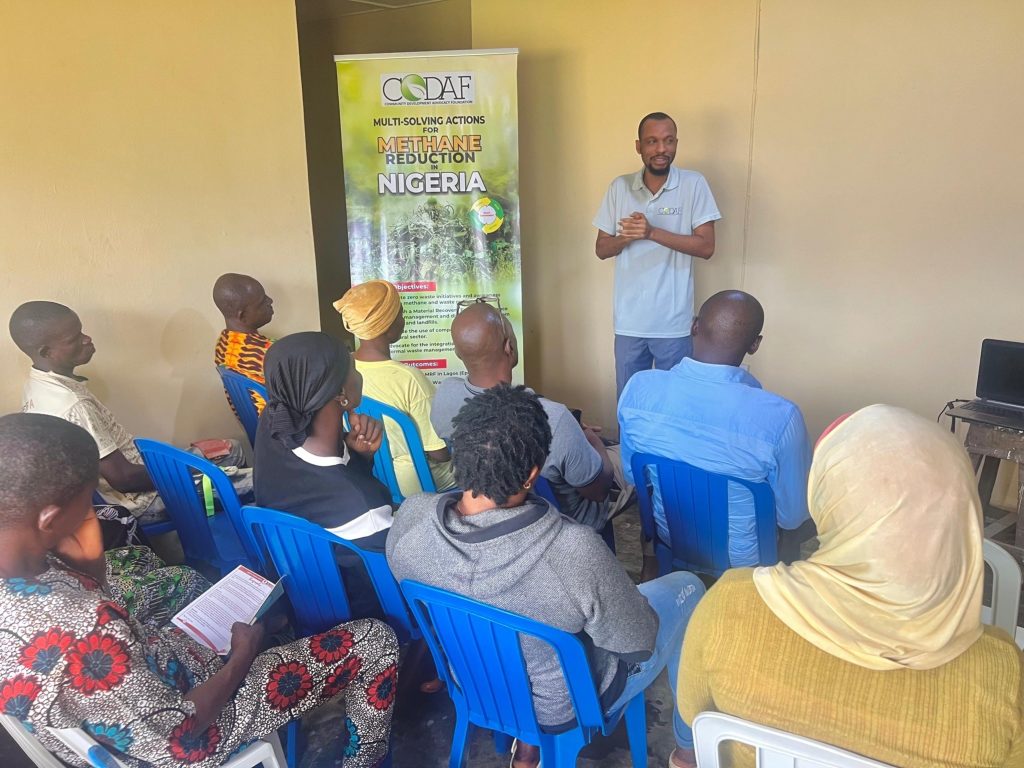
This vision comes alive during our capacity-building sessions. We’ve brought together Zero Waste Ambassadors, Zero Waste Farmers Network, and waste pickers in Epe for training.
It’s been incredible to watch these groups lead awareness campaigns together, teaching their own neighbors about segregating waste at the source and why diverting organics from the dumpsite is a win for the climate and the soil. Also, seeing a farmer hold our compost and realize they don’t need to buy expensive, soil-stripping chemicals is when “zero waste” actually clicks for people.
Of course, none of this works in a vacuum, so we’ve been deeply engaged with policymakers. We are working closely with the Epe LGA to ensure local ownership, while also collaborating with the Lagos State Ministry of Environment and LASEPA.
Our goal is to show them that the Epe MRF isn’t just a one-off project; it’s a scalable model for the entire state. We are advocating for a shift where the government sees waste as a resource to be managed locally, rather than a problem to be buried.
