

September 6, 2026 “Build roads” to combat hunger was (Fritz) Shlomo Reutlinger’s simple, final advice, when he was speaking to a roomful of food experts in Virginia as he retired from a long career at the World Bank to move to Israel, where he then lived until his passing in 2019 at the age of 93.
He was born in Pforzheim, Germany, in 1925. His father, Louis Reutlinger, a veteran of World War I, sold construction materials. Shortly before young Shlomo was to celebrate his bar mitzvah, the Kristallnacht pogrom broke out. His teacher warned Shlomo to avoid school in time for him to escape, though many of his family’s friends were sent to concentration camps (Buchenwald, Dachau).
Fleeing Nazi killers, Shlomo escaped Germany as a child, fleeing to Belgium in 1939. His younger brother Erich (shown together in the photo at right) went with him to Belgium, where they were separated. Erich died in the Holocaust.
After reaching America, Shlomo Reutlinger eventually reunited in 1956 with his sister and parents, who had been interned in France before immigrating to the United States.
He went on to earn a degree in economics, studying at Cornell University and North Carolina State University. He then worked at the World Bank in Washington, DC.
Dr. Reutlinger anchored food security analyses at the World Bank for decades. The World Bank is a very large organization, but for many years, Reutlinger and Alen Berg were the two individuals who pushed the World Bank to pay attention to nutrition and health outcomes among the poor.
Colleague Dale Miller Hill remembers: ” I … was inspired by his emphasis on Hunger not being just a function of food supply, but also income, including from food production, and nutrition.”
He was known for his ability to analyze complex economic data and translate it into actionable policies that benefited developing nations. During periods of economic instability, he was instrumental in crafting recovery plans that balanced short-term relief with long-term sustainable growth. His expertise was particularly valuable in regions facing severe economic downturns, where his insights helped shape policies that provided both immediate support and a path to economic resilience.
Throughout his influence in the World Bank, he was kind to his friends. Hailu Mekonnen reflects: “Shlomo was not only a food security guru but also a wonderful human being…a human being who “walked the talk” in the true sense of the concept…involving its ethical meaning.”
His early influential work, the 1976 World Bank staff occasional paper Malnutrition and Poverty: Magnitude and Policy Options (co-authored with Marcelo Selowsky), provided new methodologies for estimating malnutrition across income groups and offered practical policy options centered on reaching the poor. They estimated the hunger problem as universal, with 56 percent of the developing world’s population (roughly 840 million people) with diets deficient by more than 250 calories a day. They defined the “target group” narrowly as the calorie-deficient poor identified through income-distribution analysis. They recommended, on cost-effectiveness grounds, that narrowly targeted instruments (food stamps, self-targeting commodities, income transfers) were superior to universal urban consumer-price subsidies, which cost roughly $5 to deliver just $1 of additional food to the truly needy.
Reutlinger and Selowsky concluded that malnutrition was unlikely to disappear through normal income growth and food-production expansion alone. Under unequal income distribution, the absolute number of undernourished people could continue to rise with population growth—even if average income and food availability improved.
His subsequent classic World Bank report, Poverty and Hunger, co-authored with Jack van Holst Pellekaan (with assistance from Craig Lissner, Claudia Pendred, and Colleen Roberts) was a breakthrough at many levels, and the first mapping of where hunger occurred most densely in the world. 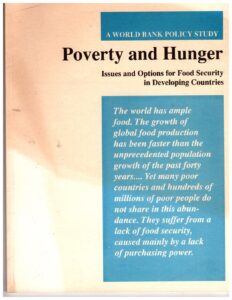 It offered a clear useful distinction between two types of food insecurity, that has endured:
- Chronic food insecurity: Persistent inability to acquire enough food for an active, healthy life due to low incomes. In 1980, an estimated 340–730 million people (roughly one-sixth to one-third of the population in 87 developing countries, excluding China) had energy-deficient diets, depending on whether the threshold was set at 80% or 90% of FAO/WHO requirements. Absolute numbers of the hungry were shown to be increasing even as proportions slowly declined.
- Transitory food insecurity: Temporary shortfalls caused by fluctuations in production, prices, incomes, or import capacity (e.g., droughts, export-earnings volatility, or price spikes). Famines, the report stresses (drawing implicitly on Amartya Sen’s entitlement framework), often occur even when food is physically available locally—because the poor lose purchasing power or employment.
Internationally, the report calls for accelerated growth-oriented adjustment lending, poverty-focused programs, better coordination of food and financial aid, multiyear food-aid commitments, and support for risk management (e.g., IMF compensatory facilities).
Food aid is portrayed by Reutlinger as most useful when integrated with development rather than used purely for relief. It framed how World Bank lending can best reduce hunger. Key instruments include:
- ¤ Raising incomes of the poor through employment generation and human-capital investments.
- ¤ Targeted transfers (food rations, public works, or cash) that minimize leakage to the non-poor.
- ¤ Selective consumer price subsidies (especially on processed staples consumed by the poor) rather than blanket general subsidies that strain budgets and benefit richer groups disproportionately.
- ¤ Trade policies that lower prices for net food buyers (urban poor, landless
 rural households) while compensating producers where needed.
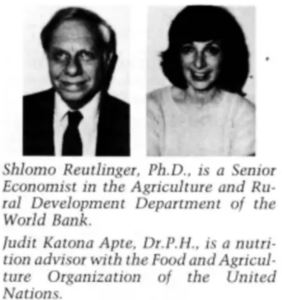
Writing with food anthropologist Judit Katona-Apte (WFP, OCHA), in “The Nutritional Impact of Food Aid: Criteria for the Selection of Cost-Effective Foods”, they coined the term “alpha-value” to reference the nutritional benefit(s) of food aid, providing the framework for studies that showed where food aid was cost efficient, and where it was not efficient, compared to other interventions. Reutlinger and Katona-Apte observe about how the poor make consumption choices “On average, the food expenditure elasticity is 0.85, and the energy intake elasticity is about 0.50. The discrepancy between the food expenditure elasticity and the energy intake elasticity is the elasticity of the cost per unit of energy. As income rises, people purchase more expensive foods per unit of energy.”
The report was refreshingly candid about administrative realities, leakage problems, and the political economy of subsidies. It incorporates household-level income variability data (e.g., from India and Nigeria) and recognizes that aggregate national food balances often mask severe intra-country and intra-household insecurity.
The poor’s status as net food buyers, net sellers, or subsistence producers should determine whether lower prices, higher farm prices, imports, agricultural production support, or transfers will improve food security.
Across his roughly two-decade World Bank career, Reutlinger’s thinking moved from a stark, quantitatively dramatic diagnosis of malnutrition toward an increasingly integrated, market-and-context-sensitive prescription for intervention.
Early on, he addressed malnutrition primarily as a magnitude-of-deficit calculation to be closed by targeted subsidies or trade stabilization alone. He addressed specific groups such as landless laborers, small farmers, pastoralists, and especially children under five and pregnant or lactating women.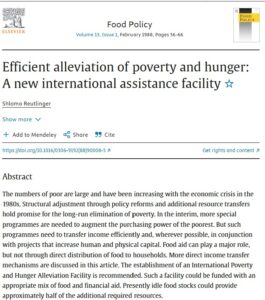
His “A Simulation Model for Evaluating Worldwide Buffer Stocks of Wheat” recommends insurance-oriented storage rules for global food reserves. He also argued that for most countries, particularly developing countries, trade liberalization and avoidance of protectionism would stabilize food supply and domestic prices more effective than buffer stocks of plausible size. Buffer stocks became less useful at the margin as a country became more open to trade, while storage, financing, depreciation, and handling costs remained substantial.
Reutlinger’s work made a sustained case that nutrition was an economic-development issue, not merely a health-sector concern. His analysis linked hunger to productivity, education, labor capacity, and human-capital accumulation, creating intellectual support for bringing nutrition considerations into agricultural and rural-development operations.
Yet, he also observed that famines and acute food insecurity often stem from lost livelihoods and purchasing power, not simply a physical absence of food. His solution was to monitor shocks to employment, wages, terms of trade, harvests, and prices, provide fast cash, food, or employment relief to affected groups.
Reutlinger was also a strong proponent of education and capacity building. He believed that empowering local economists and policymakers was crucial for sustainable development. Throughout his career, he mentored numerous young economists, encouraging them to think critically and creatively about economic challenges. His legacy includes a generation of economists who carry forward his vision of development that is both inclusive and equitable.
His colleague at the World Bank, Hailu Mekonnen remembers: “Over lunch, Shlomo and I used to talk about books. The two that come to mind are Marcus Aurelius’ “Meditations” and Aristotle’s “Nicomachean Ethics,” on developing inner and outer peace and the second is on the ethically-driven good life. Shlomo pursued both. In the early 1990s, he told me that he and his wife saw, at the Folger Theatre in Washington, D.C., a production of Henrik Ibsen’s “A Doll’s House” and recommended that my wife and I see it. [reflecting] our commitment…his and mine to promote the equality of women.”
Beyond his professional achievements, Reutlinger was remembered for his kindness and humility. Colleagues and friends alike recall his willingness to listen and his ability to inspire those around him. He had a unique talent for making complex economic concepts accessible and engaging, whether he was speaking to fellow economists or the general public.
At his retirement party, Reutlinger quoted Rabbi Hillel, who said “if I am not for myself, who will be for me? If I am only for myself, what am I? If not now, when?” Upon retirement he returned to Israel where he lived immediately after WW II, with his wife, Blossom. Their two children made aliyah with their families as well.
Reutlinger passed away in 2020, in Israel. He was survived by his children, Raanon Reutlinger and Elana Reutlinger, his sister Ruth, grandchildren, and extended family.
-Contributed by WHES Board member Steven Hansch

