

Let’s put this summer’s extraordinary heat in perspective.
Last week, the National Oceanic and Atmospheric Administration confirmed what so many Americans suspected, that the heat has been extra unbearable lately: This meteorological summer, which runs from June through August, was the hottest on record for the contiguous U.S., beating the previous champions of 1936 and 2021 by 0.4 degrees Fahrenheit. Compared to the average over the 20th century, this summer was 3 degrees hotter, with August specifically climbing even higher at 3.5 degrees. Across the pond, Europe has been suffering under one heat wave after another, which have killed more than 25,000 people this year.
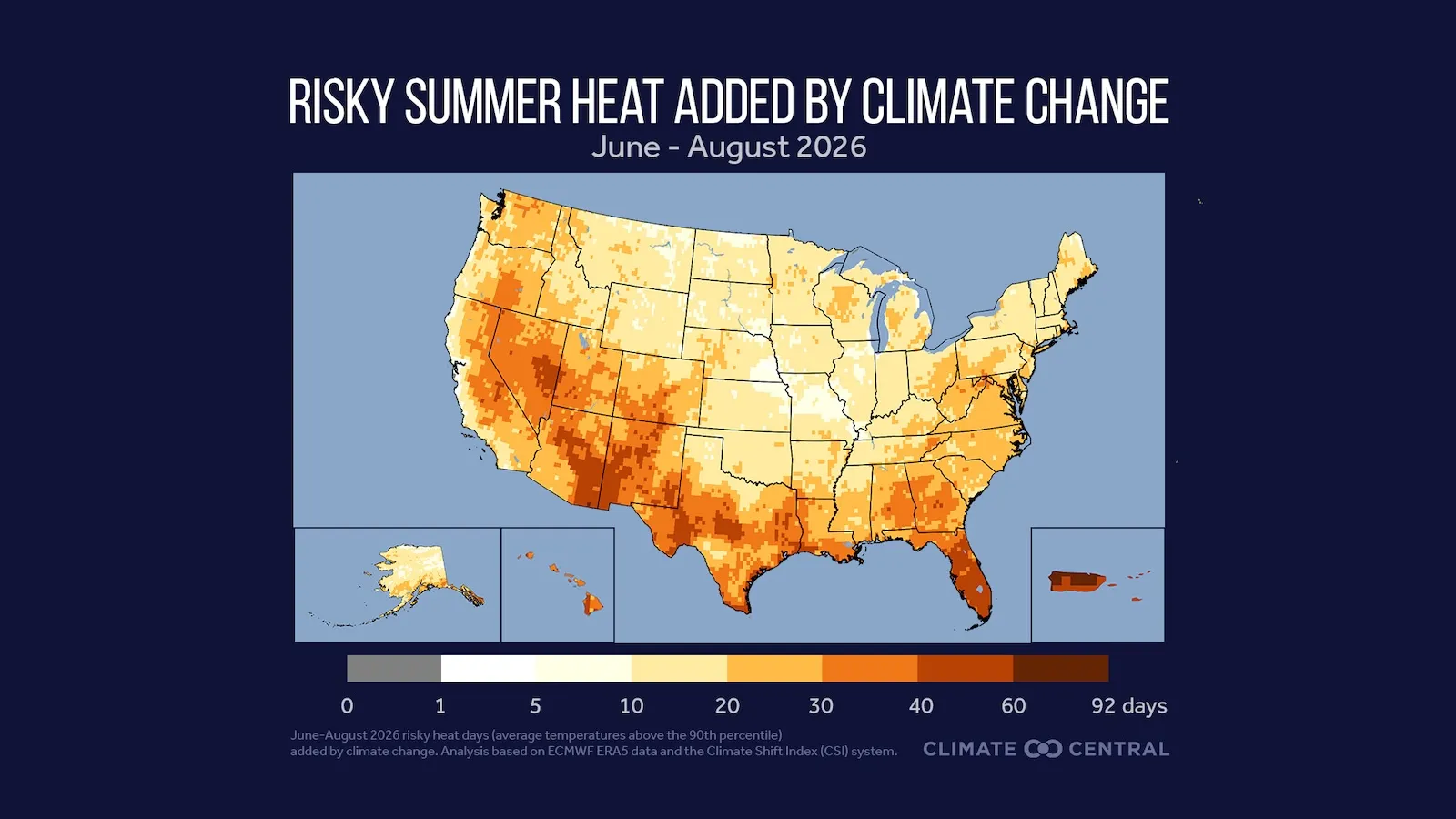
Blame the sun for doing what it’s been doing for billions of years, but also blame human-driven climate change. According to an analysis released today by the research group Climate Central, this summer 293 million Americans, or 86 percent of the population, sweltered through at least 30 days of risky heat. (Meaning those that were hotter than 90 percent of previous days in a given area.) In Asia, some 2.8 billion people faced the same exposure. Of the top 10 most unusually hot countries globally, seven were in Europe, which remains the fastest-warming continent.
“The numbers are just really mind-boggling,” said Kristina Dahl, vice president for science at Climate Central. “Extreme heat on its own can cause health problems, but it can also exacerbate a lot of underlying health conditions.”
This summer, the average American suffered about 26 days with temperatures strongly influenced by climate change, the report found, but some regions were hit harder than others. Four of the five states with the most risky days were in the west: New Mexico, Nevada, Colorado, and Utah. Colorado’s plight has been especially glaring, as its summer temperatures were 4.4 degrees F above normal, followed by Utah and Nevada, both at 3.8 degrees.
Still, Europe takes the crown as the fastest-warming continent, and it certainly showed this summer. (As we reported last month, the heat pushed electrical grids to their breaking points, but solar power swooped in to save the day.) This is due in part to the region’s proximity to the Arctic, which is warming far faster than the rest of the planet — as more sea ice disappears, it exposes darker waters that absorb more of the sun’s energy. A stranger factor is an unintended side effect of clean air policies: While they’ve massively benefited public health, they’ve also reduced the atmospheric particulate matter that reflected solar energy back into space. “As we clean up our industrial processes and we have less aerosols in the atmosphere, which is the case in much of Europe, we’re unmasking that climate signal,” Dahl said. “Europe’s experiencing more of the full brunt of climate change because of that.”
In Europe and beyond, rapidly climbing temperatures are creating a public health nightmare that got even scarier this summer. Climate change isn’t just making heat waves hotter, it is extending them. At the same time, nights are warming faster than days. So with day after day of relentless heat, and less of a cooldown at night, the human body doesn’t get a chance to recover. “When you don’t have the ability to cool off at night, your body is storing some of that accumulated heat from the daytime and carrying it over into the next day,” Dahl said.
Extreme heat can kill on its own, of course, but it can also exacerbate heart and lung conditions. This is especially dangerous for farmworkers and other outdoor laborers, who return to work in the morning carrying the heat effects of yesterday’s shift. The elderly are also at high risk, as their bodies aren’t as efficient at cooling themselves.
And now the world is staring at what could turn out to be an incredibly strong El Niño, the band of warm Pacific water extending from South America. This is adding still more heat to the atmosphere, and played a part in driving up temperatures this summer, the analysis found. But scientists worry that as El Niño continues to develop, next year’s summer could be even hotter. “It’s still an event that’s taking shape,” Dahl said, “so it’s nowhere near its peak.”

