

Last week, another federal judge blocked New York’s so-called “climate superfund law,” the state’s attempt to make fossil fuel companies pay for climate-related damages linked to their activities. Signed in 2024, the legislation inspired other states to start drumming up their own ways to hold Big Oil financially accountable for the costs of a warming planet.
The two rulings are certainly a blow to the law’s advocates. But they’re not a death knell for this approach. That’s according to seven lawmakers from Connecticut, Hawaiʻi, Rhode Island, New Jersey, and New Hampshire, who told Grist the decisions have limited relevance to their states. Most expressed continued interest in advancing their own superfund legislation.
What may be more threatening to these kinds of pollution-accountability laws is Suncor v. Boulder County, a case the Supreme Court will hear beginning next week. Though a decision may not come until next spring, the outcome could nullify all state-level attempts to make fossil fuel companies pay for climate costs.
“Worst case, they rule that federal law — both statutory and constitutional federal law — preempts all of these cases, throws them all out,” said Pat Parenteau, an emeritus professor at the Vermont Law School. This could quash not only superfund proposals, he added, but also consumer rights cases, racketeering cases, and antitrust claims, leaving every state in the country with “billions and billions of dollars piling up with no recourse.”
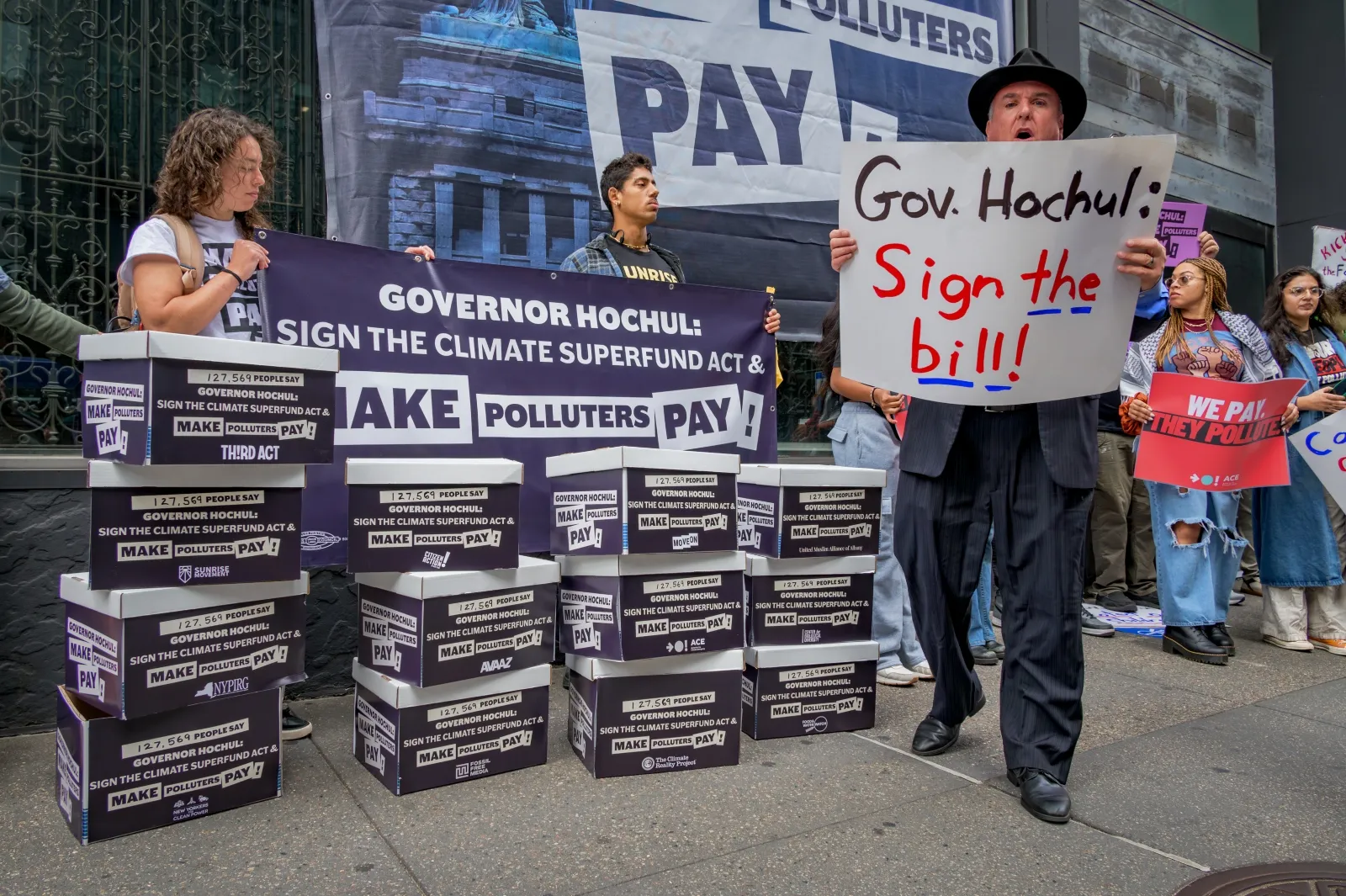
New York’s climate superfund law sought $75 billion from fossil fuel companies to help pay for costs associated with climate change, including recovery from extreme weather and adaptive infrastructure projects like upgraded stormwater drainage systems and new cooling systems in public buildings. The law was inspired by the federal Superfund Act of 1980, which made chemical and petroleum companies financially responsible for cleaning up heavily polluted sites across the country.
The two court decisions found that the New York law was preempted by federal law, specifically the Clean Air Act. In the first ruling, Judge Brenda Sannes of the U.S. District Court for the Northern District of New York wrote that the measure was “simply beyond the limits of state law,” siding with the fossil fuel companies and 22 red-state attorneys general that had sued. New York is expected to appeal both cases.
To date, Vermont is the only other state to have enacted a climate superfund law. It’s facing a legal challenge from some of the same plaintiffs as New York, and in the past month alone Parenteau said there’s been a “flurry” of briefings and press statements calling for its repeal. Republican attorneys general and industry interests have also used the legal strike against New York to oppose climate accountability in other states. In New Jersey, Republican state Senator Michael Testa said in a statement that pursuing a climate superfund measure in his state would be “a waste of time and resources.” West Virginia Attorney General JB McCuskey told Bloomberg Law that if any other state passes this type of policy he will sue them “almost instantaneously.”
But Grist spoke with several Democratic lawmakers who remained interested in advancing climate superfund legislation despite the losses in New York.
“I don’t think it’ll make any difference,” said Karl Rhoads, an outgoing senator in Hawaiʻi who sponsored a superfund bill last year. “There’s no reason for the rest of us not to continue.”
Rhode Island Representative Jennifer Boylan and Connecticut Representative Josh Elliott both said they’re planning to reintroduce climate superfund bills during their next legislative sessions. “I’m full speed ahead,” Boylan said. She dismissed the idea that the New York case would doom similar legislation elsewhere as “a convenient strategy to try to scare us all.”
Legislators from California, Illinois, and Massachusetts told Bloomberg Law last week that they were interested in putting forward new superfund bills, too.
In New Jersey, a climate superfund bill sponsored by Democratic Senator John McKeon stalled before the Legislature’s summer break but may still be considered during the year and a half that remains in the state’s legislative session. McKeon said he’s unconcerned by the New York ruling, as New Jersey is in a different court circuit and is governed by different laws.
Tony Caplan, a Democratic representative from New Hampshire, last year sponsored an unsuccessful bill to “determine the monetary costs of climate damage to the state of New Hampshire and the best means of recouping such costs.” He said he’s now focusing on decarbonization legislation and doesn’t plan to introduce another superfund bill — but that’s because of long-standing opposition to climate accountability measures from his state’s Republican-controlled Legislature, rather than anything new from the New York decisions.
“The lawfare goes on,” Caplan said. “The [New York] decision can be appealed, obviously, and there are blue states … that will continue to push forward with these kinds of bills.”
Erik McGregor / LightRocket via Getty Images
Rachel Rothschild, an assistant professor at the University of Michigan Law School, said states “can and should push ahead” with their various climate liability initiatives, as they don’t have to abide by anything the New York District Courts have said — or even anything that the higher-level Second Circuit Court might decide, if the New York superfund lawsuits are appealed. A bad outcome in Suncor v. Boulder County, however, is a much more significant threat.
Narrowly, the Supreme Court case considers whether a 2018 lawsuit brought by Boulder County and the City of Boulder against Suncor and Exxon Mobil can be heard in state court. Fossil fuel interests have argued that it shouldn’t, because it represents an attempt to dictate federal climate policy.
If just 5 of the 9 justices rule that the case is superseded by the federal Clean Air Act or the Constitution, that precedent will be binding across the country. States could be severely limited, if not outright barred, from seeking any kind of recompense from fossil fuel companies, whether via tort lawsuits or via climate superfund-style legislation.
“My fear,” said Rothschild, “is that this is going to be another notch in a long list of decisions that are threatening to our broader country and democracy, leaving states without the ability to do much on very flimsy and poorly reasoned legal grounds.”
Another, less consequential possibility is that justices will punt on the case, since it hasn’t yet traveled all the way up the Colorado court system. Rothschild described this as a “wait-and-see” approach that would be preferable to a total victory for fossil fuel interests. But she worried this outcome would leave “bad law” on the books, referring specifically to the New York state superfund decisions and two others that favor federal preemption for issues of transboundary pollution.
If Boulder prevails, then its lawsuit and other state-level accountability measures will be able to proceed. States waiting to see if this happens might get some insight into what kinds of climate claims are permissible and consistent with the limits of state authority. For example, the justices might suggest in their written decision that states can only claim damages for climate pollution released within their borders, or that they can only collect penalties for demonstrated climate harms.
“That might give us something of a yardstick with which we could evaluate what could be done under the climate superfund statutes,” said Jonathan Adler, a professor at William and Mary Law School. “We’ll have to pay a lot of attention.”

