

Coffee can improve Parkinson’s symptoms within three weeks compared to placebo, but do the benefits last?
When James Parkinson described the classic symptoms of Parkinson’s disease, “he could hardly foresee the evolution of our understanding over the next two hundred years”—like the role of nutrition. High dietary intakes of animal fat, mercury, iron, and dairy products seem to increase Parkinson’s disease risk, while a plant-based dietary pattern and the intake of antioxidants may be protective.
“Plant-based diets are known to preserve body tissues from oxidative stress and inflammation, both hallmarks of chronic-degenerative diseases” like Parkinson’s. However, animal-based foods, particularly those rich in animal proteins and saturated fats, are correlated with the promotion of neurodegenerative diseases, in addition to some of our leading killers like cancer, heart disease, and diabetes.
Not all plants are necessarily good, though. For example, consider the potential neurotoxicity of graviola, a fruit known as soursop. Consumption of soursop can lower blood pressure and uric acid levels but may also cause an atypical form of Parkinson’s disease because the fruit contains neurotoxic compounds. Indeed, population studies do show a link between the overconsumption of soursop with neurodegenerative disease.
Those who follow a predominantly plant-based diet may show the lowest prevalence and incidence of Parkinson’s disease, but plant-based nutrition is not just about reducing the risk. It can also be used to manage the disease.
I’ve previously discussed a case report in which a diet low in animal fat that included whole grains every day, as well as one to two cups a day of strawberries, seemed to be effective in reducing symptoms of Parkinson’s disease. But there are about 20,000 edible plant varieties worldwide, and only a limited number have been studied for anti-Parkinson’s activity.
One plant that’s gotten a lot of attention is coffee, which is “likely to exert a protective effect against the development of [Parkinson’s disease].” It may even help slow the disease’s progression, based on various studies, including one that shows that Parkinson’s patients who drink coffee or caffeinated tea appear to cut their risk of dying prematurely in half. But correlation doesn’t mean causation. You don’t know if caffeine really works until you put it to the test.
In a six-week, randomized, placebo-controlled, double-blind study, researchers tested caffeine as a potential treatment for Parkinson disease. Participants in the caffeine group started with approximately a cup of coffee’s worth of caffeine twice a day—once in the morning and once after lunch—and then increased to two cups’ worth twice a day, roughly equivalent to four cups of black tea twice a day or six cups of green tea. The result? A significant improvement in Parkinson’s symptoms within three weeks compared to placebo, as you can see below and at 3:05 in my video Coffee Put to the Test for Treating Parkinson’s Disease.
Coffee may be a cheap, safe, simple treatment for Parkinson’s, though an important limitation was the duration of the study. Caffeine has what’s called “tachyphylactic” properties, meaning its effect tends to diminish over time with repeated use (at least when trying to combat sleepiness), so it would be helpful to see the study repeated over a longer time frame. As it so happens, five years later, a longer-term study was published. Patients with Parkinson’s were randomized to about two cups of coffee’s worth of caffeine twice a day for not six weeks, but more than six months, and…no benefit over placebo. Drats. You can see for yourself below and at 3:49 in my video.
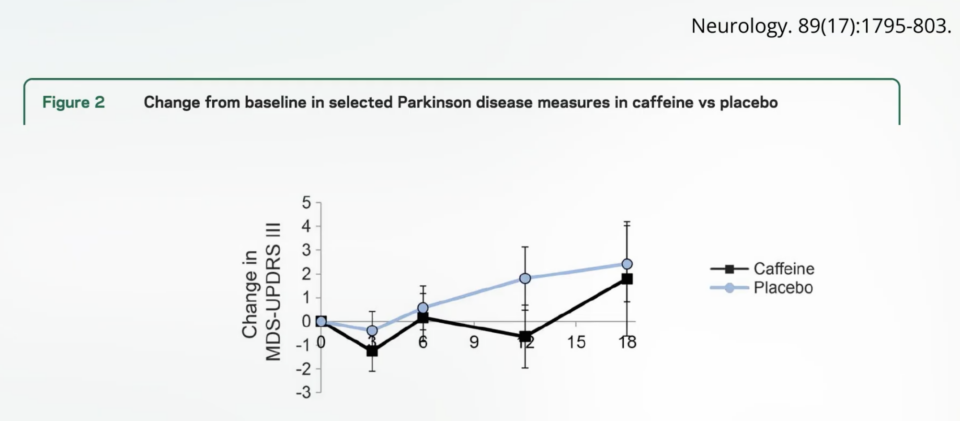
Caffeine didn’t provide sustained symptomatic benefit after all. So, caffeine may offer a short-term benefit that quickly dissipates. Regardless, “caffeine cannot be recommended as symptomatic therapy for parkinsonism.”
Doctor’s Note
My other videos on Parkinson’s disease include:
For more on coffee, see:

