

By Mariel Vilella, GAIA Climate Program Director
Methane emissions from the waste sector can be reduced with technologies that are already available. The harder question is often institutional and financial: how can cities build organic waste management systems that work over the long term, while including the workers and communities already providing essential waste services?
Over the past three years, GAIA and local partners YPBB in Indonesia, groundWork in South Africa and ANARCH in Chile have worked with municipalities and communities in Bandung, Durban and Valparaíso to answer that question.
Supported by the Climate and Clean Air Coalition (CCAC), the project set out to test and strengthen community-based models for diverting organic waste from disposal, reducing methane emissions and improving the financial sustainability of the organizations delivering these services. At its core was a simple proposition: municipalities frequently lack the resources to provide adequate waste services, while informal and community-based organizations already possess knowledge, infrastructure and relationships that can form part of a lower-cost and more inclusive pathway to methane mitigation.
The experience across the three cities points to an important conclusion: community-based organic waste management can deliver significant climate and social benefits, but it should not be expected to operate as a conventional profit-making business. Organic waste management is an essential public service. Scaling it requires sustained public investment alongside appropriate mechanisms for community participation and cost recovery.
Bandung: source separation is the foundation

In Neglasari, Bandung, YPBB has developed a decentralized system combining separate collection with Black Soldier Fly (BSF) bioconversion and composting. The system currently serves 1,777 households—around 9,700 people—and treats approximately 400–600 kg of organic waste per day.
One of the most important lessons from Bandung is that the technology was the relatively easy part.
Years of door-to-door engagement and support for the government’s organic waste segregation program increased household separation at source from 9% to 27%. This has improved the quality of incoming organic material sufficiently for it to be treated locally: approximately 75% through BSF bioconversion and 25% through decentralized composting. The resulting larvae, frass and compost can in turn support livestock and urban agriculture, creating a local circular system.
Community participation has been fundamental to this transformation. Through sustained door-to-door engagement, YPBB has helped households become active participants in the system, rather than simply recipients of a waste collection service. This experience demonstrates that source separation is not just a technical requirement but a social process that depends on building trust, changing practices and sustained collaboration with communities. The proposed institutional model builds on this foundation by creating opportunities for community cooperatives to participate in value-added activities and benefit from local resource recovery.
The climate implications are significant. Compared with the baseline, the current system is estimated to reduce methane emissions by around 15%. With full source separation, modelling indicates reductions could reach 74%.
But Bandung also demonstrates why these systems cannot be designed around the assumption that revenues from compost, larvae or agricultural products will cover the full costs of waste management.
The project proposes instead a two-part institutional model. Waste collection and processing are treated as an essential municipal service, with public funding covering the core infrastructure and operating costs. Value-added activities—including urban farming and livestock production—can then operate through community-based structures and recover part of the system’s costs.
This distinction matters. Trying to make organic waste processing entirely self-financing through product sales risks operational failure and underpaid labor. Public finance should pay for the public service; revenues from recovered resources should complement that finance rather than replace it.
Durban: making the economics of decentralized composting visible
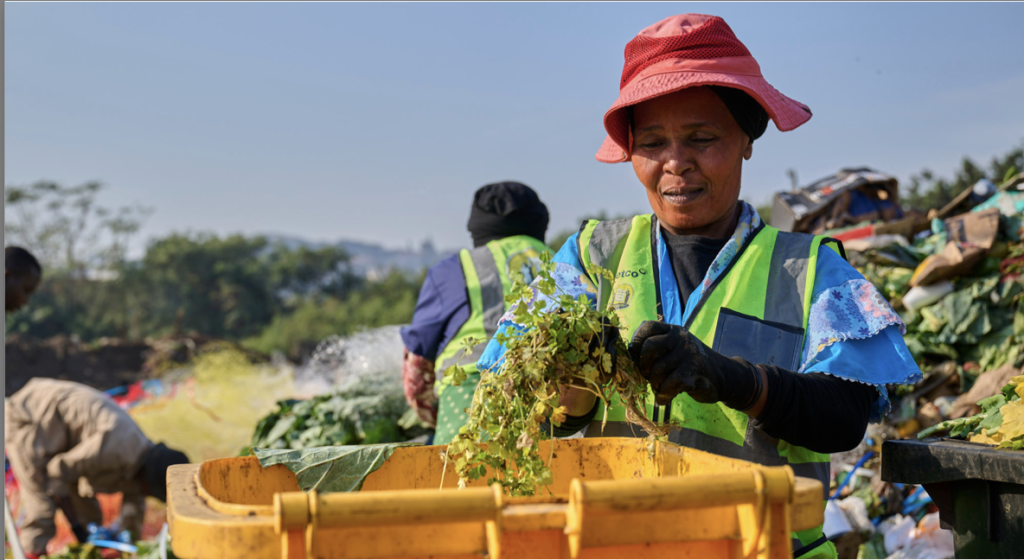
In Durban, South Africa, groundWork has worked with eThekwini Municipality and local partners to demonstrate how organic waste from municipal markets can be diverted from landfill and transformed into compost for municipal parks and community food gardens.
The results are already tangible. The project has diverted 586 tonnes of organic waste from three municipal markets, producing 190 tonnes of compost distributed to municipal parks across eight of the city’s ten districts and to community food gardens. The initiative has served approximately 900 market traders, created employment for 10 composting workers and established three composting facilities. The project also reports an estimated 133 tonnes of methane emissions avoided.
The project illustrates how decentralized composting can be integrated into existing municipal systems while creating opportunities for local participation and employment. By engaging market traders and employing composting workers, the initiative connects waste generators, workers and local beneficiaries. Collaboration with municipal departments has helped embed organic waste diversion within existing public infrastructure, rather than developing a parallel service dependent entirely on external project funding.
Crucially, the project has generated evidence of the economic benefits of decentralized composting. A cost-benefit analysis covering two municipal markets found that diverting organic waste to composting could generate a net benefit of R18 million (approximately USD 1.09 million) over ten years, with a net present value of R14.1 million (USD 852,000). By comparison, continuing to landfill the same waste would generate an estimated net cost of R32 million (USD 1.93 million) over the same period.
The analysis also identifies potential annual municipal savings of approximately R2.9 million (USD 175,000), including avoided disposal fees, landfill airspace costs and purchases of compost for municipal parks. These benefits are distributed across different municipal departments, demonstrating why the economics of organic waste management cannot be assessed solely through revenues from compost sales.
The lesson from Durban is that decentralized composting can generate significant public value, even without operating as a conventional profit-making business. Its benefits include avoided disposal costs, reduced methane emissions, local employment and useful resources for urban green spaces. Recognizing these combined benefits can help municipalities make the case for sustained public investment and scaling up organic waste diversion.
Valparaíso: extending waste picker inclusion from recycling to organics
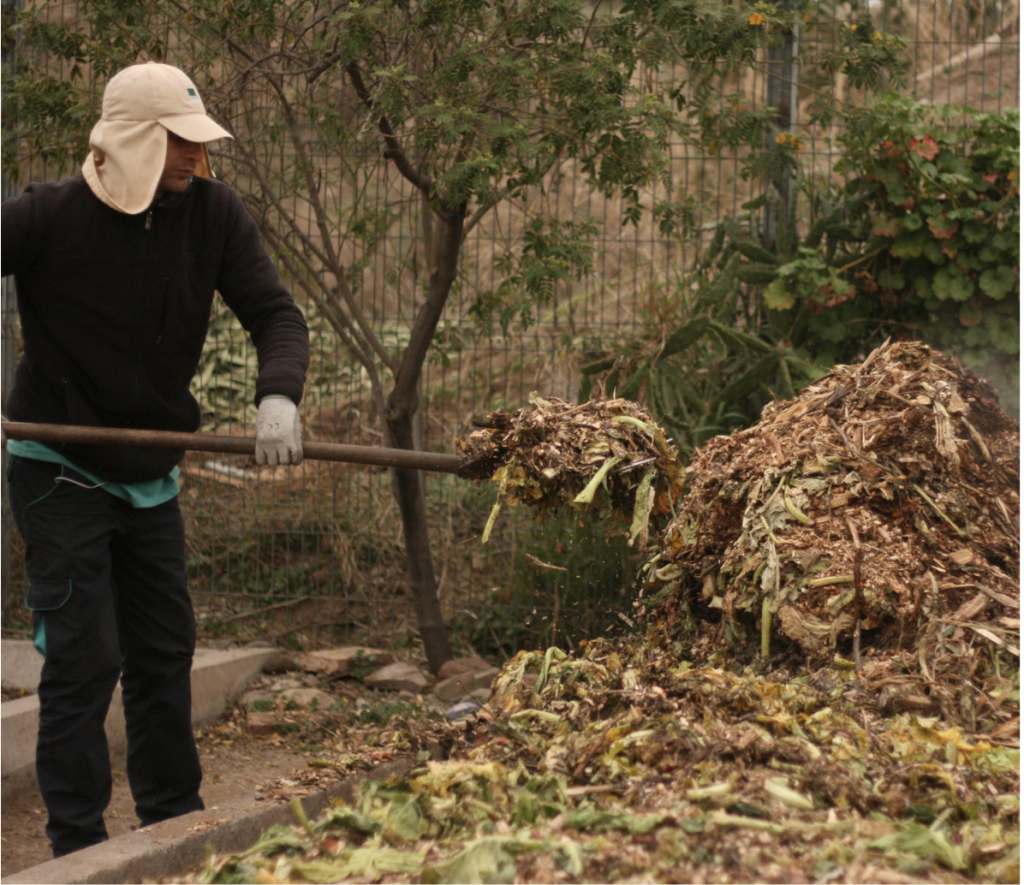
The experience in Valparaíso adds another dimension: a just transition in the waste sector requires expanding the role of waste pickers as waste systems evolve.
ANARCH’s network already demonstrates the scale at which organized waste pickers can operate. Its member organizations include 55 operational cooperatives across 14 of Chile’s 16 regions, with more than 1,000 waste pickers formalized and approximately 40,000 tonnes of materials recovered in 2025.
The Valparaíso pilot is now applying that experience to organics.
The region generates approximately 133,000 tonnes of municipal waste annually, with an estimated organic fraction of around 70%. With the useful life of the El Molle disposal facility projected to end in 2028, increasing diversion has become increasingly urgent.
The project has involved direct capacity building with grassroots waste pickers, including three training sessions totalling 12 hours for five participants, covering composting, safe operations, traceability and business-model development. Following collaboration with municipal and regional authorities, organic waste management began in September 2026 with direct participation from waste pickers. Building on ANARCH’s experience organizing waste picker cooperatives, the initiative seeks to extend their role beyond recyclable materials into organic waste management, creating opportunities for workers to participate in operations and potentially in the future governance of organic waste infrastructure.
The significance goes beyond a single composting project. It demonstrates a pathway through which workers who have historically recovered recyclable materials can become participants—and ultimately co-managers—in the infrastructure required for organic waste management.
ANARCH is already exploring how this approach could move from a pilot towards regional infrastructure, including a financing model combining preparation grants, public and international investment, and potentially results-based finance linked to verified organic waste diversion, methane reductions, livelihoods and traceability.
The conditions are critical: public co-management, appropriate permitting and waste picker leadership need to be designed into the investment model rather than added afterwards.
Five lessons for cities and funders
Taken together, the three experiences suggest several principles for governments, development finance institutions and climate funders seeking rapid methane reductions from organic waste:
- Treat organic waste management as essential public infrastructure. Collection and treatment provide a public service and require reliable public financing, including operating expenditure—not only capital investment.
- Invest in source separation before focusing on technology. Clean organic feedstock is fundamental to successful composting and biological treatment. Bandung demonstrates that sustained household engagement and separate collection are as important as the treatment technology itself.
- Value the full range of benefits. Financial assessments should include avoided disposal and transport costs, reduced municipal purchasing, climate mitigation, employment and other local benefits—not simply revenues from compost or other products.
- Build inclusion into the institutional model. Informal workers and community organizations should not merely be consulted or contracted at the end of the process. They can be operators, co-managers and partners in designing the system.
- Finance operations, not just infrastructure. Land, labor, collection, maintenance and community engagement determine whether infrastructure continues functioning after a project ends. The Bandung analysis, for example, identifies labor as 77% of operating costs, while access to publicly provided land substantially changes project economics.
From local evidence to global methane action
These projects were never intended to remain isolated pilots. The objective has been to generate practical evidence that can inform policy, investment and replication.
Lessons from Bandung, Durban and Valparaíso are already feeding into national policy engagement, technical guidance and regional exchanges, as well as international discussions through the CCAC and UN climate processes. The pathway is deliberate: local evidence → policy change → replication → global impact.
The three experiences demonstrate different but complementary dimensions of inclusive organic waste management. In Bandung, sustained household engagement makes source separation and decentralized treatment possible. In Durban, collaboration between market traders, workers and municipal departments connects organic waste diversion with public services and local employment. And in Valparaíso, organized waste pickers are developing the skills and institutional relationships needed to participate directly in organic waste management.
Together, they show that scaling organic waste solutions does not primarily require new technologies. It requires building the institutional, financial and social conditions that allow existing solutions to become part of mainstream municipal waste systems. Inclusion cannot be an afterthought: communities and workers need meaningful roles in designing, delivering and benefiting from these services.
For climate finance, the implication is equally clear: finance needs to reach the local systems and organizations capable of turning methane commitments into measurable reductions on the ground.
That is how community-led projects move beyond pilots—and become part of the infrastructure of a low-methane, inclusive and zero waste future.
Read the case studies from Bandung, Durban, and Valparaiso here.

