

Introducing Eco-Cycle’s 10th Annual State of Recycling & Composting in Colorado Report
This Colorado Recycles Week, Eco-Cycle and CoPIRG Foundation released their tenth annual State of Recycling and Composting in Colorado report. This milestone report celebrates the Zero Waste progress Colorado has achieved at the state and local levels over the last decade and shares recommendations for actions needed to continue our forward momentum toward a circular economy.
Catalyst for Change
Ten years ago, we launched our annual State of Recycling and Composting report to underscore how far behind Colorado was in recycling and composting, while shining a light on leading local communities and businesses demonstrating what was possible to achieve. In this tenth edition, we are thrilled to celebrate how far we’ve come toward building a Zero Waste Colorado, including passing nation-leading Producer Responsibility policies, a statewide single-use plastic bag ban, and many local community initiatives.
Changing our system from extractive and wasteful to circular and regenerative takes all of us. We each have important roles to play, and the report features individuals, municipalities, and businesses leading the way in recycling, composting, reuse, and waste reduction.
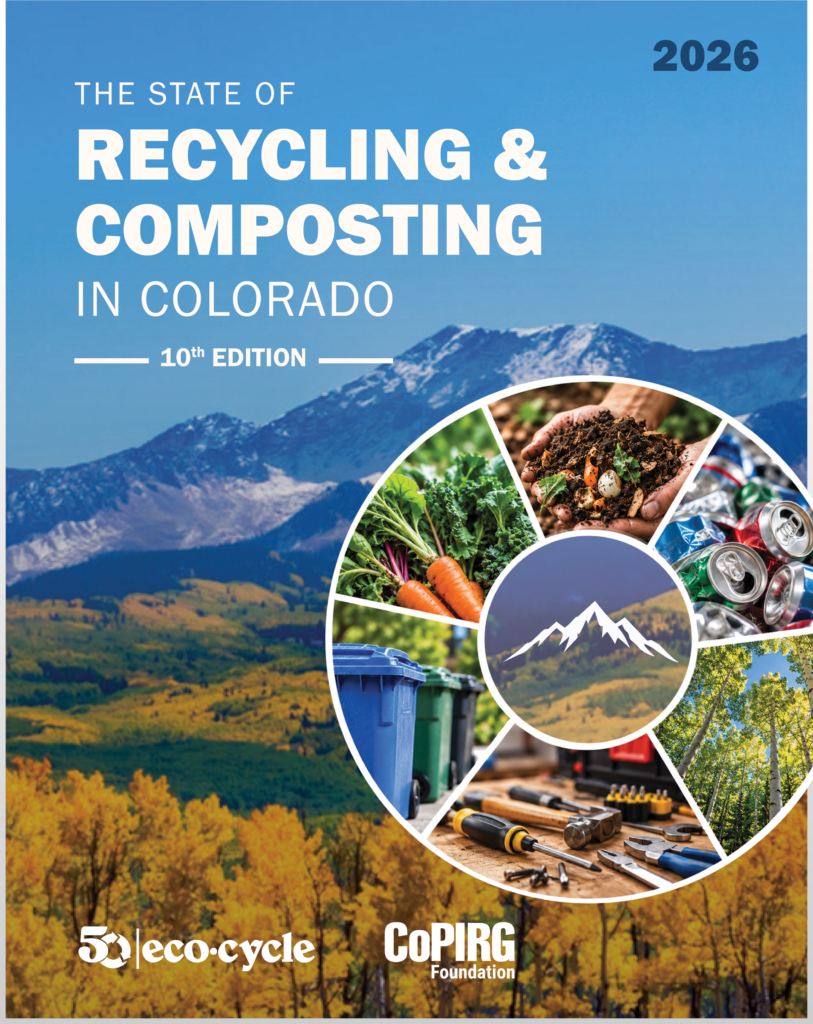
The tenth annual report highlights waste reduction progress over the last decade, including:
- Colorado diverted 29% more food scraps and yard trimmings from landfills in 2025 compared to 2023.
- Colorado has eliminated an estimated 4.1 and 5.8 billion single-use checkout bags since the Plastic Pollution Reduction Act went into effect in 2023.
- Of the 37 communities that responded to our survey this year:
- Today 13 communities provide or require single-family residential curbside organics collection, up from 5 in 2017.
- Currently 23 communities guarantee recycling for single-family residents, up from 12 in 2017. By 2030, thanks to Producer Responsibility for packaging and paper, all Coloradans will have access to recycling.
- The City of Boulder’s construction and deconstruction (C&D) recycling and reuse ordinance has diverted 114,132 tons of C&D materials from landfills since its adoption in 2020.
- Denver has expanded residential compost collection to approximately 50,000 more households (80,400 total households) resulting in 67,656 tons of organic materials (food scraps and yard trimmings) being diverted from the landfill since 2023.
- Aspen businesses diverted 2,303 tons of organic discards from landfills in 2025, up from 804 tons in 2023, after adoption of the City’s Organic Waste Ordinance.
- Longmont’s commercial waste diversion rate leaped from 35% in 2023 to 62% in 2026 after implementing its Universal Recycling Ordinance.
- Coloradans now have the broadest repair rights of any state in the country thanks to a combination of three Right to Repair policies adopted into law in the past decade.
Vision for the Future
Despite these significant wins over the last decade, Colorado still has more work to do. We need to reduce unnecessary waste, reuse more items to avoid producing so much stuff in the first place, and recycle or compost everything else. Eco-Cycle and CoPIRG Foundation highlighted key next steps in 2027 and beyond for cities and the state, including:
- Ensure Colorado’s Producer Responsibility for Packaging and Paper program achieves its goals of delivering free access to recycling for all Coloradans, incentivizing waste reduction, and ensuring that materials collected for recycling are verifiably made into new products.
- Grow our circular organics economy by adopting a state-level policy requiring large generators to divert nonedible food scraps and yard trimmings from landfills into beneficial uses such as compost.
- Reduce unnecessary plastic waste by adopting policies such as “Skip the Stuff” that requires restaurants to get confirmation from customers first before needlessly providing unwanted single-use items such as utensils, straws, and condiment packets.
The tenth annual State of Recycling and Composting in Colorado report demonstrates how much progress is possible when we work to implement solutions at state and local levels through the public and private sectors. We look forward to continuing this important work with Governor-Elect Weiser, the new General Assembly, local governments across the state, and individuals like you to keep up the great momentum toward a Zero Waste future.

