

Much of the news coverage on young men recently has focused on social media, gambling and the online “manosphere.” But some of the most consequential changes in young men’s lives are happening in school and workplaces.
Men, on average, continue to have advantages in the labour market. But some groups of men face significant disadvantages, and factors such as social class, race and migrant background can make an enormous difference to their educational and employment prospects.
This distinction is often lost in debates about the supposed crisis facing young men. Debates are often framed as a culture war that pits men’s concerns against women’s progress. Some point to the persistent gender pay gap and the continued over-representation of men in the most senior jobs. Others point to young men who drop out of school and end up unemployed.
International Men’s Day — Nov. 19 — provides an opportunity to move beyond claims about whether men are “falling behind” and instead ask which men are struggling, and why.
Men missing from equity conversations
Men who experience disadvantage receive surprisingly little attention in research on workplace inequality. In our recent paper, we reviewed research from several western countries — mainly the United States, United Kingdom and parts of the European Union — on the career barriers facing men from disadvantaged backgrounds.
We searched Google Scholar for intersectional studies of gender and found 1,330 studies with “women” in the title, compared with 234 mentioning “men.” The difference was even larger in research on career advancement. Studies examining the promotion of women into workplace roles, while also considering race or ethnicity, outnumbered comparable studies of men by about 80 to one.
There are good reasons why equity research has focused so strongly on women. Women have historically faced — and continue to face — substantial barriers in education and employment.
But this focus has left us knowing much less about men who do not share the advantages typically associated with being male. Treating men as a single group can obscure the experiences of those who are struggling.
The gap often starts in school
Inequalities often begin well before people enter the workplace. Boys from low-income families and racialized or stigmatized migrant backgrounds tend to fall behind at school.
One factor may be teacher expectations. Research suggests students are more likely to finish school when their teachers expect more of them. If disadvantaged boys are perceived as less likely to succeed, those expectations can become a self-fulfilling cycle.
(Unsplash+)
According to social scientist Richard Reeves, young men in the United States are almost 50 per cent more likely than young women to drop out of high school.
Canada shows a very similar gap, although the pattern varies by background and level of education. The 2021 census shows that about one-quarter of Canadian-born men aged 25 to 34 held a bachelor’s degree or higher, compared with almost 40 per cent of Canadian-born women in the same age group.
These educational disadvantages increasingly shape what happens later in the labour market.
A changing labour market
The labour market that once provided relatively well-paid opportunities for less-educated men has changed over the years.
A generation ago, a young man could leave school early and still find reasonably well-paid manual work. In 1970, high school dropouts held 43 per cent of American manufacturing jobs. By 2016, fewer than 10 per cent of those jobs were held by workers who had not finished high school.
Many of those jobs have disappeared, and those that remain increasingly require formal qualifications. At the same time, employers place greater value on cognitive, interpersonal and communication skills.
Research on class and gender stereotypes shows that cognitive and interpersonal skills are more strongly associated with upper-class men, while working-class men are more likely to be associated with physical strength and toughness.
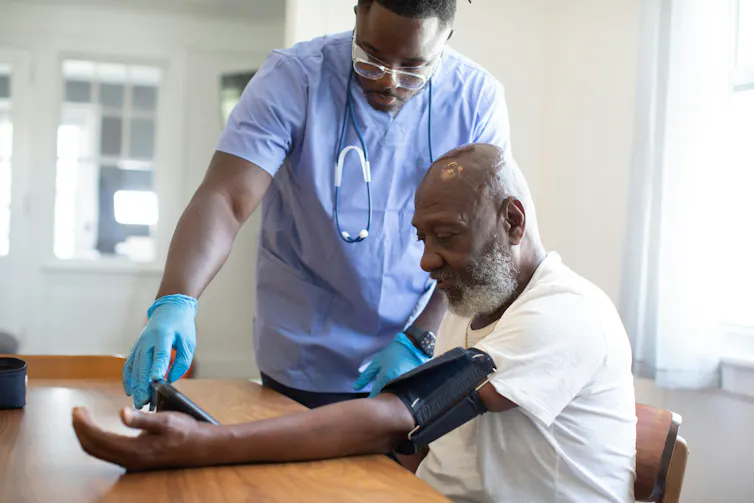
Meanwhile, employment is growing in health care, education, administration and literacy occupations. An aging population is increasing the demand for care workers. Advances in artificial intelligence are likely to make interpersonal and emotional skills more important because they are difficult for machines to replicate.
However, men remain substantially under-represented in much of this work. In Canada, about 91 per cent of regulated nurses are women, and only about 25 per cent of elementary and high school teachers are men.
Many working-class men have neither been prepared for these occupations nor encouraged to see them as realistic career choices. Some avoid them because caring and service work conflicts with their idea of what a man’s job is. The result is a mismatch between where jobs are growing and where men have been encouraged to look for work.
(Unsplash)
Equity is not a zero-sum game
Attention to men’s disadvantage is often met with resistance. We encountered this when we presented an early version of our paper at conferences. One concern was that supporting disadvantaged men could come at the expense of women’s gains by diverting attention or resources from them.
But improving opportunities for disadvantaged men does not require reversing progress for women.
French economists, for example, have argued that revaluing female-dominated occupations would advance pay equity for women while also draw more men into this work. Raising wages in undervalued care work would help the women already doing it while opening a door for men.
There is evidence this can happen. A French study found that male midwives helped the profession’s push for better recognition. Bringing more men into areas such as health care could also address staff shortages in sectors that remain overwhelmingly made up of women.
Equity for women and opportunities for disadvantaged men can both be pursued through the same policies, in many cases.
What can we do
There are broader consequences to leaving disadvantaged men behind. People who believe that economic and social institutions have failed them can become receptive to political messages built around resentment and grievance.
But this is not simply about preventing political radicalization. Stable work, economic security and a sense of purpose are important to individual and social well-being.
Schools can pay closer attention to expectations for boys who are at risk of disengaging. Governments and employers can strengthen vocational pathways into occupations with labour shortages, rather than training young people for jobs that are disappearing.
Children also need to see more men working as teachers, nurses and care workers. Seeing men in these roles can help boys imagine these careers for themselves rather than assuming they are meant for women.
International Men’s Day should be an occasion to have a more nuanced conversation about the men being left behind. Men, on average, remain advantaged in many areas of social and economic life. But not all men share those advantages, and understanding why is an important part of understanding inequality itself.

