

I spent the autumn months along the West Walker River in California’s Sierra Nevada, working at Pickel Meadow. To the east, the Sweetwater Mountains rise above the valley; to the southwest, the high country of Yosemite. Closer in, the meadow’s distinctive geologic formations tell the story of its volcanic and glacial history, and the breeze carries the scent of sagebrush and Jeffrey pine. I hear the river rushing over cobble in the mainstem, wind rustling through golden cottonwood leaves, and a pair of sandhill cranes calling as they circle overhead. The sounds of restoration have become part of the landscape, too: the beep of a water truck backing up, an excavator moving soil, boulders clattering into place along the river’s edge, and the construction crew talking and laughing across the site. As I notice this juxtaposition—machinery and bird calls, freshly moved earth and ancient rock formations—I’m reminded that this place has never been static. Volcanic activity, glaciers, flowing water, fire, and centuries of land stewardship by Tribes like the Washoe (Wašiw), whose ancestral territory we’re working within, have all shaped this place. That dynamism is exactly what we’re working to recover: not a fixed landscape, but a living system with the space and natural processes it needs to function and adapt long after we’re gone.
Why Pickel Meadow needed restoration
Pickel Meadow covers approximately 450 acres, with conditions that shift from dry, crunchy vegetation to soft, wet soils where groundwater still reaches the surface. Much of the meadow has become drier over the past several decades, in large part because the West Walker River had lost its natural connection to the adjacent meadow, which historically functioned as its floodplain via an alluvial fan.
In 1997, an artificial berm was constructed using debris from a highway landslide. The berm disrupted the river’s historic flow paths, concentrating water in the channel and limiting its ability to spread across the meadow. Over time, this contributed to channel incision, erosion, reduced groundwater recharge, and the loss of wetland and riparian vegetation.
These changes reinforced one another. As the river flowed past the meadow and cut deeper into its channel, it became increasingly disconnected from the surrounding floodplain. The river channel also lost habitat complexity, including scour pools and willow-lined banks. With less water reaching the meadow’s soils, groundwater levels declined, contributing to the loss of wet meadow vegetation. These plants play an important role in storing carbon in meadow soils, making their loss significant beyond the immediate effects on habitat. A changing climate also adds to these pressures. Earlier snowmelt, declining snowpack, prolonged drought, and more extreme precipitation can make an already disrupted system more vulnerable. The challenge, then, is not simply to repair an eroding riverbank or replant vegetation where it has been lost, but to address the underlying hydrologic impairments that have altered how water moves through the meadow.
Reconnecting the West Walker River to its floodplain
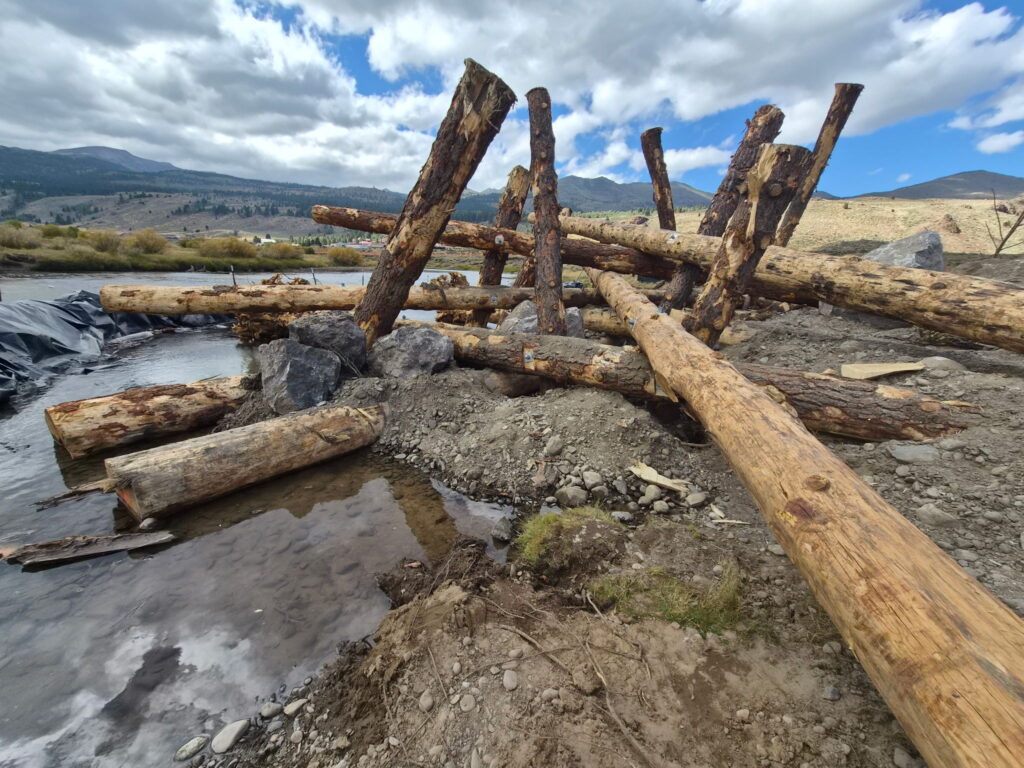
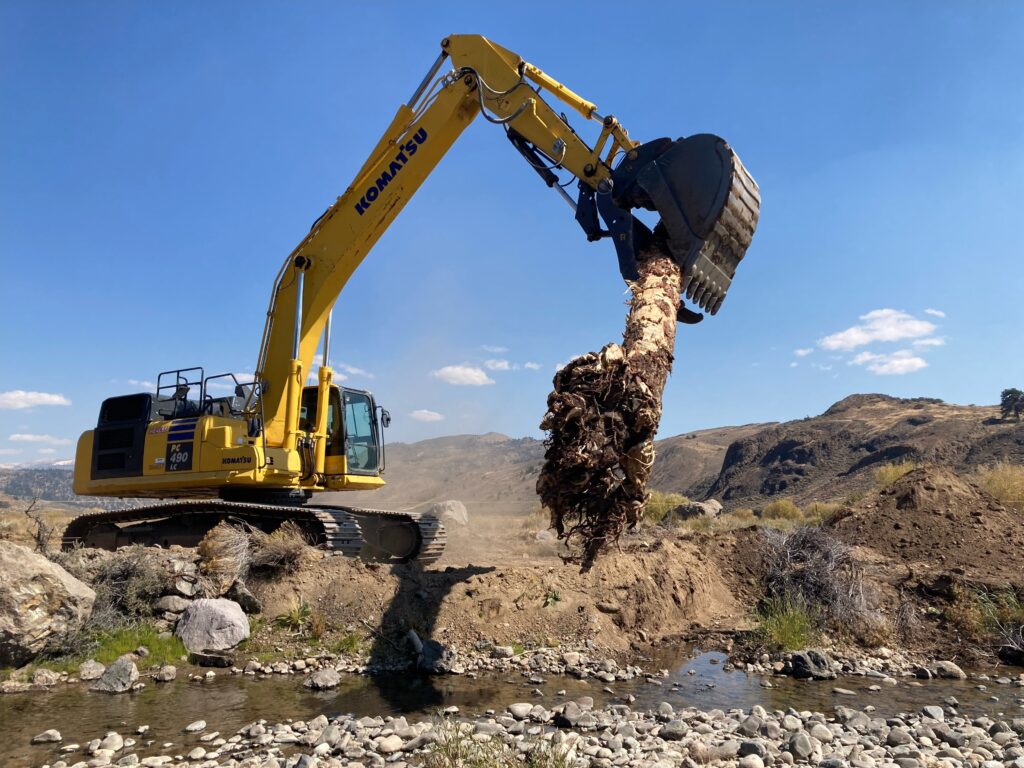
That principle guided the Pickel Meadow Restoration Project. We removed and reshaped large volumes of soil and rock, reactivated historic channels across the alluvial fan, stabilized an eroding riverbank, and placed large wood and boulders in the main channel and side channels to improve aquatic habitat. We also upgraded a previously nonfunctioning irrigation diversion that helps sustain wet meadow conditions in the upper meadow, and where the highway prevents natural river migration. In addition, we improved visitor access through trail and parking improvements, with interpretive signage to be installed soon. Together, these actions are intended to help water move more naturally across and beneath the meadow, recharge groundwater, reduce erosion and sedimentation, and support the recovery of native plant and animal communities while enhancing opportunities for people to enjoy visiting the area.

Pickel Meadow Restoration at a Glance
-
250
meadow acres restored
-
3
miles of improved habitat and connectivity of the West Walker River
-
40,000
cubic yards of soil and rock removed from the floodplain
-
250
large boulders placed to improve channel stability, aquatic habitat complexity, and visitor access
-
50
logs placed to provide additional structure and habitat
-
500
willow poles planted to support riparian vegetation recovery
-
600
pounds of seed spread across ~8 acres to help reestablish native vegetation
Restoring habitat for wildlife across the meadow
Mountain meadows support a wide range of species because they bring together aquatic, wetland, riparian, and terrestrial habitats in a relatively small area. Pickel Meadow is no exception. The project aims to improve habitat across this interconnected system. In the river, adding large wood and boulders, reactivating channels, and planting riparian vegetation will increase habitat complexity and provide the shade and cover that aquatic organisms need. Although the project reach does not currently support a self-sustaining population of federally endangered Lahontan cutthroat trout, the species occurs in nearby Silver Creek, and improving conditions in this reach of the river can contribute to the health of connected aquatic habitats throughout the watershed. We’re also focused on riparian birds, particularly the California-endangered willow flycatcher and the yellow warbler. Pickel Meadow has been identified as a priority site for these species, but degraded habitat conditions have made it difficult to consistently support nesting. Restoring wet meadow vegetation and riparian shrub communities will help create the conditions these birds need to persist in the meadow. Beyond these focal species, the benefits extend to a wide range of native plants and animals, such as pollinating insects, beavers, and migratory herds of mule deer. By restoring the processes that sustain these habitats, we’re working to improve conditions for the broader ecological community and make the system more resilient to drought and wildfire.
What is a meadow?
A meadow is an area where shallow groundwater enables grass-like plants and wildflowers to flourish. Although meadows cover only two percent of the Sierra Nevada mountain landscape in California, they are critical to the health and resiliency of the region’s rivers due to the ecosystem benefits they provide.
What does a meadow have to do with clean water?
Healthy meadows are green infrastructure. A healthy meadow has a relatively shallow, meandering stream channel that supports a shallow groundwater table and wet meadow and riparian vegetation, like willows. Runoff during spring floods can spread laterally across the meadow, slowing and soaking in, replenishing groundwater that seeps into the river in the summertime. The meadow system filters sediment and provides important wet meadow habitat.
What happens when a meadow is degraded?
Unlike in healthy meadows, water flows quickly out of degraded meadows. In a degraded meadow, the channel erodes and become deeper and less meandering. This creates a disconnect between the channel and the meadow floodplain. Springtime floods cannot spread out and sink in. Instead floodwaters cause further erosion, cutting deeper and wider channels and sending fine sediments downstream. Groundwater is drawn down below the roots of meadow vegetation and dryland plants take over historic floodplains.
Why does American Rivers work to restore meadows?
There are few landscapes that safeguard our rivers’ headwaters like a healthy meadow. Healthy meadows benefit people, wildlife, and rivers by acting as natural reservoirs that give rain, snow, and runoff the chance to slow down, spread out and sink into the soil, filtering and storing water. Healthy meadows provide many of the same outstanding natural benefits as floodplains.
What does American Rivers do to restore meadows?
American Rivers is working to restore the health of mountain meadows to help ensure that California rivers and water supply will be resilient for years to come. With assistance from the National Fish and Wildlife Foundation and others, American Rivers is working to promote meadow restoration in California through:
- Mapping high elevation meadows and quickly assessing their overall health
- Developing and applying methods to prioritize meadows for restoration work
- Restoring high-priority meadows to provide multiple benefits
- Evaluating restoration methods and developing a “toolbox” from past successes
- Standardizing monitoring methods to assess restoration success and improve future projects
In addition, American Rivers helps promote meadow restoration at a regional scale. We co-lead the Sierra Meadows Partnership, a regional collaborative of diverse partners focused on restoring Sierra meadows, and co-authored the Sierra Meadows Strategy, an approach to increasing the pace and scale of meadow restoration in the Sierra.
Will DeDominic, Hanford ARC
Measuring restoration success over time
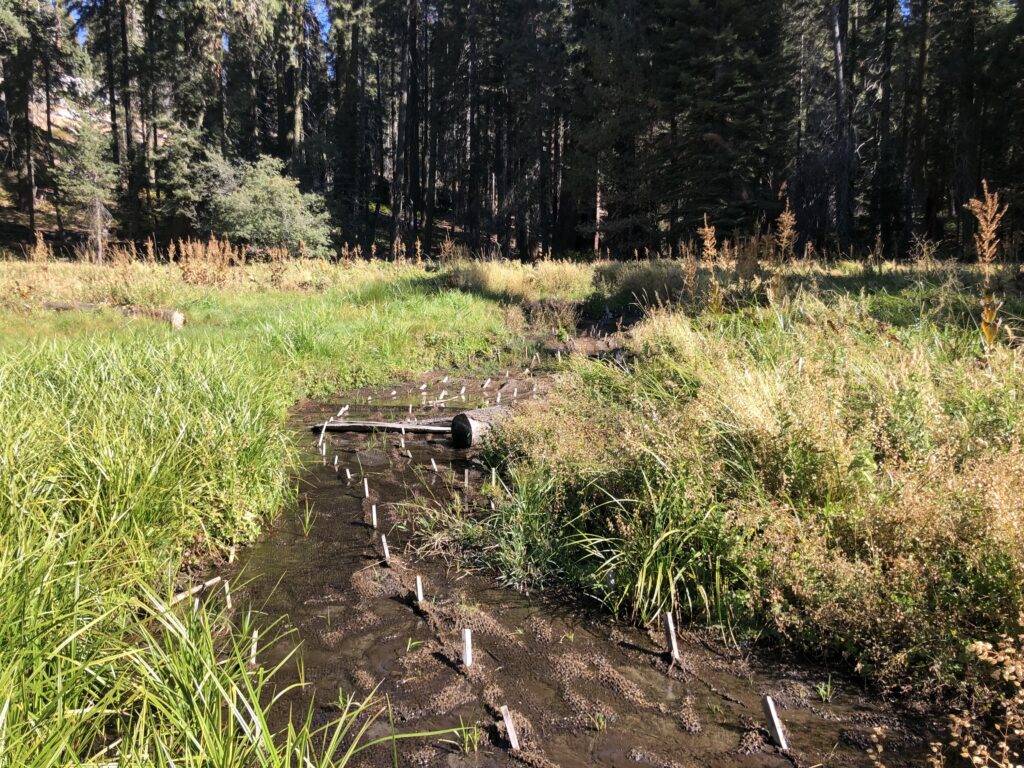
These are longer-term outcomes, not changes we can expect to see immediately after construction. The extent of the benefits will depend on how the meadow responds, which is why restoration doesn’t end when the construction equipment leaves. The next step is to understand whether the changes we’ve made are helping the system move toward the conditions we want to restore. We collected baseline data before restoration to document existing conditions, and we’ll use that information to evaluate changes in meadow and river condition over time. Monitoring wells will help us track groundwater levels throughout the meadow. Botanical surveys will document changes in plant communities, while avian point-count surveys will help us understand how bird communities respond. Photo points will provide a visual record of landscape changes. Together, these efforts will help us evaluate how the restoration efforts are supporting meadow recovery, and whether we might need to make further adjustments in the coming years.
Pickel Meadow is one of the larger mainstem river and meadow restoration projects in the region. What we learn here can help inform future restoration efforts in Sierra Nevada headwaters and other watersheds facing similar challenges. The landscape will continue to change, as it always has. Our job is to restore the natural processes that give it the capacity to respond.
Rediscovering the Lost Meadows of California’s Sierra Nevada
Mountain meadows make up a small percentage of the land area in the Sierra Nevada, but not as small a percentage as once thought. This is exciting news as they have an outsized impact, often functioning as high-elevation floodplains. As snow melts in the springtime, meadows act like a sponge for cold water, holding on […]