

By Barbara R. Blackburn
 As a part of our overall classroom assessment, we want students asking themselves questions for self-assessment.
Why? Encouraging students to assess themselves adds some extra rigor to the learning process. It’s a better move than the teacher providing all the assessment – it calls on them to use metacognition, Self-assessment in the classroom also helps them develop a habit that will serve them throughout their lives.
Let’s look at four simple strategies.
Muddy Point Board
With the muddy point board, you designate an area in the room or a board for students to use to pin questions they have – “muddy points” that confuse them. You may have students do this at the end of lessons, or you may use them throughout the lesson.
Not only does this provide you perspective on their learning, it allows you to customize your instruction to their needs. I particularly like using sticky notes, so we can move the muddy points to the “cleared up” board.
Reflective Journals
Another strategy for self-assessment is the use of reflective journals. Former middle school teacher Kendra Alston used journals with her students. She asked students to continually reflect on their learning in their daybooks, which are simple bound notebooks.
Then she asked them to write a reflection on their learning at the end of the nine weeks. Some students wrote about specific content they learned. Others reflected on how they learned.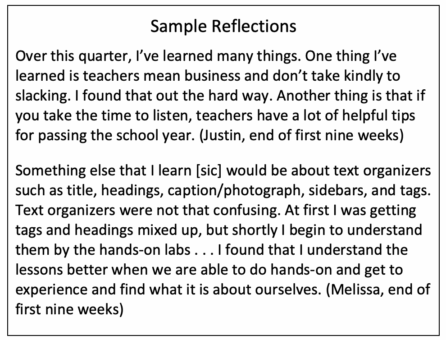 You can also use journals for students to reflect on specific information about their subject area. For example, in math, students might focus on explanations.
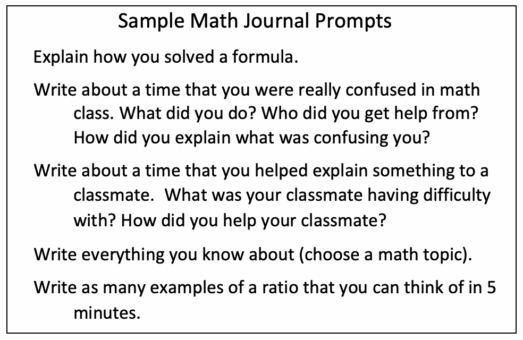 Your students can write in their journals daily, weekly, or at the end of the month or grading period. Students can also keep their journals online in a blog format, or through Google Docs.
Video Confessionals
As described by Suzie Boss in an Edutopia blog entry, Ruth Farmer borrowed an idea from reality television. As Suzie describes, “Farmer set up a self-contained ‘video confessional’ in the corner of the classroom equipped with a stool and a video camera on a tripod, which she then surrounded with a curtain for privacy. When students had a free moment from their engineering investigations, they could duck behind the curtain, hit the Record button, and talk about how it felt to be an inventor.
“Farmer says the makeshift recording booth not only encouraged students to articulate what it means to think like an engineer or a scientist but also unexpectedly captured her students’ feelings about the program. ‘From reading a written journal, I wouldn’t have gotten the emotional attachment they had to their projects,’ Farmer explains. ‘On video, you can see them kind of puff up a little if they’re excited or proud of what they’re accomplishing.’
“With her video-confessional approach, Ruth Farmer provided a fresh way of eliciting genuine student responses, which Charner-Laird says is the key to fruitful reflection. Kids can grow weary of ‘the reflection question’ if teachers always present it to them the same way, she says.”
Notice how the use of the “confessional” increases the rigor. Students must explain their thought processes, rather than simply demonstrating a basic understanding of the content.
Which Road Are You On?
A teacher in one of my workshops shared a strategy to help students determine how well they understand the lesson. Rather than being totally open-ended, students choose one of four options. Her version used a travel metaphor: “Which Road Are You On?”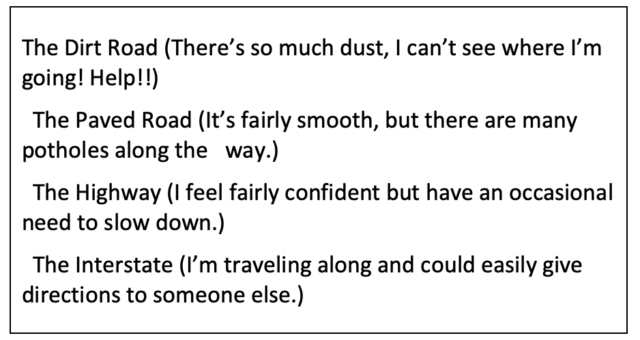
A Final Note
Teaching students how to self-reflect and then incorporating self-reflection in your classroom can move students to higher levels of thinking. Options such as a Muddy Point Board, reflective journals, video confessionals and Which Road Are You On? provide opportunities for your students to reflect.
 Dr. Barbara R. Blackburn, a “Top 10 Global Guru in Education,” is a bestselling author of over 30 books and a sought-after consultant. She was an award-winning professor at Winthrop University and has taught students of all ages. In addition to speaking at conferences worldwide, she regularly presents virtual and on-site workshops for teachers and administrators.
Barbara is the author of Rigor and Assessment in the Classroom: Strategies and Tools (Routledge/Eye On Education, 2025) and many other books and articles about teaching and leadership. Visit her website and see some of her most popular MiddleWeb articles about effective teaching and support for new teachers here.

