December 21, 2025
Tom Goreau, President, Global Coral Reef Alliance
I: Biorock to restore damaged Jamaican coral reefs, beaches, and fisheries after worst hurricane in history
II: Biorock Indonesia: A quarter century of the world’s longest, largest, most biodiverse, and most beautiful coral reef and beach regeneration projects
III: Biorock Sustainable Blue Ocean Economy to reverse climate change
Record-Setting Hurricane Melissa slams full force into Jamaica
I: Jamaica Devastated by Strongest Hurricane in History: Biorock Electric Reefs to Regenerate Coral Reefs, Beaches, Fisheries, Biodiversity, and Ecotourism
Jamaica is the latest victim of catastrophic economic losses from fossil fuel-caused global warming, after the strongest hurricane on record, Melissa, hit full force on October 28, 2025.
Charlie, the strongest Hurricane ever to hit Jamaica back in 1951, and still the deadliest, blew the roof off our home when I was a baby, and flattened coral reefs around the island. Five years later, those coral reefs had grown back! Now the coral reefs, Jamaica’s richest renewable resource and source of its marine biodiversity, beaches, fisheries, and tourism economy, are gone and unable to recover.
Natural coral reef regeneration no longer happens due to severe coral damage from global warming, pollution, and new diseases. Regeneration of coastal ecosystems won’t happen by itself. But coral reefs and fisheries can be regenerated using Biorock Electric Reef Technology, invented in Discovery Bay, Jamaica, in the 1980s, and now used around the globe, but sadly no longer in its own native land.
GCRA will use funds raised to train Jamaican Marine Protected Area and Fish Sanctuary management staff to grow Biorock shore protection and sand-producing reefs in front of the severely eroded Discovery Bay Public and Fishermen’s Beaches, St. Ann, in collaboration with the Discovery Bay Marine Protected Area and Fish Sanctuary, and local environmental management organizations.
A Biorock coral nursery will also be set up in Silver Sands, Trelawny, to propagate fragments of Acropora collected by Felix Charnley that survived the last three years of record-high temperatures and coral bleaching mortality, and survived Hurricane Melissa, in collaboration with local environmental management groups. If more funding can be raised the program will expand to marine protected areas and fish sanctuaries around Jamaica, and in other tropical islands.
The Global Coral Reef Alliance was founded in 1990 to represent the urgent need to fund Jamaican, Caribbean, and Small Island Developing States (SIDS) grass-roots coral reef ecosystem regeneration and community-based management projects at the United Nations Summit on Sustainable Development, in Rio de Janeiro, Brazil, because the inevitability of coral reef extinction was already clear then. Sadly, funding to help small island developing states save themselves never materialized, or was hijacked by rich country organizations who left out tropical islanders (islanders call these groups “whiteboy tourist divers”, who love jet-setting PR selfies but don’t stay to work with us).
Biorock works directly with Jamaican fishermen to preserve their reef resources. Serious coral reef restoration has no benefactors or major donors anywhere in the world; almost all of our donations are in the $10-$20 range. Those who have profited the most from destruction of coral reefs have never helped to save them.
DISCOVERY BAY BEACH COMMUNITY CLEANUP AFTER HURRICANE MELISSA NOVEMBER 16, 2025
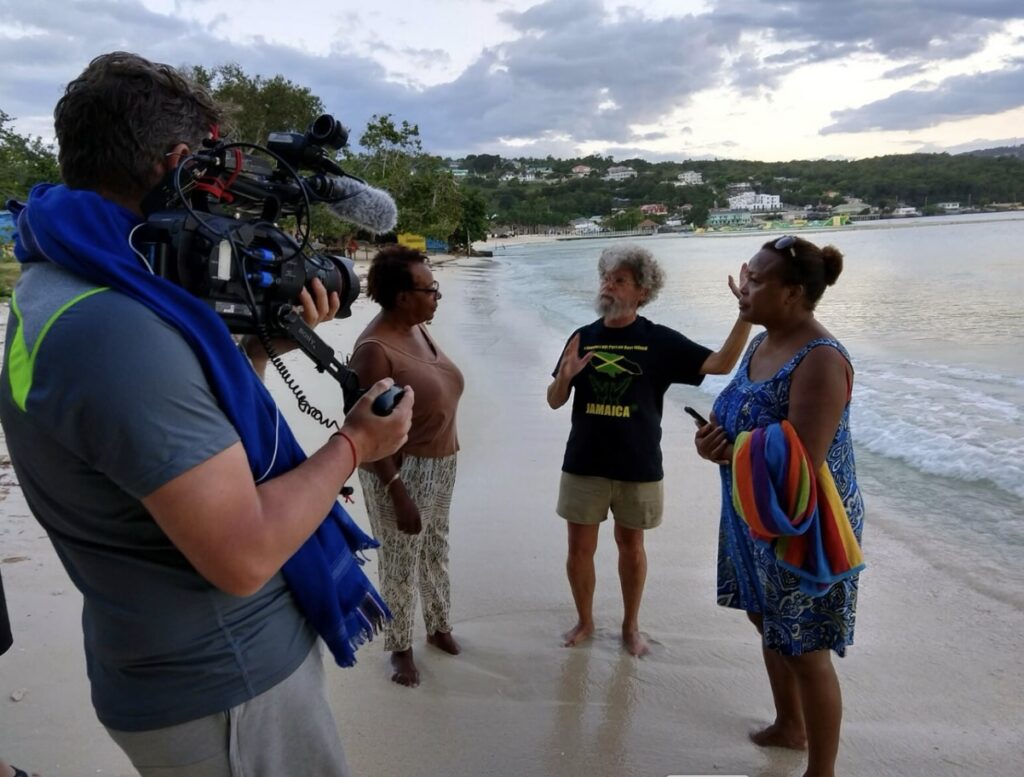
Photographs by Sharon Chin Quee (right), text by Tom Goreau (second right). Dedicated to the late Lee Arbouin (second from left) who helped lead local efforts to protect the Discovery Bay Public Beach from pollution by dolphin pen operators and who tragically died swimming at the place she loved most in the world (photo and video by Thomas Sarkisian, 2019 showing Discovery Bay Beach days before the dolphin pens went in).
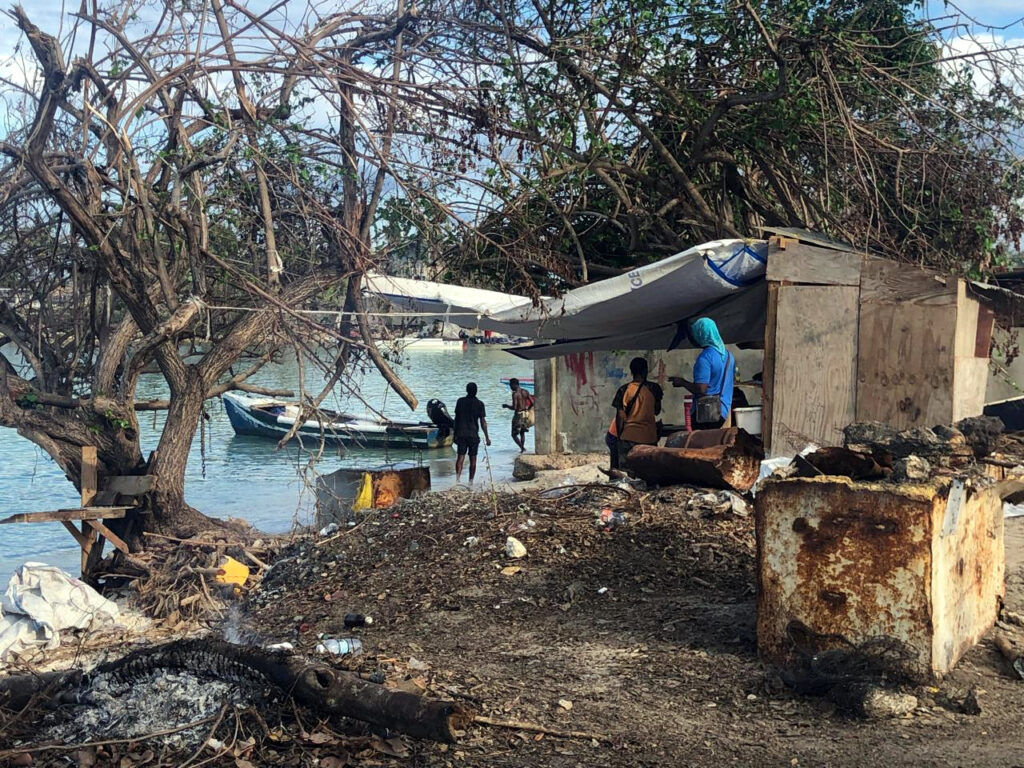
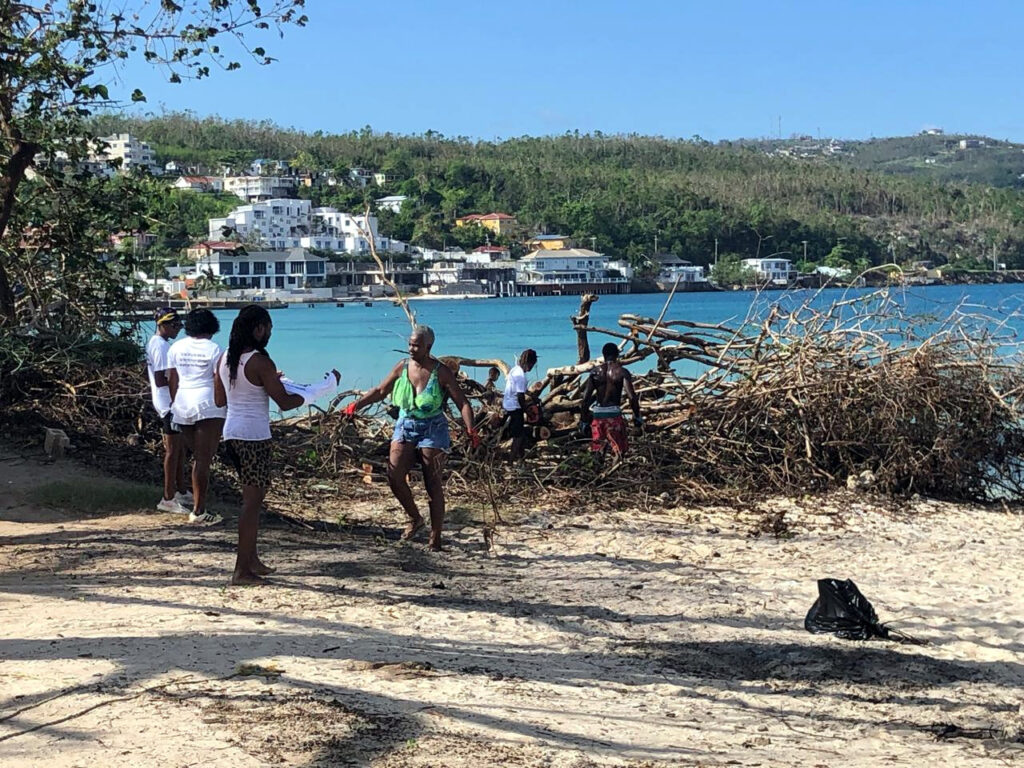
The photographs clearly show that the beach was almost entirely washed away and the sand dumped on land. The beach in 2019 had already lost around two thirds of its width in the previous 50 years:

Historic painting of Discovery Bay Fishing Beach by the late Jamaican artist Herbie Rose (reproduced with kind permission of the artist)
Hurricane Melissa was the strongest ever documented to hit land, but worse lie ahead as global warming and fossil fuel use race ahead out of control.
JAMAICA is the latest and one of the worst victims of global warming caused by fossil fuels, as our island was battered by the most powerful hurricane on record. It is far too soon to assess the damage, or the cost of rebuilding, but all coastal areas are devastated, and with them, a major part of the economy.
Increasing damage from record hurricanes Charlie, Flora, Allen, Gilbert, Ivan, and Melissa, is caused by global warming and global sea level rise, driven by the world’s fossil fuel addiction, and by self-inflicted wounds from poor coastal planning, driven by greed.
Given near complete destruction of our natural coral reef, mangrove, and sea grass coastal defenses long BEFORE Hurricane Melissa hit, rebuilding damaged coastal infrastructure the same way guarantees far worse losses in the next record hurricane, unless our natural defenses are regenerated for future generations.
We can’t afford to repeat the same mistakes again! A climate-smart strategy is needed now to reinvigorate coastal ecosystems and protect shorelines against accelerating future climate change.
Biorock technology, invented and developed at the Discovery Bay Marine Laboratory, is the best method in the world for recharging biodiverse coastal ecosystems and the fisheries that depend on their health, for regrowing eroded beaches and protecting coasts.
Biorock is used in some 50 countries all around the world, but NOT in its own native land, Jamaica!
We call for the Discovery Bay Marine Protected Area, Fish Sanctuary, and Marine Laboratory to be rejuvenated as a leading global centre for cutting-edge research and training in ecosystem regeneration. By growing back coastal ecosystems, soils, and fisheries to protect coastlines from climate change, we aim to accelerate Jamaica’s natural recovery from Melissa’s devastation, and make it the most beautiful island in the Caribbean again, above and below water, as it was in 1494.
Screenshot
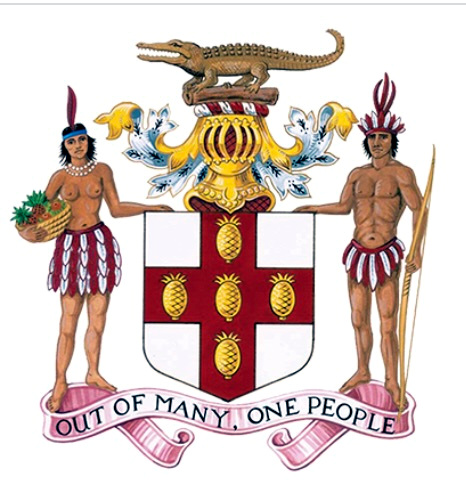
Jamaica’s Coat of Arms shows Indigenous Jamaicans and the pineapples they carried by canoe when they immigrated from Amazonia. DNA shows one of the author’s great great great great grandmothers was Native Caribbean Taino Arawak.
II: A Quarter Century of the World’s Longest, Largest, Most Biodiverse, and Most Beautiful Coral and Beach Regeneration Projects:
Pemuteran and Gili Trawangan Grow Back Coral Reefs, Beaches, and Sustainable Blue Economies While Climate Change Destroys Them Elsewhere

New Biorock reef, in form of traditional Balinese Hindu Temple Gates, on Pemuteran Beach just before installation. Left to Right: I Gusti Agung Bagus Mantra (Yayasan Karang Lestari, Taman Sari Resort), Made Gunaksa (Biorock Centre), Tom Goreau (Global Coral Reef Alliance), Jro Mangku Sumer (Balinese Priest blessing the project), Komang Astika (Biorock Centre), Kadek Asa (arranging offerings to Balinese Gods). The beach has been grown by Biorock projects for a quarter century.
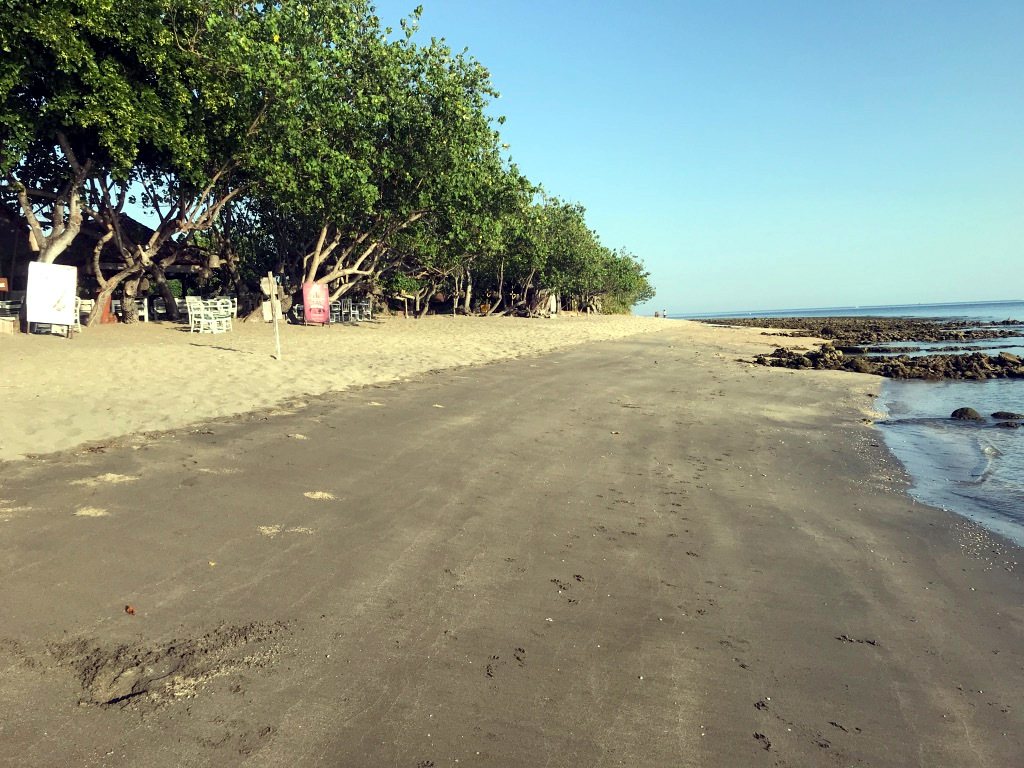
When we began growing new Biorock reefs in front of the dead reef at Pemuteran that had died from bleaching in 1998, this beach was entirely under water at high tide; the deck chairs could not be left on the beach because they washed away at high tide. The trees were falling over into the sea, so they built a sea wall in front to protect them, which increased erosion of the black volcanic beach sand. 25 years later the beach has grown by 10-20 metres in width (the high tide line is shown by wet sand at right) and a metre in height, and so much new limestone sand is being produced by the Biorock reefs to the right, that the color of the sand has changed from black volcanic sand to white limestone sand (photo by Tom Goreau).
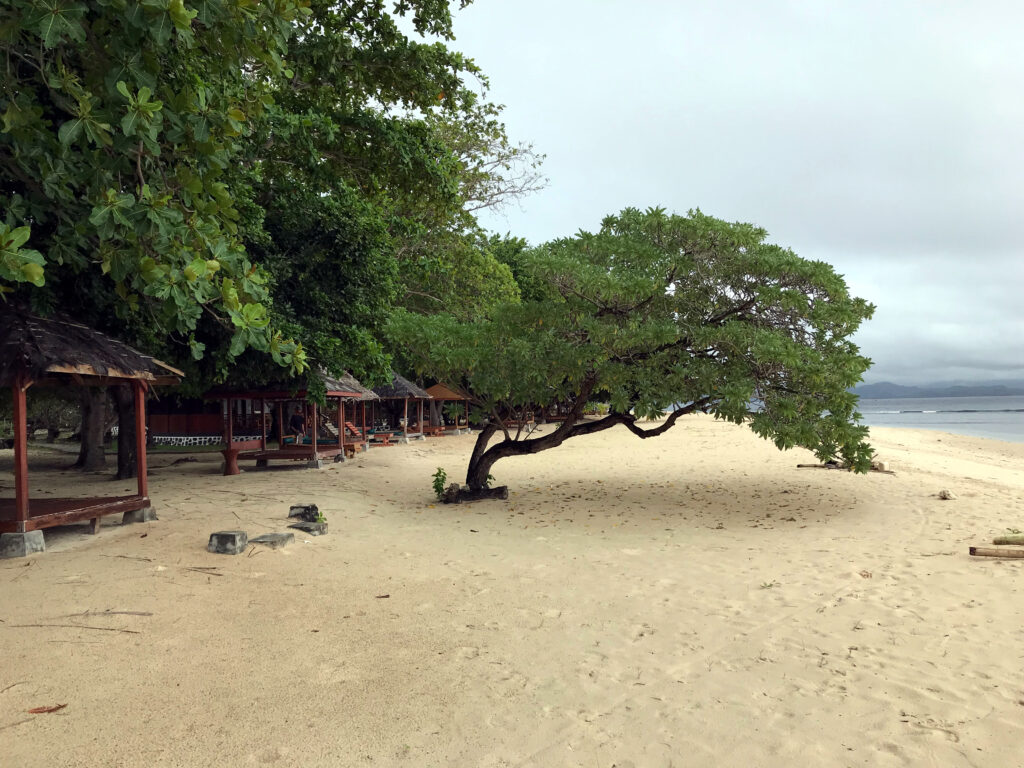
This beach at Pulau Gangga, Sulawesi, Indonesia had entirely washed away and the beach cabins were falling into the sea when we began. There was a cliff 1.5 meters high right in front of the cabins that had to be moved inland before they fell into the sea. The large tree fell over into the sea, the main trunk is now buried under the sand beach that grew back over it in months naturally without any dredging, dumping, and pumping, and a side branch grew upward into a new trunk. The new beach sand came from coralline algae growing in the coral reefs to the right, that protect them from erosion (photograph by Tom Goreau).
The health of coral reefs and beaches has never been worse, nor deteriorated faster, than over the last three years of record heat and sea levels. As earth’s heatstroke fever rises, coral reefs are the first ecosystems to die, but many more will follow.
Coral reefs are dying from accelerating global warming all over the world, and many of the most abundant species are now functionally extinct across the Caribbean, Pacific, Indian Ocean, and Australia. Beaches are washing away world-wide as global sea level rise accelerates and storms become stronger due to global warming.
But not in Pemuteran, Bali, and Gili Trawangan, Lombok, Indonesia, where Biorock technology has been growing back coral reefs and beaches for over 25 years, in the longest-running, largest, most biodiverse, and most beautiful coral reef restoration projects in the world, and the basis of entire village and island economies. You can see a very small part of the Pemuteran project in this video by Komang Astika, of the Biorock Centre in Pemuteran. The Biorock reefs shown range in age from one year to 25 years, with the youngest reefs at the start and the older ones at the end. Photos showing growth of corals on nearly 80 Biorock reefs are available at these links from Biorock Indonesia and Karang Divers, which has helped maintain the projects. These beaches are especially popular with macro photographers, because of the extraordinary biological diversity of rare species.
The following short video, taken December 2025 by Tom Goreau on Pemuteran Beach shows the constant stream of tourists diving and snorkeling on the Biorock reefs, the life blood of the Pemuteran sustainable tourism economy. People come from all over the world to see a village growing back its coral reefs, beaches, and natural Balinese beauty. They come by word of mouth, not from advertising campaigns. Pemuteran has been recognized with repeated awards for sustainable tourism and environmental management over the last two decades, including the United Nations Development Programme Equator Award for Community Based Development of Indigenous Communities, and many awards from world tourism and environmental organizations. The latest from the UN World Tourism Organization is the 2025 World Sustainable Tourism Village of the Year.
In 2025 the Karang Lestari project installed one of the largest Biorock reefs, in the form of traditional Balinese Temple gates. This was put under power, and the power supplies of several other projects were repaired. After a quarter of a century of continuous maintenance, the project is now imperiled by failure of old electrical components readily available 25 years ago, but now obsolete and no longer available. The Global Coral Reef Alliance Technology Development team, led by Thomas Sarkisian, has tested a new generation of power systems that are twice as efficient and are sealed so they don’t corrode from salt air, on two Pemuteran Biorock reefs, and we are seeking funding to implement the much more efficient system, with real-time data logging and transmission, to the entire project in 2026 to bring it from its first quarter century towards its first half century.
You can see the extraordinary growth of coral on Biorock in this short video taken by Delphine Robbe of the Gili Eco Trust, in Gili Trawangan, Lombok, home to the largest coral restoration project in the world. The bare structure shows where a boat that broke its anchor rope in a storm and ran onto the Biorock reef smashed off a meter of coral growth, exposing the Biorock reef structure hidden below. It will soon grow back just like the undamaged portions. This video shows that Biorock can rapidly grow meters of coral reef to protect beaches and provide reef habitat for fishes and tourists. No other method does.
The Pemuteran projects were the first of the Bali Indonesia network, of which the first daughter group, the Gili Eco Trust, runs the largest complex of coral regeneration projects in the world, with 182 Biorock reefs. These reef power supplies also need upgrading after more than 20 years. Their phenomenal growth is shown in this video by Delphine Robbe:
Another extraordinary Biorock project can be seen in another part of Pemuteran Bay, in front of Reef Seen, the only place where an entire reef was wired up without any Biorock reef structures. Millimeter-thick binding wire has now grown up to a metre-thick solid limestone, growing hard rock bottom upwards faster than sea level rise.
Besides these Biorock projects in Bali and Lombok, the Biorock Indonesia network also has projects in Java, Sulawesi, Flores, Sumbawa, Sumatra, Ambon, Halmahera, and other places across Indonesia. These Biorock Arks are helping save and amplify Indonesia’s biodiversity in our planet’s heartland of global marine biodiversity, the largest and most biodiverse coral reef, mangrove, and seagrass ecosystems on Earth.
III: Coastal Adaptation for a sustainable Blue Economy:
Geotherapy Regenerative Development To Reverse Global Climate Change
Coastal ecosystems everywhere in the world except at Pemuteran, Bali and Gili Trawangan, Lombok, Indonesia are collapsing from fossil fuel global warming, land-based sources of pollution, and new diseases, and our most productive renewable marine reefs, fisheries, biodiversity, and sand supplies are being replaced by slime, weeds, parasites, and invasive pests as the world rushes to capitalize, degenerate, and destroy its sustainable coastal ecosystem resources and services as fast as possible.
In 2025, following three years of record global high temperatures and sea levels, corals are dying from heat stroke, pollution, and disease at record rates, as we first warned in Jamaica would happen decades ago. In 2025 Florida coral reef scientists announced that the two most abundant coral species in the Florida Keys were now functionally extinct in the wild, with only a handful of survivors being maintained in aquaria. The same is true in Jamaica, Grand Cayman, Mexico, and across the Caribbean. The few survivors are so heat stressed they can’t reproduce. The Great Barrier Reef has never had less corals following repeated bleaching events. The last Acropora in the Persian Gulf are extinct in the wild and being maintained on Biorock Coral Arks. During the last two years places that had never bleached before, and were falsely claimed to be “resilient”, such as Raja Ampat in West Papua and the Gulf of Aqaba, bleached like all other reefs once it became sufficiently hot. It is just a matter of time for the rest, except for the more heat tolerant corals we are growing in Biorock Coral Arks in Pemuteran, Gili Trawangan, and wherever local communities can find the funds and governments will permit them to save their own corals.
Only Biorock Electric Reef Technology, an open-source technology invented by the Global Coral Reef Alliance in Jamaica and developed in tropical islands around the world, reverses collapse of coastal ecosystem resources and regenerates them at record rates. Small Island Developing States desperately need funding to grow their own way out of global climate change, but they have been effectively denied funding to do so by the rich country and international funding agencies, who instead peddle worthless seawalls that quickly collapse.
GCRA will work with local management groups in coral reef countries trying to regenerate their lost coastal resources, especially in tropical islands and indigenous fishing communities. Please contact us for more information on how Biorock Technology can be used to solve sustainable marine resource management problems at YOUR site: info@globalcoral.org
Effective adaptation to runaway climate change overshoot is essential everywhere, repeating the disastrous mistakes of coastal management based on greed and exploitation instead of nurturing and growing our coastal reef ecosystems will only hasten their collapse. GCRA stands in the forefront of innovative technologies for regenerative ecosystem development to reverse climate change to safe levels.
Reversing the catastrophic impending impacts of global climate change before runaway warming triggers disaster for coral reefs and human civilization will need a three-pronged strategy to stabilize temperatures at safe levels: 1) ending fossil fuel pollution, 2) large scale BioGeoTherapy to regenerate ecosystems on land and sea to absorb and safely store the dangerous excess CO2 now in the atmosphere, and 3) urgent efforts to develop safe methods to make the Earth shinier to reflect more solar radiation and prevent further warming (solar radiation management) in time to save coral reefs from global warming extinction.
Much worse lies ahead when crazy politicians force us into runaway climate overshoot, extreme temperatures that coral reefs and humans will not survive. Biorock offers the last hope to save coral reefs, beaches, and all coastal ecosystems, while helping reverse climate change with greatly increased Blue Carbon storage.
Global warming is killing coral reefs, but the beaches will wash away before politicians can see the light and allow communities to grow back their own natural resources.