

By Erik Palmer
 Students speak in your class.
Though I don’t know what grade you teach or what subject you teach, I feel confident that I’m correct.
Sometimes the speaking is casual – asking questions, doing a think-pair-share activity, discussing, and many more.
Sometimes the speaking is formal – reciting a poem at the Poetry Café for parents, presenting research to the class, participating in debates, using the school broadcast system.
Unfortunately, most students don’t speak very well.
I know that seems harsh, but listen with new ears. How many student presentations are engaging? How many poems come alive because of the way they are delivered? How many discussion comments are powerful and persuasive?
“Oh well, that’s just how students speak.”
I often get that comment when I ask these questions. We seem to think there is nothing that can be done. But such a cavalier and defeatist attitude does an enormous disservice to our students.
Speaking is by far the number one language art. Oral communication skills are valued in business and social situations. In a world where AI can read and write for us, speaking competence will be in demand and well-spoken people will stand out. Every day improved verbal communication skills will make your students’ lives better.
We don’t need to accept weak speaking. We don’t need to feel powerless to help. Speaking skills can be taught just as the skills of math, reading, writing, research, thinking, dissection, poetry, drawing, violin, basketball, cooking, and [you-name-it] can be taught.
In Well Spoken: Teaching Speaking to All Students, I point out that all speaking has two distinct parts – building a talk and performing a talk. Building refers to everything we do before we open our mouths. Performing refers to the things we do as we are speaking.
Whether formal or informal, in-person or digital, one-to-one or in front of group, we think of what we are going to say and then we deliver the message.
Before speaking, great speakers think about the audience, come up with the content, organize that content, add visual aids, and think about how to dress. As they speak, they are poised, have a voice that allows every word to be heard, add personal energy to help the words come alive, make eye contact, include gestures, and alter speed for dramatic impact. That’s it. That eleven-step framework works in all situations and, importantly, has individual pieces that can be easily taught.
Strengthening Digital Presentation Skills
One article can’t cover all of the pieces, but let’s look at how to apply parts of the framework to some contemporary activities.
Specifically, let’s imagine a teacher using easily available tools to make digital products at the end of curricular units:
- a health teacher who wants students to make Instagram shorts about fitness, nutrition, hygiene, smoking, and alcohol;
- a history teacher who wants to make a video for YouTube using a green screen behind students talking about Reconstruction;
- a geography teacher recording students talking about the South American country they were assigned;
- an English teacher who wants to video poetry readings to be submitted to Schoology;
- a Spanish teacher who wants to produce TikTok vocabulary lessons made by students.
You’ll think of other ideas, I’m sure. Each of these requires some effort before students record and some instruction about how to speak as they are recording.
 Before we hit record, it may be tempting to use AI to generate content. I don’t have a problem with starting there, but using my recommended framework will make clear that more is needed to create an engaging talk.
AI can tell me that saturated fats increase LDL cholesterol, causing plaque buildup in the arteries, but will my audience know what that means?
AI says Hiram Revels and Blanche Bruce became the first Black U.S. senators, but is that important and memorable to 7th graders?
Most teachers give checklist assignments: Tell us the name of the country, size of the country, physical features, main exports, famous people, food, language, religion, and currency, all easily generated by AI. But no middle schooler cares or will remember that Konstantinos Tasoulas is the President of Greece or that yerba mate is a drink first consumed by the indigenous Guarani people of South America..
Step 1 for any talk: Analyze the audience
Teach students how to do that. Ask: Who is the intended audience? What do they know? What do they need to know? What are they capable of knowing? What are they interested in knowing? Not all facts resonate. Not all famous poems appeal to 6th graders. Not all Spanish words are useful in daily conversation. Ask: Would you want to listen to this? Only by understanding the listeners will we be able to design content that is engaging and appealing.
Step 2: Design the content
As I noted, teachers require certain content. Students dutifully state the name of the book, the main characters, the setting, the plot, and an opinion about the book. Boring. The problem is exacerbated in the digital world.
Amusing videos and sport highlights are just a click away. Teach students to select content that is engaging. Items in the checklist will go away as you focus on what the audience wants. Dutifully naming the book, the main characters, the secondary characters? No. Explaining how the main character’s traits are common to all of us and how those traits get her into trouble? Yes. The size of the country in square miles? No. Resources the country has that we use and how their traditions compare to ours? Yes.
Step 3: Introduce the content with a powerful opening
“I’m going to tell you about…” is a dreadful but common way students begin talks. Brainstorm beginnings that make listeners curious and willing to continue watching.
Do you eat French fries? Imagine stuffing a French fry directly into your heart. The cholesterol in fries kinda does that. Here’s how…
If you learn 300 words, you can understand 90% of conversations in Spanish. This series of videos will teach you only what you need to know to chat with that chico or chica in your class. Listo?
What food did you used to hate when you were little but that you like now? Poetry was like that for me. I didn’t care much for poetry. But I discovered a poem that changed my mind.
These are three simple lessons to teach before hitting Record, and there are also simple lessons you can teach to improve organization, visual and audio aids, and appearance/set design.

Some tips to help students maximize engagement
Of course at some point we will hit the record button, so here are a couple of lesson ideas to make the videos engaging.
Thinking back to audience analysis: how will the viewers/listeners be accessing the content? On a tablet? On a cell phone? Those have small screens and small speakers. Additionally, listeners will likely have distractions around them. Talking will not sustain interest. Speakers must perform. Teach about voice and life.
Every word must be heard. Teach students how to adjust volume levels of their voices and their microphones. Will listeners struggle to hear? Fix that. Teach students to speak very clearly. “Thane q furjoiny uz on taze poetry podcass” is what listeners hear through small speakers if you speak normally. “Thank you for joining us on today’s poetry podcast” is what they hear if some lessons about enunciation are taught before recording.
And teach students how to add life to their voices. What was pretty lively in person is flat online, and something a bit monotonous in person is dreadfully dull when recorded. Show students how adding life to words has power by playing with a simple phrase:
~ Don’t give that to your sister! (Oh oh, I’m in trouble.)
~ Don’t give that to your sister. (Oops, I was supposed to give her something else.)
~ Don’t give that to your sister. (Right, I was supposed to give it to Kim’s sister.)
Changing the inflection changes the meaning of the phrase and makes clear that adding life to words is important. Then show how adding life can make “boring stuff” more interesting. Most students will read this at the audience:
Fifty years ago, 5% of American children were obese. Now four times as many kids are obese. That’s 21%. The number has quadrupled. Obesity can shorten lives by up to 20 years.
A speaker will add life:
Fifty years ago, 5% of American children were obese. Now four times as many kids are obese. That’s 21%. The number has quadrupled. Obesity can shorten lives by up to 20 years.
Record, rerecord, and rerecord. The first take will not be enough to hold the listeners’ attention.
Raise the bar with every recording until the words come alive.
You can teach this!
You know that student audio and video products can make three minutes seem like forever. You know that the competition for attention online is brutal. But now you also know that with some simple lessons, you can help make your students’ products stand out.
In a world where oral communication is showcased everywhere and where being well-spoken will greatly increase chances for professional and social success, take the time to give all your students an effective voice. It’s truly a 21st century superpower.
Erik Palmer is an education consultant from Denver. He focuses on showing teachers practical, engaging ways to teach oral communication skills, and showing educational leaders how to be more effective communicators.
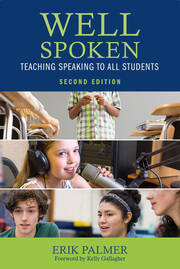 Erik is an internationally acclaimed speaker and has given keynotes and led in-service trainings for districts across the US and for educators around the world. He is also a frequent contributor to educational magazines and is the author of several books: Well-Spoken: Teaching Speaking to All Students (2nd Edition – Routledge/Stenhouse, 2025), Teaching the Core Skills of Listening & Speaking (ASCD, 2014), Researching in a Digital World (ASCD, 2015), Good Thinking: Teaching Argument, Persuasion, and Reasoning (Stenhouse Publishers, 2016), Own Any Occasion: Mastering the Art of Speaking and Presenting (ATD Press, 2018) and Before You Say a Word: A School Leader’s Guide to Clear and Compelling Communication (ASCD, 2024).
Erik is also a program consultant for Houghton Mifflin Harcourt’s Into Reading and Into Literature language arts programs. His educational background includes Oberlin College, University of Denver Law School, and the University of Colorado. He taught English, math, science, and civics over a 20-year career and coached numerous sports as well as debate and forensics.

