

Every person experiences a city differently. Some residents move easily through its systems, while others face barriers at every step. Barriers that are shaped by a wide range of factors, including income, language, gender, age, family status, or disability. When these factors overlap, they deepen inequality and limit access to opportunities, services, and representation.
Cities that work towards equity begin by understanding these overlapping realities. This is often described through the lens of intersectionality, a concept that helps explain how different forms of disadvantage interact and shape people’s experiences at the same time.
Intersectionality helps reveal challenges and forms of discrimination that remain invisible when looking at only one factor. A Black woman may face both racism and gender-based discrimination. These are not separate experiences, they overlap, creating forms of exclusion that neither racism nor sexism alone can fully explain.
Civil rights advocate and scholar Kimberlé Crenshaw illustrates this through a traffic metaphor: When discrimination comes from several directions, people standing at the intersection can be hit by more than one flow at once.
Across the Malmö Commitment network, different cities are taking this approach and showing what it looks like in practice. They are identifying specific target groups, learning from lived experiences, and designing ways to engage people who are often left out of public processes.
Cities apply intersectionality through a range of approaches. In Newcastle, Australia, intersectionality shapes long-term social planning. In Glasgow, Scotland, school-based initiatives meet families facing child poverty. In Del Carmen, Philippines, inclusive housing and local assemblies involve the whole community in climate adaptation. And in San Diego, United States, improved accessibility and participation practices enable more residents to take part in public processes.
These examples show that equity is not a principle to declare but a practice to maintain. It begins with knowing who your residents are, understanding what keeps them from being heard, and creating the conditions for their voices to shape the city’s future.
In Newcastle, equity is treated as a foundation for planning, not an afterthought. The city’s Social Strategy 2030 uses an intersectional lens to understand how different forms of disadvantage overlap and shape daily life for residents.
“We used an intersectional lens to better reflect our city’s diverse communities and identify who was missing from our strategies.”
— Lisa Davis, City of Newcastle
During the strategy’s development, the team looked closely at how several barriers can converge for a single person. One example illustrated this clearly: A seventeen-year-old newly arrived refugee from Afghanistan who is learning a new language, facing cultural and racial stereotypes, managing economic pressure, and experiencing the challenges of adolescence. Situations like this helped the city reflect on the kinds of experiences that often remain invisible in traditional planning approaches.
To build a more accurate picture of local needs, the city combined national socio-economic data from the Australian Bureau of Statistics with insights gathered from community engagement. This made it possible to see where different disadvantages intersect across neighborhoods and highlighted groups who were not well supported by existing policies. These included newly arrived migrants, young people without strong support networks, older adults living alone, and families living in areas with limited services.
The process also encouraged the administration to rethink how it interacts with residents. Engagement activities were designed to be accessible, with clear language, visual tools, and opportunities for open conversation. Throughout the City’s approaches, intersectionality is not a theoretical concept but a practical way of making planning inclusive from the beginning.
In Glasgow, child poverty remains one of the most pressing social challenges. The City’s response focuses on a clear target group: Families struggling with the combined pressures of low income, high living costs, and limited access to support.
Through its Child Poverty Strategy, Glasgow created a network of Financial Inclusion Support Officers (FISOs) who work directly in schools. These officers connect with parents during drop-offs, meetings, or school events and help them access benefits, childcare services, and local assistance programs.
“The easiest way is to go where people already go. Embedding officers in schools lets families drop in, ask questions, and maximize household income.”
— Guy Wells, Glasgow City Council
The decision to embed support in schools was deliberate. Schools are familiar spaces where families feel comfortable. This everyday contact builds trust and continuity, allowing officers to follow up and adapt support over time.
Each officer also collaborates with a broader multidisciplinary team that includes social services, education departments, and local health organizations. Together they align interventions so that families receive consistent support rather than fragmented assistance.
By meeting families where they already are, Glasgow turns strategy into presence. Poverty reduction becomes not only a financial goal but a matter of daily interaction, care, and proximity.
On Siargao Island in the Philippines, the Municipality of Del Carmen has shown how inclusion can guide climate resilience. Its “Dignity of a Home” program relocates families from flood-prone and coastal danger zones to safe, climate-resilient housing while ensuring that accessibility and participation are built into the process.
“We ensure the new housing is inclusive, PWD-friendly, senior-friendly and that every sector has a voice in our assemblies.”
— Vill Andro Escauso, Municipality of Del Carmen
The program plans on resettling around 1,000 households, focusing on people with disabilities, older adults, and families with young children. These houses include features such as wider doors, ramps, and accessible bathrooms that can serve as a panic room. Beyond physical safety, the program supports residents through livelihood partnerships with national agencies like the Department of Social Welfare and Development (DSWD), the Department of Labor and Employment (DOLE), and the Technical Education and Skills Development Authority (TESDA), helping families rebuild income and stability.
A key part of the program is the series of public consultations carried out specifically for the resettlement. These sessions gather concerns directly from the community and support the co-creation of solutions between the Local Government Unit and residents. They complement the barangay – the smallest local administrative unit in the Philippines, similar to a neighborhood or village – assemblies that bring together between 70 and 80 percent of local residents twice each year. These gatherings allow different sectors, including women, youth, and people with disabilities, to identify needs, share feedback, and monitor ongoing projects.
By aligning housing, livelihoods, and participatory governance, Del Carmen demonstrates that equitable adaptation is about more than infrastructure. It’s about dignity, shared ownership, and inclusion at every stage of recovery and development.
City staff in San Diego, USA, understand that more voices being included in decision-making results in better policy outcomes for San Diegans. However, historically, the City has experienced challenges in garnering broad and continuous participation from people who are representative of the city’s demographic diversity. Additionally, some community members have noted barriers that prevent them from meaningfully engaging.
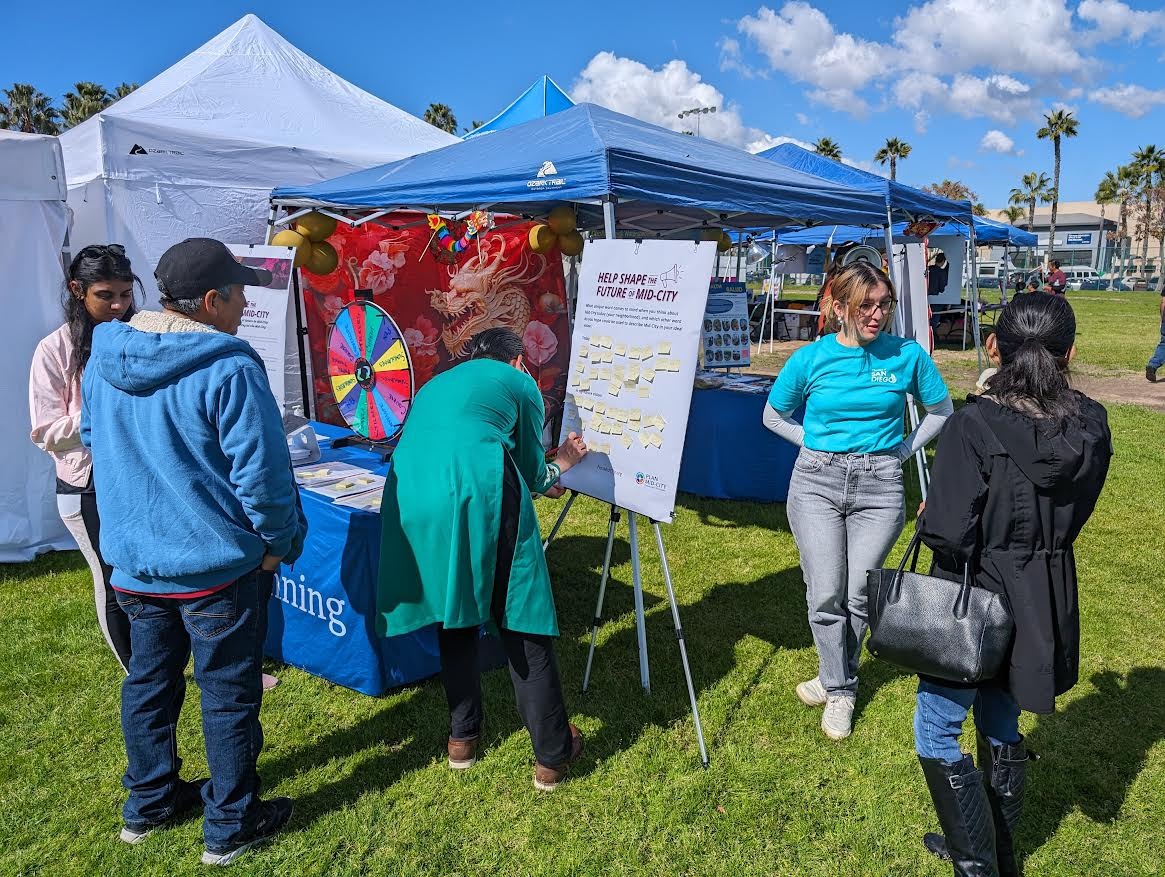
To address this, the City of San Diego developed the Inclusive Public Engagement Guide, a practical tool that sets out clear guidance for reaching and involving the public, including underrepresented groups.
The guide contains more than thirty engagement techniques and gives detailed advice on accessible communication and event design. It includes specific considerations for how to engage diverse groups including youth, older adults, and members of the LGBTQIA+ community and outlines how to adapt engagement to meet their needs.
Each department is encouraged to plan for accessibility from the start. That includes providing different ways for people to participate, providing translation and interpretation services, preparing materials in plain language, and offering participation support such as meals or gift cards when appropriate and possible.
San Diego’s approach reframes inclusion as a design issue. Public engagement is not effective if only the most resourced community members can participate. By accounting for accessibility and building authentic, sustained connections with the communities they serve, the City can do its best to ensure that every community member has opportunities to be involved in shaping local policy.
Equity requires more than well-written strategies. It depends on knowing who your residents are, what barriers they face, and how to keep them engaged over time. The experiences of Newcastle, Glasgow, Del Carmen and San Diego point to several lessons that can guide any city working toward meaningful inclusion.
The first is the importance of identifying who is missing early in the process. Combining data with lived experience helps reveal which groups remain invisible in standard planning and where policies fail to reach them. Another is to engage through everyday spaces. Schools, housing sites, and community halls often serve as trusted entry points, creating settings where residents feel comfortable expressing concerns and ideas.
Cities also need to budget for accessibility. Translation, childcare, and participation stipends are not additional expenses but necessary measures that make public involvement possible for a wider range of people. Finally, inclusion requires continuity. Assemblies, feedback sessions, and regular contact build the trust that equity depends on and turn participation into an ongoing relationship between governments and residents.
These programs show that inclusion grows through daily practice. By defining target groups and designing meaningful ways to engage them, cities create systems that listen, adapt, and respond.

