

September 12, 2026 Public updates about U.S. elections, Congressional oversight and legislation related to hunger was convened on Thursday Sept 10 by Bread for the World (a Christian, Washington-DC based, nonprofit institute). The timing was especially important because Congress was nearing the September 30 fiscal-year deadline. Participants said the House and Senate had agreed to a continuing resolution (CR) that would keep the federal government funded at current levels until December 11, 2026, reducing the immediate risk of a shutdown. Yet the CR effectively postponed final decisions on fiscal-year 2027 spending, leaving anti-hunger advocates with a short window before a likely year-end negotiation.
The briefing framed American hunger policy as a domestic and international agenda rather than a choice between competing priorities. Speakers argued that SNAP and WIC support U.S. families’ ability to obtain nutritious food, while Food for Peace, McGovern-Dole school feeding, PEPFAR, Gavi, nutrition programs, and humanitarian assistance form part of the same broader effort to prevent hunger, malnutrition, disease, and instability abroad. The organization’s faith-based advocacy model was presented as a way to connect direct service to longer-term policy reform.
The presentation’s central message was that advocacy had preserved important openings, such as for SNAP, WIC, Food for Peace, McGovern-Dole, global health, and African trade. But that many of those gains remain provisional, subject to unresolved appropriations, Farm Bill negotiations, agency implementation decisions, and electoral change
Farm Bill and SNAP dispute
Bob Powers summarized developments in the current U.S. Farm Bill which did not get out of the Senate Committee. The unresolved Farm Bill was the presentation’s most prominent domestic concern. The House had passed its version earlier in the year, while the Senate Agriculture Committee had failed to advance its own bill before the August recess. The key conflict concerned a new SNAP cost-sharing framework under which states would, for the first time, assume part of the cost of SNAP benefits, based on payment-error rates, as well as 75 percent of SNAP administrative costs. Bread for the World described the policy as a potentially major fiscal burden on states and stressed that payment errors are not synonymous with fraud. Senate Democrats were said to be insisting on a two-year delay in the benefit cost-sharing provision; Senate Republicans had proposed a one-year delay.
On the table is a one or two year delay before implementing the cost-share provisions for SNAP, the federal program which now would transfer $17 billion in expenses to state governments.
The briefing included one guardedly positive Farm Bill development: both House and Senate texts would reauthorize the Gus Schumacher Nutrition Incentive Program, or GusNIP. Although neither version reportedly adds funding, continued authorization would preserve a program intended to make fruits and vegetables more affordable for eligible households.
WIC and lost hunger data
WIC emerged as another urgent but unsettled issue. According to the presentation, the House fiscal-year 2027 appropriations bill would cut WIC by $200 million and reduce the program’s fruit and vegetable benefit. Bread for the World argued that this would reverse demonstrable nutrition gains for pregnant and postpartum women, infants, and young children. The Senate had not yet acted, however, leaving open the possibility that final negotiations could retain current funding and protect the benefit.
A second WIC concern is the pending expiration of virtual certification flexibility. This allows participants to recertify remotely rather than arranging transportation, child care, and time away from work for an in-person appointment. Presenters said congressional leadership had signaled interest in making the flexibility permanent, potentially through a year-end appropriations package and the proposed Modern WIC Act, but no final action had occurred.
The speakers also called attention to the cancellation of USDA’s annual household food-security report, which has been written about here in Hunger Notes. They described this as the first interruption in three decades of consistent national food-insecurity estimates, occurring as hunger was said to be at a 10-year high and food banks reported elevated demand.
International programs and implementation
Internationally, the presentation identified meaningful congressional support but emphasized an unsettled implementation environment. The House Farm Bill would reauthorize Food for Peace through 2031, retain U.S.-commodity sourcing requirements, support ready-to-use therapeutic foods for severe child malnutrition, preserve development programming, and move Food for Peace authorities to USDA. The bill would also reauthorize McGovern-Dole through 2031; the latter program reportedly reaches about 2.5 million food-insecure children in 34 countries.
On funding, presenters called the House’s proposed $900 million for Food for Peace and $240 million for McGovern-Dole a significant achievement because the administration had reportedly sought to eliminate both. The House’s State Department and related-programs measure was also described as providing about $8.88 billion for global health, including $5.5 billion for HIV/AIDS programming, $300 million for Gavi, and $165 million for nutrition interventions. These amounts are not final: the Senate bills had not been released, and final appropriations remain to be negotiated
The most consequential uncertainty concerned Food for Peace execution. USDA had issued a May funding opportunity covering seven countries—Democratic Republic of Congo, El Salvador, Ethiopia, Guatemala, Haiti, Kenya, and Rwanda—and a July 14 agreement with Catholic Relief Services provided $235 million for emergency assistance in Sudan and Ethiopia. But presenters said it was still unclear whether the funding originated in fiscal year 2025 or 2026. They also noted that USDA was operating with temporary staffing and initially in only seven countries, compared with Food for Peace’s historical reach of roughly 45 million people in 35 countries.
That uncertainty matters because appropriated Food for Peace funds generally must be obligated within a two-year period. The presentation therefore raised a serious oversight question: whether funding will be awarded and obligated rapidly enough to avoid delays or possible lapses in assistance. Congressional report language and continuing engagement with USDA and the Office of Management and Budget were presented as mechanisms for pressing the administration to disclose spending plans and move funds more quickly.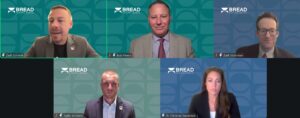
Finally, Bread for the World views the American 2026 midterms as an institutional turning point. Presenters noted unusually high congressional turnover, with more than 80 House and Senate members—about 16 percent of Congress—reported to be retiring, losing primaries, dying, or running for other offices. They observed that the next Congress could include more than 100 new senators and representatives, requiring advocates to educate many officials unfamiliar with SNAP, WIC, Food for Peace, McGovern-Dole, PEPFAR, or Gavi.
The organization’s conclusion was deliberately nonpartisan: the immediate task is not to endorse candidates but to ensure hunger becomes an issue candidates must address.
– reported by Steven Hansch of the World Hunger Education Service

