

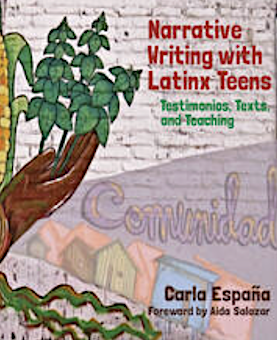
Narrative Writing with Latinx Teens: Testimonios, Texts, and Teaching
By Carla España
(Routledge, 2025 – Learn more)
Reviewed by Melinda Stewart
Carla España’s Narrative Writing with Latinx Teens Testimonios, Texts, and Teaching is an amazing exploration of the role of narrative writing in the lives of Latinx adolescents. This book is not just a guide for educators, but it is a rich examination of the intersection between culture, identity and storytelling.
España, an educator deeply immersed in the intersection of culture, identity, and language, weaves together personal experience, scholarly research, and practical strategies for teaching with deep insights into how Latinx teens navigate their complex cultural identities.
[ Note: An extension of Narrative Writing with Latinx Teens Testimonios, Texts, and Teaching can be found in En comunidad (Heinemann, 2020) an earlier work that explores similar themes but through a more community focused lens.]
 One of the key strengths of Narrative Writing with Latinx Teens Testimonios, Texts, and Teaching is its nuanced understanding of the ways in which Latinx teens navigate their identities in both their personal lives and their creative writing. España delves into the challenges that come with the intersection of culture, language and community, particularly in the classroom.
She highlights how narrative writing can be a powerful tool for Latinx teens to explore and express these intersections, offering them a chance to grapple with their cultural heritage, family dynamics, and the complexity of living in two, often opposing, worlds – one world that celebrates their culture and one that may marginalize it.
España offers specific examples of students’ works throughout the text, demonstrating how narrative writing not only provides a platform for self-expression but also fosters deeper self-awareness. The stories shared are deeply poignant, showcasing the intricate relationship between personal identity, family history and societal pressures. By bringing these voices to the forefront, España challenges readers to reconsider how the educational system views and values the writing of marginalized students, particularly those from Latinx backgrounds.
España also provides a rich collection of unit scope and sequence as well as teaching strategies tailored to Latinx students that ensures the act of writing itself becomes a meaningful and relevant process. She stresses the importance of acknowledging cultural nuances and the diverse experiences that students bring into the classroom. For example, she discusses how educators can incorporate cultural references, such as family traditions, language blends, and historical context into their curriculum. España emphasizes that these elements should be embraced as rich, authentic content that allows students to express themselves more fully and in their own terms.
She advocates for creating a safe and supportive environment, one where Latinx teens can write about their lived experiences without fear of judgement or erasure. She suggests using narrative writing as a tool for students to explore not only personal experiences but also collective cultural memories, which is healing and empowering.
By centering the voices of Latinx teens and the power of narrative writing as a means of personal and cultural expression, España’s book offers a compelling argument for the transformative power of storytelling in education. It’s a reminder that when students can write about their own lives and experiences, they don’t just learn to become better writers but they learn to understand themselves, their culture, and their place in the world more fully.
Ultimately, Narrative Writing with Latinx Teens is a celebration of language, identity, and the power of narrative. However, I feel I need to issue a warning about this work. España did such a beautiful job providing suggestions for unit progressions that I spent quite a bit of money stocking my bookshelf with her suggestions and also some time writing grants to seek funding for literature circle copies of many of the titles.
Melinda Stewart has been an educator for 30 years. She has an MA in Teaching, Education and Learning and has done graduate work in the areas of English as a Second Language, Reading, Spanish, and most recently English Language Arts. She is currently working as a Spanish teacher and ELM coach at Fairmont Junior Senior High School. Melinda is an MEA and AFT professional development facilitator and trainer who has a deep passion for learning and equity.

