

In 2000, a severe dzud, an extreme winter that can cause widespread livestock losses, hit Mongolia. As herders lost their livelihoods, many moved to Ulaanbaatar. A shock unfolding across the country’s rangelands became an urban challenge, adding pressure to a capital already grappling with rapid growth, infrastructure demands, mobility and air pollution.
For B. Purevdagva, Governor of the Capital City and Mayor of Ulaanbaatar, the experience illustrates how closely land, livelihoods and urban development are connected. Pressures can also travel much further: He pointed to winds carrying sand and dust from the Gobi Desert across Northeast Asia, affecting cities in China, the Republic of Korea and Japan.
“Land resilience is not an abstract global agenda. It is about whether our cities can provide safe water, clean air, green spaces, secure livelihoods and a healthy future for our children and our communities,” Purevdagva said.
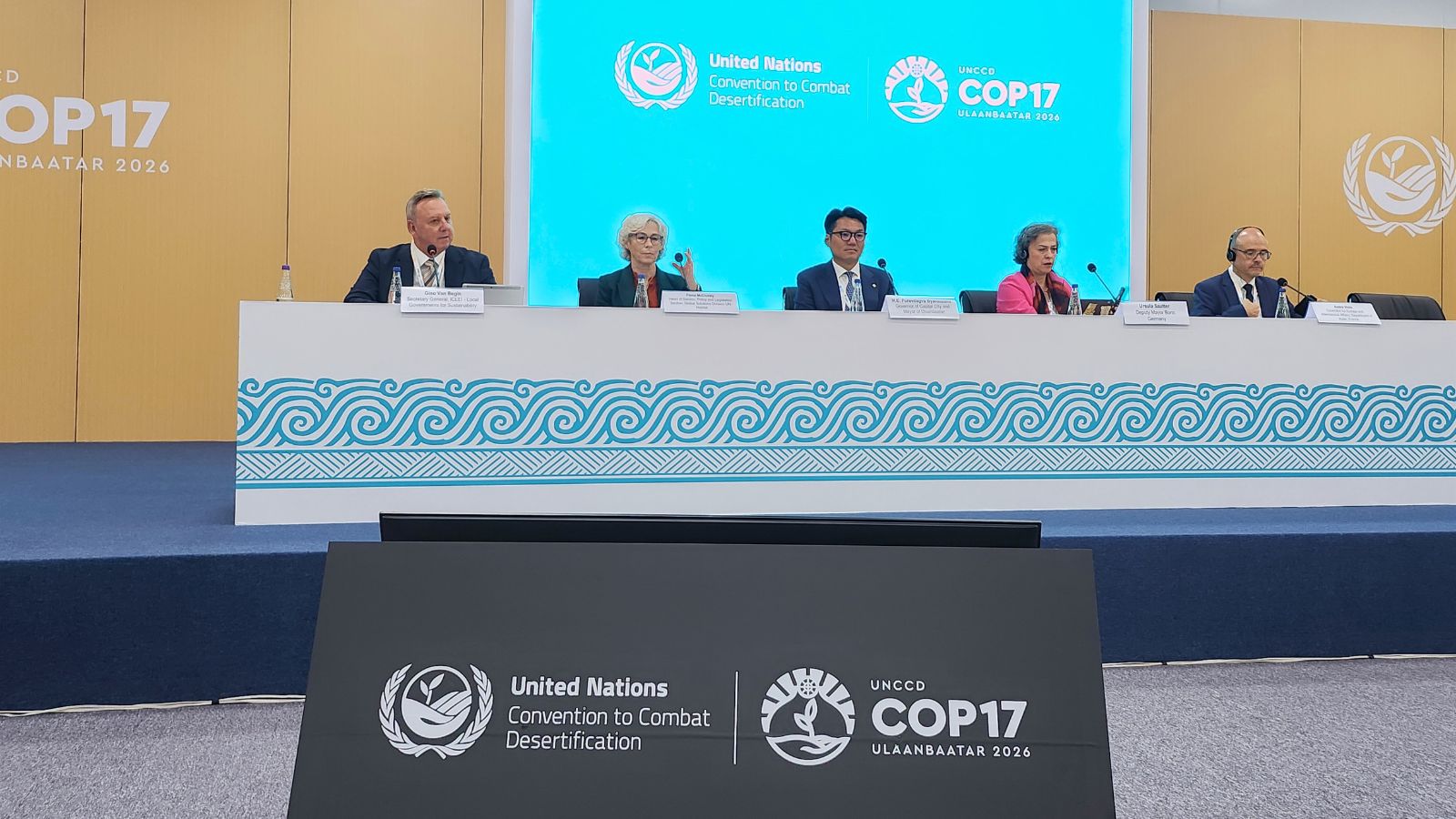
These connections between land resilience and urban life were at the heart of the UNCCD COP17 Mayors’ Forum, which brought together more than 200 participants, including mayors, governors and other local and regional leaders, from over 30 countries in Ulaanbaatar from 20 to 22 August as part of UNCCD COP17.
Hosted by the Governor’s Office of Ulaanbaatar and co-organized by the UNCCD Secretariat, UN-Habitat and ICLEI, with UCLG and the Local2030 Coalition as key partners, the Forum marked the latest step in strengthening local and regional government engagement in the global response to land degradation, desertification and drought.
Discussions culminated in the Ulaanbaatar Declaration, calling for a stronger and more sustained role for local and regional governments in the UNCCD process, and the Ulaanbaatar Initiative to test practical approaches for cities to measure and report land degradation.
The experiences shared throughout the Forum showed why that stronger role matters.
For local and regional governments, land, water, biodiversity and climate converge in the same territory.
Ursula Sautter, Deputy Mayor of Bonn, Germany, pointed to the city’s Nature Capital Fund as an example of an integrated approach currently being developed. The initiative aims to connect landowners whose land can provide nature, water and climate benefits with private investment in those functions. The same intervention can support flood retention, cooling, biodiversity, water quality, sponge-city functions and human health.
“Cities have never acted in silos; they have always spearheaded holistic action, because what nations discuss in sectoral meetings happens all in one on the ground, on the land of our cities and regions,” Sautter said.
Yet global environmental governance still largely divides these challenges between different processes, plans, reporting systems and sources of finance. Cities and regions have to manage them together and the experience they build in doing so can travel.
Ordos, in Inner Mongolia, China, shows how. The city has gained international recognition for its efforts to combat desert expansion through sustained governance and innovation. Its approach combines large-scale vegetation restoration and sand stabilization with water and soil conservation, renewable energy and technological innovation. In the Kubuqi Desert, for example, solar installations are being developed alongside ecological restoration, with vegetation planted beneath and around panels to stabilize sandy land.
Deputy Mayor Ji Rimutu described this experience as “holding back the desert with green growth”, saying that Ordos demonstrates how “firm governance commitment and continuous innovative measures can rejuvenate deserts.” He added: “We look forward to deepening cooperation with all cities, sharing sand-control technologies, jointly shouldering ecological responsibilities, and striving hand in hand to enhance the green well-being of all humanity.”
Bonn and Ordos approach land resilience from very different contexts, but both bring action back to the territory. As André Viola, Regional Government Councillor of the Department of Aude, France, put it: “Desertification is a global challenge, but its implementation is territorial.”
The Ulaanbaatar Declaration translated many of the issues raised during the Forum into a common political call. Building on the Mayors’ Forum at UNCCD COP16 in Riyadh, Saudi Arabia, it sets out five areas for action: Advancing integrated local action on land, drought, biodiversity, climate, water and sustainable urban development; strengthening the role of local and regional governments within the UNCCD process; improving coherence across the three Rio Conventions (on climate, biodiversity and land degradation) and the water agenda; supporting implementation through partnerships and finance; and strengthening knowledge exchange, innovation and cooperation. Among its concrete asks are more direct, simplified and predictable access to finance for local and regional governments and stronger partnerships to support implementation.
Presenting the Declaration on 21 August, Mayor Purevdagva underscored the need to move from political commitments to implementation: “What we must do now is turn our commitments into tangible results.” That commitment also took practical form in the Ulaanbaatar Initiative, a voluntary effort led by the Capital City to test how cities can measure and report land degradation more practically, with results to be shared with the UNCCD by COP18.
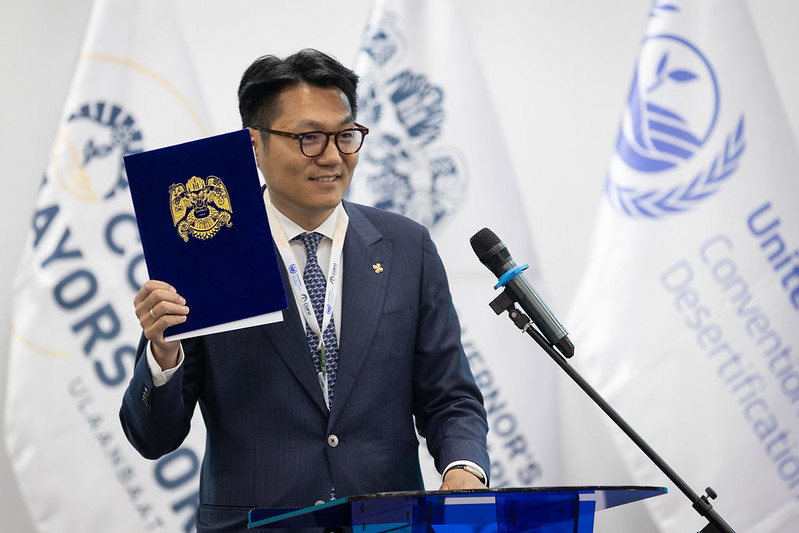
Photo: © UNCCD/Kiara Worth
The demand for a stronger place for cities and regions in the UNCCD process has a much longer history, with mayoral engagement on desertification stretching back nearly three decades. Looking back on that trajectory from Ulaanbaatar, Deputy Mayor Sautter said: “This process started in Bonn in 1999, and it means a great deal to see it reach this point almost thirty years later, with mayors from every region adopting a shared declaration.”
Since that first World Forum of Mayors on Cities and Desertification, the process has continued through forums in Rome, Ordos and Riyadh. The Ulaanbaatar Declaration now takes it a step further, calling for more structured and regular engagement between local and regional governments, UNCCD Parties and the Secretariat between COPs, building on the Riyadh Process.
The political question raised in Ulaanbaatar extends beyond the UNCCD. More than 30 years after the three Rio Conventions emerged from the 1992 Earth Summit, climate, biodiversity and land are still too often addressed through separate plans, funding mechanisms and reporting systems, even as local governments increasingly implement them together.
The timing gives that argument particular weight. In 2026, UNCCD COP17 in Ulaanbaatar is followed by CBD COP17 in Yerevan and UNFCCC COP31 in Antalya, bringing the three Rio Conventions together within a matter of months.
At the Mayors’ Forum, ICLEI presented its Global Position on Rio Synergies, calling for greater coherence across the three Conventions and for local and regional governments to be recognized, empowered and adequately resourced as essential implementation partners. As ICLEI Secretary General Gino Van Begin put it: “The building blocks are already there. What we need now is the political will to connect them.”
Discussions in Ulaanbaatar showed how local action increasingly cuts across the institutional boundaries separating land, climate and biodiversity.
On the ground, these boundaries are already being crossed. Global systems have yet to catch up.
Featured photo: © UNCCD/Kiara Worth

