

A bill aimed at increasing the number of wood pellet mills in Louisiana has sailed through the state’s Legislature — despite some lawmakers, including the bill’s sponsor, acknowledging they know little about the controversial industry.
State Representative Chuck Owen, a Republican from Vernon Parish in west Louisiana, said he proposed House Bill 670 in February shortly after learning about the industry, which exports about $1 billion worth of pellets from Louisiana each year. Nearly all the production comes from two British-owned mills in central and north Louisiana that emit large — and sometimes illegal — quantities of air pollutants linked to cancers and other serious illnesses.
Owen, whose district spans one of the state’s most timber-rich regions, said the goal of his bill is to make Louisiana a “premier location for wood pellet manufacturing.”
The legislation gives a state agency, Louisiana Economic Development, broad direction to develop new incentives for pellet manufacturers, potentially including new tax breaks, state-funded workforce training programs, and port upgrades tailored to the industry’s needs. It also instructs state regulators to streamline permitting for pellet mills and review environmental and public safety rules that “impose unnecessary burdens on this emerging industry.”
For Owen, talking during a meeting ahead of the vote, the rationale behind expanding pellet manufacturing is simple: “We have a lot of trees in Louisiana, and north of Bunkie, that’s about all we have,” he said, referring to a town in central Louisiana. “There’s a market craving wood pellets, and I think we should get further into it.”
But when a fellow legislator asked him to describe one of the mills and “what exactly it produces,” Owen admitted he was only vaguely familiar with it. “I do not know a lot about it,” he said. “No, sir, I do not. I know they’ve had some struggle in recent years, but I know that they’re there.”
Despite that uncertainty, Louisiana’s House and Senate passed Owen’s measure unanimously. The bill is expected to be signed into law by Governor Jeff Landry, a Republican who has backed similar measures aimed at boosting industrial growth in the state.
Allison Allsop / Louisiana Illuminator
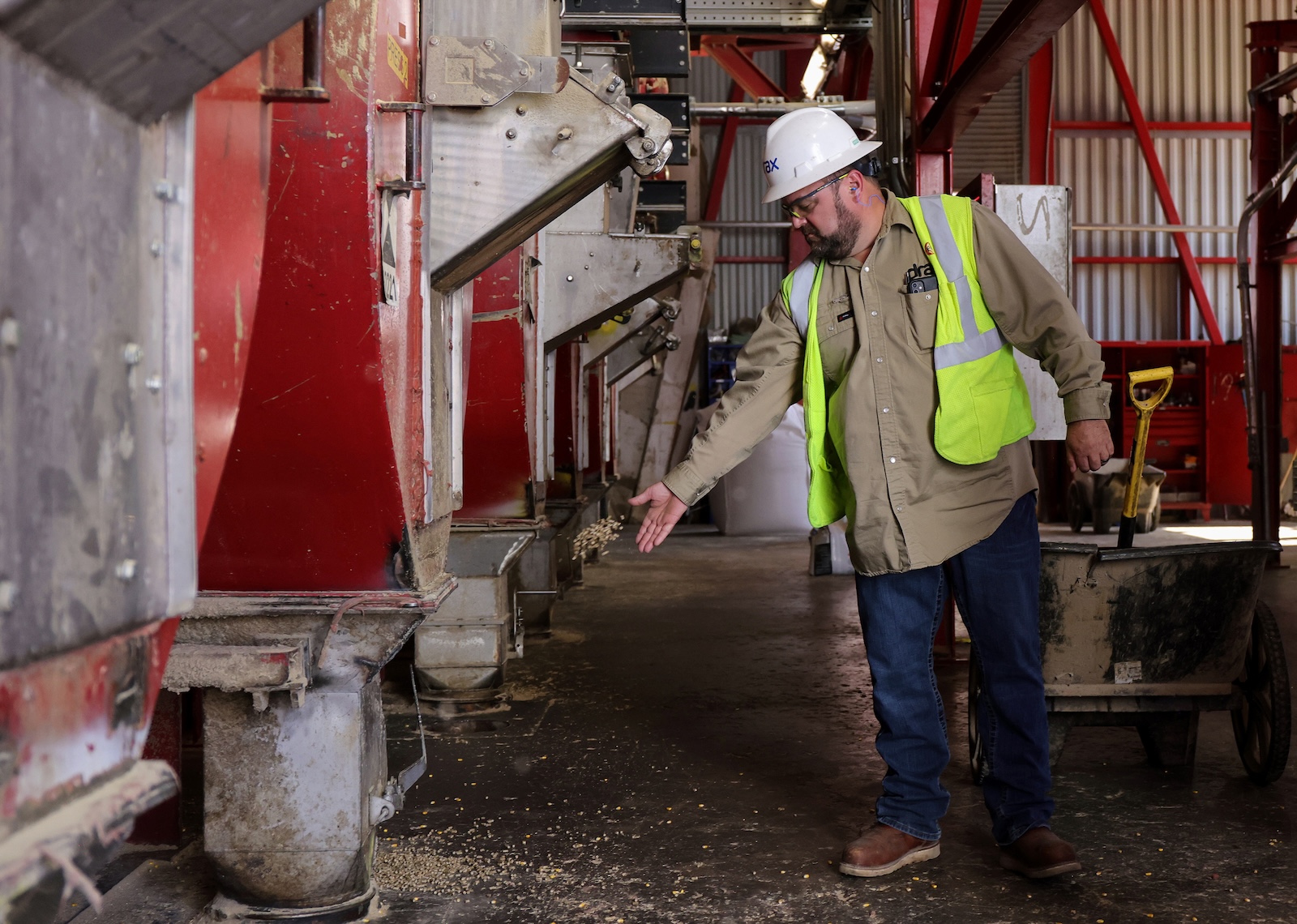
The British energy company Drax operates the two large pellet mills in Louisiana: one in Urania, a small town in the central part of the state, and another near Bastrop in the northeast corner. Together with a nearly identical Drax facility in Gloster, Mississippi, the mills churn out billions of wood pellets to meet demand in the United Kingdom for electricity generated by wood, what the industry markets as “sustainable biomass.”
In the U.K. and several other European countries, wood pellets are classified as a renewable energy source, making the industry eligible for large subsidies typically given to solar and wind projects. While Drax promotes itself as a purveyor of green energy, communities in the Deep South that host the pellet mills pay a high cost from air pollution, dust and noise, said Kadin Love, a community organizer with the Dogwood Alliance, an environmental group in North Carolina opposed to wood pellet manufacturing.
“This is an industry that doesn’t have a clean history,” Love said. “This bill opens doors to the industry that we might not be able to close.”
Drax has paid nearly $6 million in fines and settlements for hundreds of pollution violations in Louisiana and Mississippi over the past six years. Despite some facility upgrades aimed at reducing pollution, the company has continued to rack up violations.
In Gloster, where Drax has operated the longest, several residents are suing the company over what they say is a decade of exposure to toxic chemicals, including formaldehyde, acrolein, and methanol. In the mostly Black, low-income town, about 40 miles north of the state Legislature in Baton Rouge, many people blame widespread health problems, including cancer and respiratory illnesses, on the mill’s pollutants.
In a motion to dismiss the case, Drax’s lawyers argued that the lawsuit fails to show “particularized injury that is traceable to [the mill’s] conduct.”
When asked about Owen’s bill, Drax expressed gratitude to Louisiana lawmakers for supporting the industry but declined to address pollution concerns raised by Love and other critics. “We appreciate the engagement of lawmakers and our community partners in Louisiana,” a company spokesperson said in a statement. “We remain focused on operating responsibly and transparently, working constructively with regulators, and continuing to support jobs and economic activity in the communities where we operate across Louisiana.”
Eric J. Shelton / Mississippi Today
During the recent deliberations over Owen’s bill in the state House, none of the representatives mentioned concerns about pollution. Like Owen, most legislators were unfamiliar with the industry and asked only basic questions.
“Are we talking about the wood pellets you put in the smoker, or do you build stuff with these wood pellets?” asked Representative Candace Newell, a Democrat from New Orleans. “What do they look like?”
The only expert testimony came from Scott Roe, a consultant who produced a feasibility study on pellet mills in Louisiana. Roe described pellet burning as “cleaner” than other fossil fuels and said the industry could eventually use technology that “releases nothing at all.”
“So, it’s clean-burning,” said Newell, who voted in favor of the bill. “You can’t build anything with it — just clean-burning clean energy.”
But several scientists say that’s far from the truth. Drax’s wood-fueled power station in rural England emitted more than 14 million tons of carbon dioxide in 2024, making it the largest single source of CO2 in the U.K., according to a report last year from the climate research group Ember. That amount is more than the combined emissions from the country’s six largest gas plants and more than four times the level of the U.K.’s last coal plant, which shut down in 2024.
The most contentious discussions about the bill concerned the industry’s potential use of carbon capture and storage technology, or CCS, which allows emitters to inject carbon dioxide underground rather than release it into the atmosphere. Tax credits and other incentives are available to industries that integrate CCS into their operations, but a growing number of Louisiana legislators oppose the technology; several pending bills would restrict CCS projects amid concerns about health and safety risks at storage sites and along pipelines that transport the gas.
During the discussion over his bill in the state House, Owen sought to distance his bill from CCS, or the “C-word,” as he called it.
Drax, however, has pledged heavy investment in CCS technology. In 2023, the company established a new office in Houston focused on pairing biomass with CCS projects across North America. “The U.S. Gulf Coast has emerged as a major hub for carbon capture and sequestration investment and technology, a key component of the company’s plans to expand clean electric generation from renewable resources,” Drax CEO Will Gardiner said at the time.
Some members of the Louisiana Legislature wanted assurances that the bill wouldn’t help Drax reach its CCS goals. Owen promised to kill his own bill if the Senate tried to insert language supporting the technology.
“If, on the [Senate] side, they try to make it pro-carbon capture, will you pull it?” asked Representative Robby Carter, a Democrat from St. Helena Parish.
“Pull it,” Owen responded.
The Senate steered clear of the CCS debate and passed the bill with only a few minor wording changes on May 27.
The bill gained support largely because of its promises to boost the state’s struggling forest products sector. Several pulp and paper mills have shut down in Louisiana, leaving many small communities with few jobs and empty downtowns. Backers argued that the pellet industry could help fill that void. Low-grade pine once used for paper production can instead be made into pellets, creating a new market for Louisiana trees and potentially revitalizing the state’s forestry economy.
“What this bill is about is employing people,” Owen said during deliberations.
But the three Drax mills each employ about 70 people, which is far fewer than the hundreds employed by many of the older mills.
Louisiana has granted Drax generous tax breaks aimed at boosting employment. Through the state’s Industrial Tax Exemption Program, Drax has avoided paying about $75 million in property taxes that would otherwise support local school districts and local government operations, Verite News and Grist found in a review of estimates from Louisiana Economic Development.
The industry’s growth looks uncertain as European countries are increasingly skeptical of the claim that burning wood is better for the environment than relying on other energy sources. The U.K. government recently decided the current subsidies for Drax would be cut in half next year.
There have been other signs of trouble for the industry. Enviva, once the world’s largest wood pellet producer, filed for bankruptcy in 2024. Drax has also scaled back some of its North American expansion plans and recently shuttered its two Arkansas mills after only a few years in operation.
Love, from the Dogwood Alliance, said he was stunned that Louisiana’s legislators rushed to pass Owen’s bill unanimously despite having only a superficial understanding of the industry and without much, if any, consideration of the environmental and economic risks.
“If you’re making a state law that exclusively benefits one industry, I’d hope they’d do some homework on it,” Love said. “The fact that they’re not doing the due diligence of researching this industry is incredibly concerning.”

