

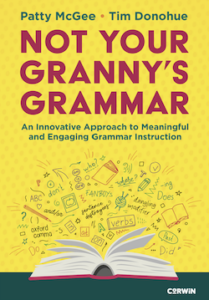
Not Your Granny’s Grammar: An Innovative Approach to Meaningful and Engaging Grammar Instruction
By Patty McGee and Tim Donohue
(Corwin, 2025 – Learn more)
Reviewed by Kathleen Palmieri
Not Your Granny’s Grammar by Patty McGee and Tim Donohue offers a fresh, engaging, and highly practical approach to grammar instruction that is rooted in authentic writing practice.
The book is thoughtfully organized into four distinct parts, each guiding teachers through the philosophy, structure, and application of a comprehensive Grammar Study.
Part One: Understanding Grammar Study
 Part One begins by exploring what grammar does and what grammar study is, and includes a “Succinct Overview of a Grammar Study Unit.” On page 14, the authors introduce the three key phases of a unit – Immersion, Focus Areas, and Transfer – which serve as the framework for all subsequent instruction.
This section also walks teachers through setting up a classroom environment that fosters grammar exploration. The authors stress the importance of making time for grammar, stating, “Schedules reflect our priorities. We can examine them; we can pick up an eraser, so to speak, and erase what isn’t working. We can craft instructional time. We can teach grammar.” (p. 23)
An especially helpful resource in this section is the Grammar Scope and Sequence for Grades 2–8 (p. 18). While the authors encourage teachers to design their own, they provide a ready-made scope and sequence to save planning time.
Part Two: Lessons to Begin
Part Two, “Lessons to Begin,” introduces the what, why, and how of Grammar Study (p. 49). Units are designed to start with Immersion Lessons, move into Focus Areas, and conclude with Transfer Lessons, with the authors noting that the lessons are “intended to be taught in the order we have placed them.” This part offers concrete examples and teacher-friendly lesson formats that make implementation seamless.
Part Three: Lessons for the Journey
Part Three, “Lessons for the Journey: Immersion, Exploration, Transfer,” builds on the foundation of the earlier sections. In Chapter 5, the “Explore and Play” lessons stand out for their emphasis on joyful experimentation with grammar. As the authors explain, “This play…is essential and the heart of a true Grammar Study.” (p. 145) The lessons in this section are rich with student engagement strategies, encouraging active thinking and creativity around grammar concepts.
Part Four: Your Grammar Refresher
The final section, “Your Grammar Refresher” (p. 231), serves as a concise and approachable review of essential grammatical concepts and skills for student writers. The authors frame it as “an invitation for you to join us on a tour of grammatical concepts and skills that are essential for student writers.” This makes it both a teacher-friendly reference and a confidence booster for those who may feel rusty in their own grammar knowledge.
Additional Resources and Features
The book is filled with practical tools and engaging elements, including QR codes that link to standards, printable handouts, and further explanations. Icons – such as a lightbulb for immersion lessons and a magnifying glass for focus area lessons – help teachers navigate lesson types quickly. Student reflections, photographs, charts, and tables provide additional clarity and inspiration. “The Grammar Lovers’ Book Nook” offers a curated list of mentor texts and professional development titles to further enrich grammar instruction.
One particularly strong recommendation from the authors is the use of a simple paper notebook for Grammar Study. As they explain, “There really is no substitute for it at this juncture. The pages of the notebook become filled with musings, playful experimentations, sketches, notes, reminders, reflections, and more. The most conducive and rich place for this is in a paper notebook.” (p. 30)
Not Your Granny’s Grammar is more than just a set of grammar lessons – it’s an invitation to reimagine grammar instruction as lively, meaningful, and integrated with student writing. With its clear structure, abundant resources, and emphasis on play and exploration, this book is an excellent resource for any teacher looking to kick-start or refresh their grammar practice in the classroom.
Kathleen Palmieri is a National Board Certified Teacher, NBCT Professional Learning facilitator and education writer. She is a fifth-grade educator in upstate New York who reviews and writes regularly for MiddleWeb. With a passion for literacy and learning in the classroom, she participates in various writing workshops, curriculum writing endeavors, and math presentations.
As a lifelong learner, Kathie is an avid reader and researcher of educational practices and techniques. Follow her on X-twitter at https://twitter.com/Kathie_Palmieri and at Bluesky @kathleenpalmieri.bsky.social. And learn more about her education adventures at www.kathleenpalmieri.com.

