

In plots of just 16 m², students planted more than 60 native trees and shrubs, transforming previously sparsely vegetated schoolyards into living laboratories for ecological learning.
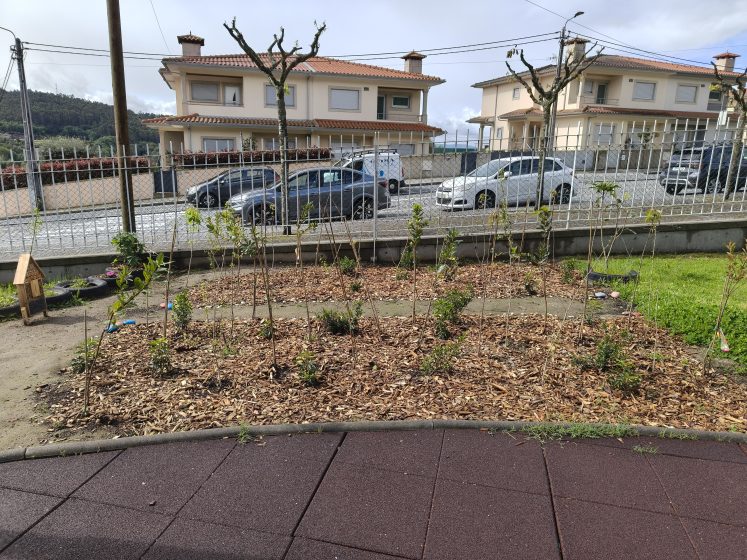
Many contemporary schoolyards are dominated by hard surfaces, sparse grass, and isolated ornamental trees, offering few opportunities for children to experience nature [1]. This disconnection at a formative stage limits ecological literacy and detaches young learners from the living systems around them. In Guimarães, European Green Capital 2026, the municipal environmental education programme PEGADAS, active for over a decade, responded to this challenge through the “Mini Forests, Big Impacts!” project. Using the Miyawaki method, dense native forests were created in pilot-schools. In plots of just 16 m², students planted more than 60 native trees and shrubs, transforming previously sparsely vegetated schoolyards into living laboratories for ecological learning. Young learners played a central role in the project by learning about local ecology, designing their own mini-forests collaboratively, and implementing them with hands-on planting. This participatory approach fostered teamwork, leadership, autonomy, and inclusion, enabling students to take an active role in their learning journey. The project reframed the schoolyard as a living space where ecological restoration and education coexist, making the presence of nature visible and meaningful in everyday experience.
Childhood and the ecological imagination
The importance of children’s contact with nature is no longer anecdotal but empirically substantiated across disciplines. Studies in environmental psychology demonstrate that proximity to green space buffers stress in children [2] and enhances attention restoration and cognitive functioning [3, 4]. Longitudinal research indicates that early experiences in natural environments are strongly associated with pro-environmental attitudes in adulthood [5]. But contemporary childhood is increasingly spatially and sensorially detached from nature. Many school environments prioritize safety, surveillance, and ease of maintenance over complexity and biodiversity. Surfaces are sealed for efficiency. Vegetation is sparse and manicured. Soil is often inaccessible. Ecological succession, decomposition, pollination, and habitat formation remain invisible phenomena. When nature is reduced to imagery in textbooks, environmental education risks becoming abstract and distant. Ecological literacy requires encounter. It requires unpredictability, texture, and seasonal change. To plant a forest in a school is therefore not merely a landscape intervention; it is an opportunity to learn from nature.
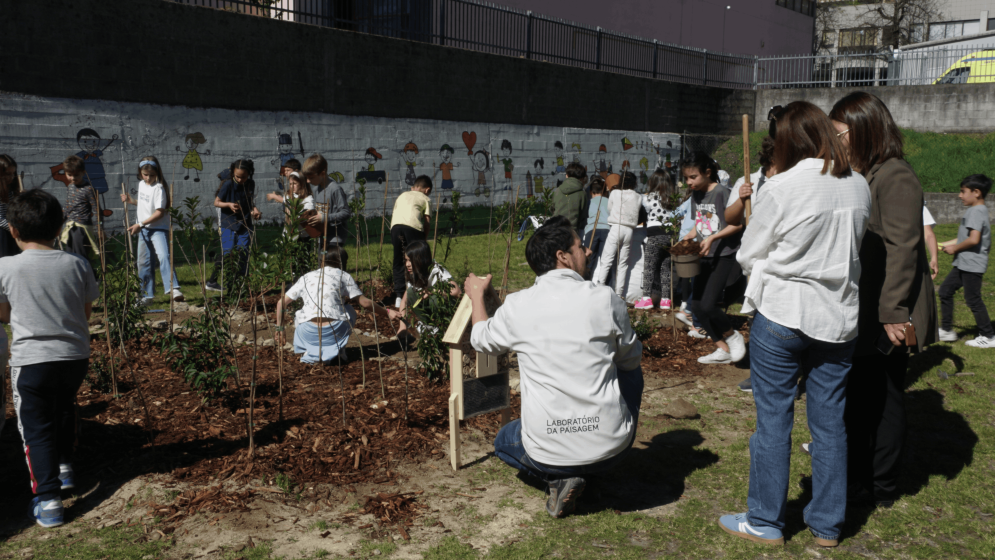
Nature-based Solutions in the schoolyard
The transformation of school grounds through dense native planting aligns with the broader framework of Nature-based Solutions (NbS), which seek to address societal challenges through the restoration and sustainable management of ecosystems. Urban forests are widely recognized within this framework for their capacity to mitigate urban heat island effects, regulate stormwater, sequester carbon, and enhance biodiversity [6]. Yet in dense urban settings, large-scale reforestation is rarely feasible. The question becomes not whether forests matter, but how they can be spatially embedded within constrained environments. The Miyawaki method offers a compelling response. Developed by Japanese botanist Akira Miyawaki, this approach proposes the rapid establishment of dense, multi-layered native forests by replicating potential natural vegetation patterns. High species diversity, close planting density, soil preparation, and early maintenance accelerate structural development. Emerging research suggests that Miyawaki forests can develop structural complexity and begin to deliver ecosystem services more rapidly than conventional planting schemes [7].
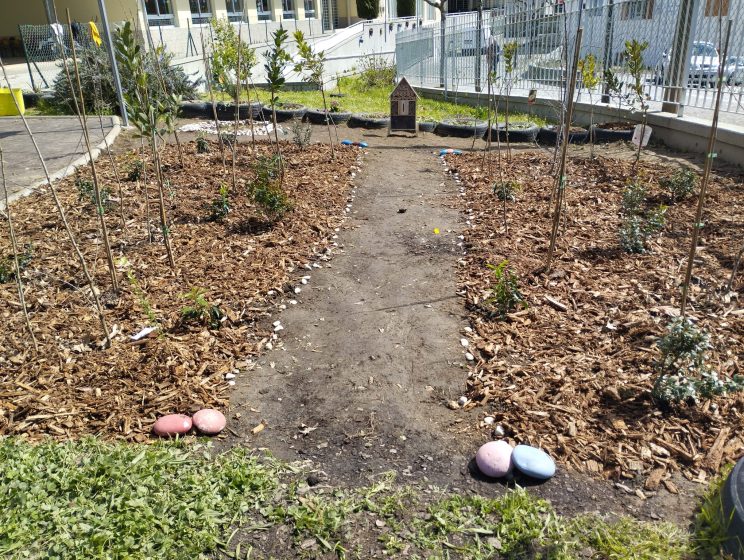
Reintroducing ecological function to the school grounds
Schoolyards dominated by impermeable materials intensify thermal stress. Children are more vulnerable to heat exposure, and climate projections indicate that southern Europe will experience increasing frequency and intensity of heat waves [8]. Even modest increases in canopy cover can reduce local surface temperatures through shading and evapotranspiration [9]. In this context, a dense mini-forest is not decorative landscaping but rather a micro-scale climate adaptation infrastructure. At the same time, urban biodiversity depends on spatial continuity. Ecological fragmentation restricts species movement and weakens ecosystem resilience [10]. While large parks are essential, small habitat patches can function as stepping stones within the urban landscape. By inserting dense native vegetation into school grounds, the project strengthened local ecological connectivity between peri-urban forest areas and built environments. Within months, biodiversity monitoring through citizen science recorded dozens of species, including birds and pollinators. Bird nesting boxes, bat roost boxes, and insect hotels complemented vegetative complexity, accelerating habitat diversification. These early ecological signals suggest that even small patches can catalyze meaningful ecological processes. For students, biodiversity ceased to be an abstract term. It became observable in these newly established living labs.
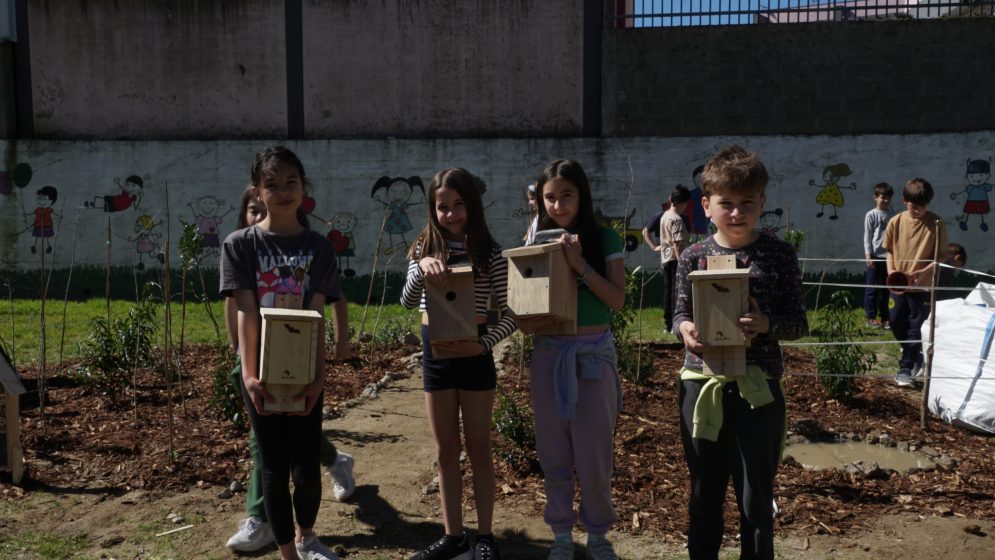
Co-creation as environmental education
A defining feature of the project was its participatory architecture. Students were involved not only in planting but in planning, species discussion, spatial design, and biodiversity monitoring. Digital visualization tools supported collaborative design sessions, enabling children to imagine spatial transformation before it occurred. Citizen science platforms allowed them to document species observations, effectively appropriating elements of scientific methodology in an accessible form. Environmental education research consistently highlights the importance of participatory and action-oriented approaches in fostering lasting ecological engagement, as programs that integrate hands-on activities, collaboration, and community‑based actions are more likely to produce meaningful environmental outcomes [11]. Post-intervention surveys revealed substantial increases in students’ ability to identify native species and articulate ecological functions beyond simplified narratives of oxygen production. Children described habitat provision, shade, pollinator attraction, and climate regulation, indicating a shift from reductive to systemic understanding. Importantly, emotional engagement intensified alongside cognitive learning. All the participating students planted trees. Satisfaction levels during planting sessions were exceptionally high. Physical interaction with soil and vegetation generated enthusiasm that no classroom simulation could replicate. The forest was not delivered to them. It was designed and planted by them.
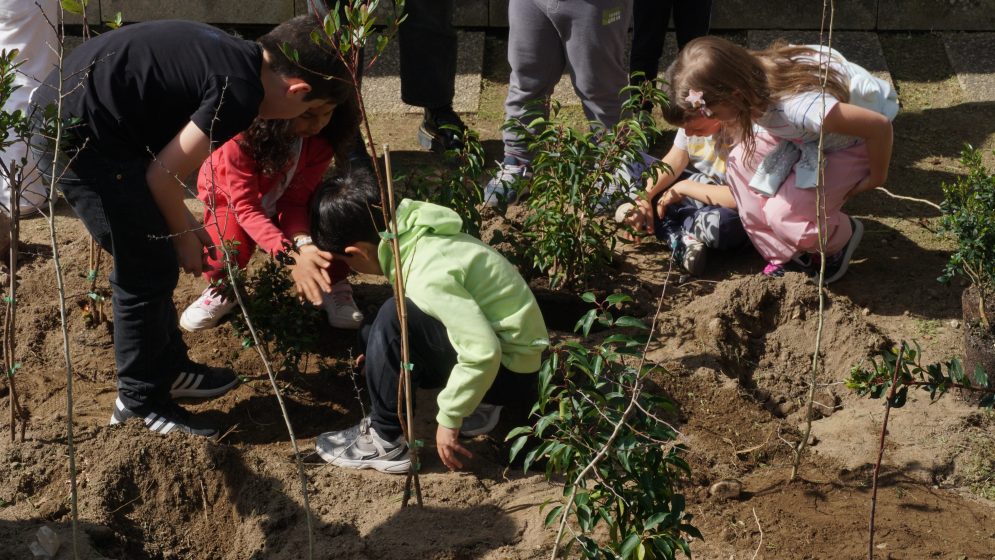
Scaling change through ordinary spaces
These mini-forests will not alter global climate trajectories. Yet they reveal a scalable logic: distributed, small-scale ecological interventions embedded within everyday urban infrastructures can operate simultaneously across environmental, pedagogical, and social domains. If cities are to adapt to ecological instability, transformation must occur not only through large infrastructural projects but through the reconfiguration of ordinary spaces. Schools are among the most formative of those spaces. They shape habits and civic norms over decades. A mini-forest planted in a primary school may appear modest in scale. Yet it alters daily experience. It introduces shade where there was glare, complexity where there was monotony, and growth where there was stasis. Children witness trees maturing over years, observing succession and seasonal change. Perhaps the most radical shift is perceptual. When students evaluate their school grounds not as neutral backdrops but as ecosystems in formation, environmental responsibility becomes personal. The forest is no longer somewhere else; it is here, growing within reach. And in that proximity lies possibility.
Ana Pinheira and Daniel Ferreira
Guimarães, Portugal
References
[1] Lindemann‑Matthies, P., & Köhler, K. (2019). Naturalized versus traditional school grounds: Which elements do students prefer and why? Urban Forestry & Urban Greening, 46, 126475. https://doi.org/10.1016/j.ufug.2019.126475
[2] Wells, N. M., & Evans, G. W. (2003). Nearby nature: A buffer of life stress among rural children. Environment and Behavior, 35(3), 311–330. https://doi.org/10.1177/0013916503035003001
[3] Faber Taylor, A., & Kuo, F. E. (2009). Children with attention deficits concentrate better after a walk in the park. Journal of Attention Disorders, 12(5), 402–409. https://doi.org/10.1177/1087054708323000
[4] Lieberman, G. A., & Hoody, L. L. (1998). Closing the achievement gap: Using the environment as an integrating context for learning. San Diego, CA: State Education and Environment Roundtable
[5] Chawla, L. (2015). Childhood experiences associated with care for the natural world: A theoretical framework for empirical results. Children, Youth and Environments, 25(1), 1–22.
[6] Nowak, D. J., Greenfield, E. J., Hoehn, R. E., & Lapoint, E. (2013). Carbon storage and sequestration by trees in urban and community areas of the United States. Environmental Pollution, 178, 229–236. https://doi.org/10.1016/j.envpol.2013.03.019
[7] Parra, A. F. O., Evangelista, J., & Shebitz, D. J. (2026). The root of urban renewal: Linking Miyawaki afforestation to soil recovery. Land, 15(1), 84. https://doi.org/10.3390/land15010084
[8] Fischer, E., & Schär, C. (2010). Consistent geographical patterns of changes in high-impact European heatwaves. Nature Geoscience, 3(6), 398–403. https://doi.org/10.1038/ngeo866
[9] Gill, S. E., Handley, J. F., Ennos, A. R., & Pauleit, S. (2007). Adapting cities for climate change: The role of the green infrastructure. Built Environment, 33(1), 115–133.
[10] Tiang, D. C. F., Morris, A., Bell, M., Gibbins, C. N., & Azhar, B. (2021). Ecological connectivity in fragmented agricultural landscapes and the importance of scattered trees and small patches. Ecological Processes, 10(1), 20. https://doi.org/10.1186/s13717-021-00284-7
[11] Ardoin, N. M., Bowers, A. W., & Gaillard, E. (2020). Environmental education outcomes for conservation: A systematic review. Biological Conservation, 241, 108224. https://doi.org/10.1016/j.biocon.2019.108224

