

Robert F. Kennedy Jr., the U.S. Secretary of Health and Human Services, recently underwent surgery for a rotator cuff injury, sparking interest in this common shoulder problem. His case highlights how these tears affect active people, even at age 72, with recovery involving physical therapy and gradual activity. Many face similar issues, but home exercises can help manage pain before professional care.
What to Know About RFK Jr.’s Rotator Cuff Injury
RFK Jr. had arthroscopic surgery on March 10, 2026, to repair his torn rotator cuff. He plans to return to duties soon, though doctors note healing brings discomfort and requires a sling plus therapy. This mirrors typical recoveries, where patients rebuild strength over weeks despite initial pain.
Such injuries hit public figures and everyday folks alike. Consider a weekend athlete like Maria, who ignored her shoulder twinge after tennis; it worsened until surgery mirrored RFK Jr.’s path. Early action prevents that.

What Is a Rotator Cuff Tear?
The rotator cuff is a group of four muscles and their tendons that help your shoulder and arm rotate, says Theresa Marko, PT, DPT, a physical therapist in New York City. These include the supraspinatus, infraspinatus, teres minor, and subscapularis, which stabilize the shoulder joint.
A tear happens when one or more tendons rip, either partially or fully, detaching from the bone. Partial tears leave some attachment; complete ones create a full gap. Causes range from sudden trauma to gradual wear.
Rotator Cuff Tear Symptoms to Watch For
Pain at rest or night, especially lying on the shoulder, signals trouble. Weakness when lifting or reaching overhead follows, along with popping sounds during motion.
Limited range of motion and arm fatigue complete the picture. A Finnish study found 99% of people over 40 have rotator cuff issues on MRI, though not all hurt. That weakness? It sidelined a construction worker I know until he spotted it early.
Rotator Cuff Tears Are More Common with Age
Tears rise sharply after 50: 13% in ages 50-59, 20% in 60-69, 31% in 70-79, and 51% over 80, per a study of 411 asymptomatic shoulders. Degeneration frays tendons like rope ends over time.
Overhead activities or falls speed it in youth, but age drives most cases. Statistics show MRIs reveal pathology in nearly all over 60.
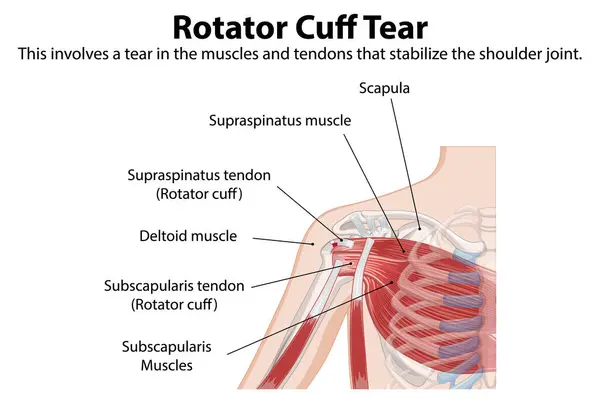
When to See a Doctor About Rotator Cuff Pain
Seek care if pain disrupts sleep, daily tasks, or shows swelling and redness. Weakness or motion loss demands prompt evaluation.
“If you suspect a rotator cuff tear, don’t hesitate to consult a healthcare professional for a proper diagnosis and to discuss the best course of action for regaining shoulder strength and function,” says Brian Lee, MD, board-certified orthopedic surgeon at Cedars-Sinai Orthopaedics in Los Angeles. Imaging confirms tears; delay risks worsening.
Rotator Cuff Exercises to Ease Pain at Home
These gentle moves build stability without strain. Start slow, 8-12 reps, 2-3 sets daily. Stop if pain sharpens.
Shoulder Blade Squeeze
Sit or stand tall, arms at sides. Squeeze shoulder blades together and down; hold 6 seconds, relax.
This strengthens scapular muscles supporting the cuff. Feel that gentle pull? It counters slouch from desk work.
Cross-Body Stretch
Extend one arm across chest at shoulder height. Use opposite hand to pull gently toward body; hold 30 seconds.
Targets posterior cuff for better flexibility. Repeat per side; a patient eased her overhead reach this way.
Also Read | How to Stop Osteoporosis With Quick Hacks and Top Bone Exercises
Soundhealthandlastingwealth.com offer the most up-to-date information from top experts, new research, and health agencies, but our content is not meant to be a substitute for professional guidance. When it comes to the medication you’re taking or any other health questions you have, always consult your healthcare provider directly.

