

Life on the windswept highlands of South Africa’s Eastern Cape is defined by trust.
In this biodiversity hotspot, there are no fences to mark where one family’s land ends and another’s begins. Cattle and sheep graze without borders; rivers and ridgelines serve as boundaries — held not by law, but by the word of neighbors, determined to keep the grassland healthy, together.
This is an ancient way of herding livestock — a system that depends on movement.
For generations, herders grazed livestock the way their semi-nomadic ancestors did — chasing rainfall alongside the great herds of African wildlife, never settling in one place long enough to wear the land down.
But that tradition has collapsed under the long shadow of Apartheid — disrupted by the forcible displacement of pastoralist communities from their ancestral territories. “When the fences came up and the movement of livestock stopped, the traditional pastoralist way of life started to fall away,” said Julia Levin, Africa Advisor at Conservation International.
In the Eastern Cape, Conservation South Africa — the local affiliate of Conservation International — and the are determined to help communities revive it.
Now, that revival has a powerful new partner. In May, Danish fashion giant BESTSELLER committed US $3 million to the Regenerative Fund for Nature. The fund, set up by Kering and Conservation Internation in 2021 and joined by Inditex in 2023, aims to restore and revitalize nature hand in hand with local communities. In Africa’s Eastern Cape, the partners are making an ambitious bet on regenerative wool by investing in a program that has already helped nearly 1,000 herders restore 17,000 hectares (42,000 acres) of grassland.
“This is part of a supply chain nobody sees,” said Virginia Keesee, Conservation International’s sustainable fashion lead. “A better-fed flock makes for a stronger wool clip and, in turn, a better life for local people. It all traces back here — to healthy grasslands.”
Breaking the cycle
Every garment begins somewhere.
In the Eastern Cape, the story begins with an animal — and the land it grazes.
In many cases, that land is struggling. Without the seasonal movement that had defined their landscape, herders graze sheep on the same patches of ground season after season, year after year. The cycle is self-reinforcing: poor land produces poor fleece, poor fleece fetches poor prices, and poor prices leave farmers without the means to restore the land.
For years, Conservation International has been working to help that cycle run in reverse. Farmers whose sheep graze recovered pasture, rested and rotated the way their ancestors managed it, produce finer fleece. Finer fleece fetches a premium price. And a premium, over time, could connect a communal hillside of a village like Matatiele to the racks of fashion brands in Copenhagen.
“I’ve spent my career trying to figure out how nature and commerce can work together instead of against each other,” said John Buchanan, vice president of the organization’s Center for Regenerative Economies. “What the Regenerative Fund for Nature is creating — with these communities, with these partners — demonstrates the potential for nature positive fiber supply chains.”
Few people understand the gap between natural wealth and human poverty more personally than Peter Shisani, the CEO of Conservation South Africa, who grew up in one of the landscapes the organization now works to restore.
“When I was growing up, my father had 5,000 cattle and 13,000 goats,” he said. “But we were sleeping with hunger. We were shut out of the market.”
The missing link for Shisani’s father is one that he has spent his career trying to build.
“The value chain we are building here can create shared value — from the communal grasslands to the international wool market,” he said. “We are bringing communal people in, giving them the capacity to understand how to farm using the resources they already have, and making sure they understand where the market is and what is needed to play in it.”
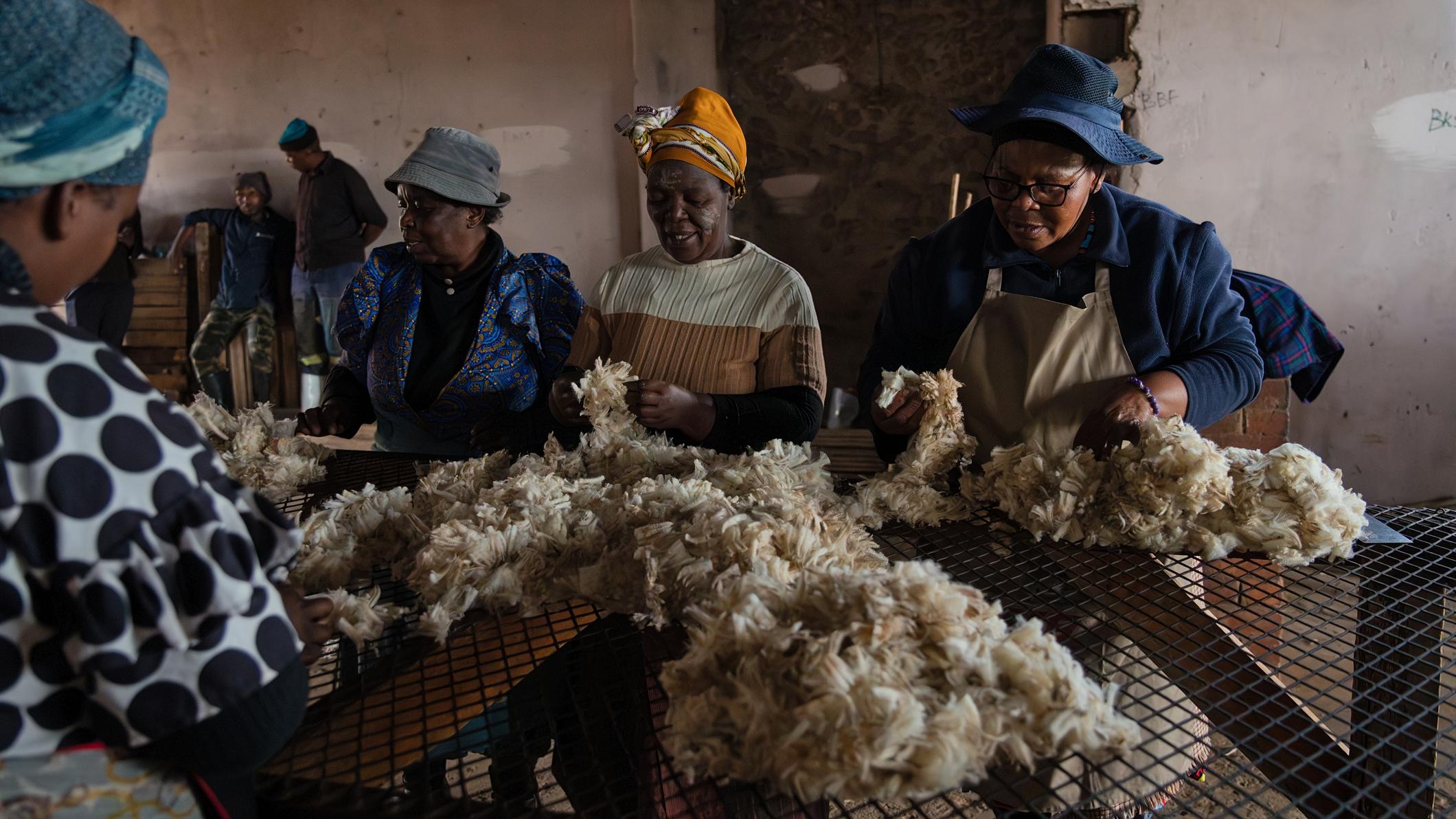
The results, he says, are already visible.
“People are now sleeping with stomachs full of food,” he said. “They’ve educated their children.”
For Conservation South Africa and the Regenerative Fund for Nature, success depends on working through existing community structures. Village chiefs are the key — their buy-in encourages farmers to follow grazing rules across the wider landscape. Those rules are inked in pen through conservation agreements: pacts that outline good grazing practices and come with tangible benefits for farmers who sign them. Members receive vaccinations for their animals, and are supported to shear, sort, package and transport their own wool — building the skills and capacity to participate directly in the international market, rather than selling cheaply into the hands of intermediaries.
“It’s always heartening to see how excited people get when they are able to better own and manage their space,” said Alice Barlow-Zambodla, Conservation South Africa’s landscape director for the Eastern Cape. “So that they just live better.”
Nolie Wemba Asa, a farmer in the Eastern Cape, has felt that change firsthand.
“At first, we did not have good rangelands,” she said, “but now we know how to protect them.”

